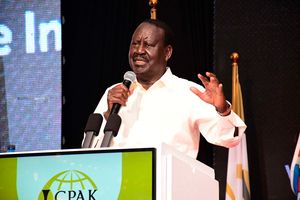
Though most of the presidential election petitions filed by former Prime Minister Raila Odinga —in 2013 and 2022—were ultimately dismissed by the Supreme Court, their legal and institutional impact has been profound.
Each case exposed systemic weaknesses in Kenya’s electoral process, forcing judicial, legislative, and technological reforms that continue to shape how elections are conducted today.
From clarifying vote-counting procedures to reinforcing judicial independence and mandating transparency in results transmission, Odinga’s petitions have left an indelible mark on Kenya’s democracy.
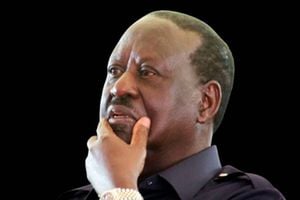
Former Prime Minister Raila Odinga.
Photo credit: File| Nation Media Group
The petitions transformed Kenya’s electoral system by exposing flaws and compelling reforms. Their legacy endures in stronger institutions, clearer laws, and a more engaged electorate, cornerstones of a functioning democracy.
This article examines how each case drove critical changes, setting new standards for electoral integrity.
2013 Petition: Setting precedents on vote counting
The 2013 petition marked Kenya’s first presidential election dispute under the 2010 Constitution. Mr Odinga challenged Uhuru Kenyatta’s victory, alleging widespread irregularities backed by an 839-page affidavit from the opposition outfit Coalition for Reforms and Democracy (CORD).
Though the Supreme Court dismissed the case unanimously, its ruling established key legal principles.
The court ruled that spoiled or rejected ballots should not factor into the 50%+1 threshold calculation, correcting IEBC’s initial inclusion of rejected votes in tallies.
“The rejected vote is void. Why should such a ballot paper… be made the basis of computing percentage accumulations?” —Supreme Court, 2013, led by Chief Justice (retired) Willy Mutunga stated.
The verdict emphasised procedural fairness over numerical outcomes, setting a template for future petitions.
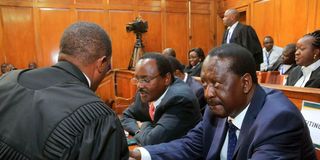
Azimio La Umoja Party leaders Raila Odinga and Martha Karua look at a document at the Milimani High Court in Nairobi on August 22, 2022.
Photo credit: Simon Maina | AFP
The dispute centred on IEBC’s announcement that Mr Kenyatta was the winner with 6,173,433 votes out of a total of 12, 338,667 (50.07% of all votes cast), while Odinga had received 5,340,546 votes (43.31% of the votes cast).
“The rejected vote is void. Why should such a vote, or ballot paper which is incapable of conferring upon any candidate a numerical advantage, be made the basis of computing percentage accumulations of votes, so as to ascertain that one or the other candidate attained the threshold of 50% + 1,” asked the Supreme Court in the judgment.
The 2013 petition helped refine the legal strategy for future challenges, focusing on systemic failures of the electoral process rather than just numerical tallies.
2017 Petition: A landmark nullification and electoral reforms
The 2017 case became Africa’s first Supreme Court-ordered presidential election nullification. Odinga, alongside other petitioners, contested Mr Kenyatta’s win, citing hacking of IEBC servers and irregularities in Forms 34A/34B. The court’s nullification triggered sweeping reforms.
This is arguably the most significant outcome of Odinga's efforts to entrench electoral reforms in the country.
The judgment highlighted judicial independence from the Executive, as the Supreme Court's majority decision to overturn a presidential election was a historic moment for Kenya and the continent.
In the judgment, the court emphasised the voting process over the outcome. In that nullified election, Odinga garnered 6,762,224 votes, 44.74% while Mr Kenyatta garnered 8,203,290 votes being 54.27% of the votes cast.
The court emphasised that the integrity of the electoral process was paramount, stating that the IEBC's breaches of the law had rendered the results invalid, regardless of the final numbers.
A key recommendation from the court led by retired Chief Justice David Maraga was that the constitutional timeline, within which to hear and determine a presidential election, should be extended.
The court underscored the need to extend the 14-day limit, for purposes of efficient case management by the court, and also to afford the parties sufficient time to ventilate their cases. We hereby make a similar recommendation.
Further, the judgment put the IEBC's technological systems under intense scrutiny. The court's order to audit the IEBC's servers revealed non-compliance by the commission.
The court decisions prompted significant reforms and changes in electoral conduct. The 2017 petition underscored the legal importance of the paper-based Form 34A (polling station results) as the final and verifiable source of truth, addressing issues with electronic transmission and display.
The rulings triggered a contentious period of political and legislative reform, with various factions proposing legislative changes.
The Jubilee Party-controlled Parliament passed the Election Laws (Amendment) Act of 2017, introducing several key changes, including reducing the IEBC quorum from five to three members.
Rt. Hon. Raila Odinga at Mjadala Africa Rehearsals at the Africa Union Headquarters in Addis Ababa.
Photo credit: Photo |Pool
The legal amendment also defined the term "chairperson" to include a vice-chairperson or member acting in that capacity. This allowed the commission to operate despite resignations triggered by the controversy.
The amendments removed the requirement for electronic transmission of presidential results from polling stations and legally mandated the manual transmission of physical results forms. This was a reversal of the push for a more transparent electronic system.
The IEBC also undertook several operational changes, including the adoption of an enhanced Kenya Integrated Electoral Management System (KIEMS) for the repeat election in October 2017. The KIEMS integrated voter registration, identification, and results transmission.
The Supreme Court's finding prompted increased pressure on the IEBC to improve the transparency of its operations, particularly regarding the transmission of verifiable results and public access to election forms.
2022 Petition: Institutional overhaul recommendations
In 2022, Odinga and 17 other petitioners challenged the election of President William Ruto, alleging that the technology used by IEBC during the 2022 General Election fell short of the prescribed constitutional and statutory standards.
In that election Mr Ruto was declared winner with 7,176,141 votes (50.49% of presidential votes cast) and Odinga as the runner’s up with 6,942,930 votes (48.85% of presidential votes cast).
Even though Odinga’s challenge was dismissed for lack of evidence, the court, led by Chief Justice Martha Koome, issued seven critical IEBC reform recommendations touching on election technology, statutory Forms and corporate governance of IEBC.
On corporate governance issues, the Supreme Court urged Parliament to consider enhancing the statutory and regulatory framework on the separate policy and administrative remit of IEBC.
The second recommendation was that IEBC ought to effect formal internal guidelines that clearly delineate the policy, strategy, and oversight responsibility of the Chairperson and the Commissioners. The commission was also advised to develop institutionalised guidelines on how to manage the separation of administrative and policy domains.
“The roles of the Chairperson, Commissioners, and the Chief Executive Officer, other staff and third parties should be clearly set out in both the legislative and administrative edicts,” said the judges.
On election technology, the court stated that to avoid suspicion from stakeholders, unless where and when it is absolutely necessary, access to the servers supporting the transmission and storage of Forms 34A, 34B and 34C should be restricted to IEBC staff during the election period.
“IEBC should ensure that the servers supporting the elections and those serving their internal administrative work are distinct and separate. This would then allow the Court, should the need arise, to carry out forensic imaging of the same without compromising and/or infringing any third-party agreements,” it held.
Regarding statutory Forms, the court said IEBC may consider simplifying and restructuring the Form 34A and include a column that accounts for stray ballots.
In addition, the court said IEBC may consider having only one section for the total valid votes.
“The independent body may also find it prudent to thoroughly train its Returning Officers as to what constitutes valid votes per this Court’s decision,” said the court, adding that IEBC ought to put in place specific mechanisms to allow for special voting as contemplated under regulation 90 of the Elections (General) Regulations 2012.
“It is clear to us that there are legal, policy and institutional reforms that are urgently required to address the glaring shortcomings within IEBC,” the court concluded.