The police are unlikely to respond to your distress call for help as the service does not have enough vehicles, with more than half of those available in a sorry state and beyond repair.
According to a report submitted by the National Police Service to the National Assembly's Committee on Administration and Internal Security, the police are operating with obsolete vehicles.
The report paints a grim picture of a police service that is grounded and unable to move to where its services are urgently needed.
According to the report presented by Deputy Inspector General of Police Eliud Lagat, the police service has a total of 5,866 motor vehicles, of which 2,853 are under the National Treasury Leasing Programme, while 3,013 are owned by the government.
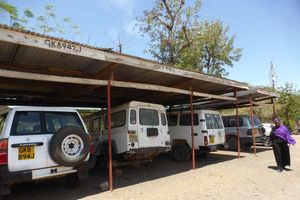
However, of the 3,013 government-owned vehicles, 1,934 are currently unserviceable, leaving the police service with 1,079 vehicles nationwide.
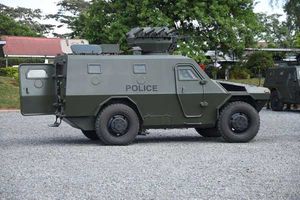
According to the report, the police have a total of 115 specialised armoured personnel carriers, but these are currently grounded and in need of an overhaul.
Mr Lagat told the committee, chaired by Narok West MP Gabriel Tongoyo, that there was an overall shortfall of 5,621 vehicles needed by the police.
Speaking during the launch of the 2023-2027 strategic plans for the National Police Service and the State Department of Correctional Services at the Kenya School of Government last year, President William Ruto said 1,000 new vehicles would be acquired for the police under the police leasing programme early this year to address the shortage at police stations across the country.
"It is our intention to ensure that many of our policemen and women, who carry out a very sensitive responsibility of protecting us all, work in conditions that help them discharge that responsibility," said President Ruto.
Traffic police try to identify a problem with their vehicle after it stalled on the Nyeri-Karatina highway on July 12, 2018.
Photo credit: File | Nation Media Group
Previously, the government purchased vehicles from dealers and incurred costs for insurance, maintenance and depreciation.
The government's original idea of leasing vehicles was to allow the state to access new vehicles using private sector capital and repay it over a period of time. The savings would be used in other priority areas such as health and infrastructure.
In Supplementary Estimates 1 for 2023/2024, the government allocated Sh3 billion to settle outstanding bills under the police vehicle leasing programme.
In March last year, the Interior Ministry said that since the introduction of the car leasing programme for the National Police and National Government Administration officers in 2013, there has been a 50 per cent reduction in officers responding to emergency calls.
The ministry also said that the rate of complaints about police officers not responding to calls has fallen from 49 per cent to 22.1 per cent.
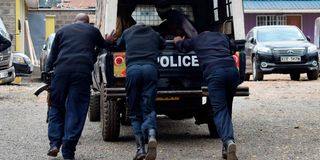
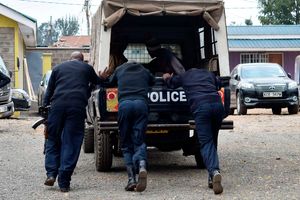
Residents of Kangema help push a Kiria-ini police vehicle that had broken down in the middle of the road in Kangema town.
Photo credit: File | Nation Media Group
This comes as members of the committee questioned the viability of leasing, especially in areas where officers do not need to be very mobile.
"This leasing should only be done in certain areas because you can imagine telling a police officer to take a matatu in a place like Marsabit," said Saku MP Dido Raso.
The committee chairman, Mr Tongoyo, also called for an assessment to be carried out to determine which works better between leasing and buying.
"In your assessment, when you weigh between leasing and buying, which one serves us better? Mr Tongoyo asked the top security officials who appeared before the Budget Policy Statement (BPS) 2025 Committee.
But National Police Service Commission (NPSC) CEO Peter Leley said the leasing option works for them because the money allocated for motor vehicles for the service is not enough to buy enough cars for police officers.
"The money allocated, which is about Sh20 million, cannot buy enough cars for police officers across the country, so the leasing option works," said Mr Leley.
According to the report, the police's problems are compounded by the refuelling system as the leasing scheme provides only 450 litres of fuel per vehicle per month, which is not enough.
Mr Lagat told the committee that the fuel was inadequate, especially in vast areas such as the North Eastern Region and the North Rift, among others.
Furthermore, the Total stations where the police vehicles are supposed to be refuelled are more than 300km away from the stations, further complicating the mobility of the officers.
The Deputy Inspector General further told the lawmakers that the designated garages for the leased vehicles are also located 300km away against the requirement of a 50km radius from police stations.
Mr Lagat said the service would liaise with the National Treasury to address the challenges posed by the leasing programme.