A new report has exposed rampant corruption in government, revealing counties where officials pocket the highest bribes, the rot in magistrates’ courts and how public service employment is auctioned to the highest bidder.
The largest average bribes are paid to officials in Kakamega (Sh79,305), West Pokot (Sh16,400), Isiolo (Sh13,912), Vihiga (Sh12,389) and Garissa (Sh12,297), according to the report by the Ethics and Anti-Corruption Commission (EACC).
“In Kakamega County, huge amounts of bribes were made to judicial officers,” says the Kenya National Gender and Corruption Survey report 2025, which was released yesterday in Nairobi.
Based on bribes paid to public officials, those seeking services in government offices reported paying the largest average cash bribe (Sh164,367) to magistrates.
And asked about the public service for which they were extorted the highest amount, those polled reported securing employment in government institutions attracted the highest bribe (Sh85,033).
This was followed by obtaining government contracts through public procurement (Sh24,020) and seeking a passport (Sh12,514).
These are huge bribes considering the national average bribe paid to public officials was Sh6,724 in 2025, an increase from Sh4,878 in 2024.
Other counties where officials asked for high bribes are Kericho (Sh11,799), Nandi (Sh11,664), Bungoma (Sh11,048), Meru (Sh11,014), Elgeyo-Marakwet (Sh10,962), Laikipia (Sh10,364), Nyeri (Sh9,390), Nyandarua (Sh8,687), Samburu (Sh8,495), Busia (Sh8,214) and Nakuru (Sh6,688).
The least average bribes were recorded in Kitui (Sh2,168), Siaya (Sh2,155), Nyamira (Sh1,655), Kilifi (Sh1,559) and Baringo (Sh1,314) counties.
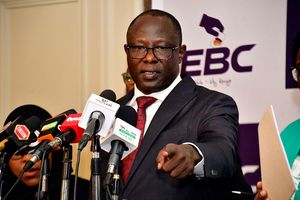
“Following these findings, EACC will deploy undercover integrity testing and enhanced monitoring in high bribery sectors. We have set a clear target to reduce bribery prevalence in these identified areas and regions by at least 20 per cent within the next six months,” said the commission’s Chief Executive Officer Abdi Mohamud.
EACC notes that each time a service is sought in county offices, including public utility firms like water and sanitation companies, one is likely to be asked for a bribe.
Bribery is rampant among police officers, civil registration officers who record births and deaths, National Transport and Safety Authorities (NTSA) officers, land registry officers and registration of persons officers.
In the 12 months prior to the survey, 35.5 per cent of service seekers reported having given a bribe to police officers, civil registration officials (30 per cent), NTSA officers (25.4 per cent), land registry officers (23.3 per cent) and registration of persons officers (21.2 per cent).
Apart from magistrates (Sh164,367), other officials who extort the largest average cash bribes are land registry officers (Sh17,996), elected representatives from the county governments (Sh13,038), immigration officers (Sh12,102) and prosecutors (Sh11,809).
The report reveals that each time a person paid a bribe in an institution, they were twice more likely to receive a service than if they did not give a bribe.
Some of the respondents revealed that they were paying Sh1,000 to process death certificates, yet the official fee is Sh150.
“Civil registration officials deliberately create delays, but once you pay the Sh1,000, your birth certificate is processed very fast,” revealed a respondent from Kakamega County.
Another respondent revealed that obtaining medical reports by victims of abuse, especially women and children, in Nakuru County had been turned into a cash cow by health professionals.
The EACC survey, conducted between May and September 2025, sought to investigate corruption trends as well as gender dynamics of corruption in the country, to understand the different ways men and women experience and participate in corruption. A total of 16, 858 respondents were interviewed during the survey.
The report revealed that men are the most corrupt, dominating high corruption sectors like the NTSA and the National Police Service, where their engagement in corruption is 92.9 per cent and 89.8 percent, respectively.
Women were reported to give bribes mostly when trying to secure essential documents like birth and death certificates.
However, women are disproportionately exposed to sexual corruption and are the most affected by corruption in the country, especially while pursuing employment.
Women seeking services, especially in hospitals, and young women seeking employment, were found to be the groups most vulnerable to sexual coercion, popularly known as “sextortion”.
The report reveals that direct requests for sexual favours affect women (3.4 per cent) more than four times the rate of men (0.8 per cent).
It further shows that 9.3 percent of women who interacted with public officials in the 12 months prior to the survey reported being asked for sexual favours compared to 7.4 per cent of men. Women seeking services from public offices were more than twice likely to be asked for sexual favours.
“At least 73 per cent of women service seekers were asked for sexual favours in more than three occasions ,76 per cent on three occasions,84 per cent two times and 82 per cent once in the past 12 months prior to the survey,” states the report.
Nearly half of all sextortion victims in the private sector were individuals seeking employment opportunities.
Most Kenyans, the report notes, do not report cases of bribery or being asked for sexual favours before receiving services. It shows that only 1.4 per cent of Kenyans who paid a bribe reported the experience to an official at the institution.
“Most Kenyans remained silent because they believe it is useless and no action will be taken. Only about 6.9 per cent of Kenyans would consider reporting to the EACC ,” states the report.
Bribes paid to public officials were presented in form of cash, food and drinks, valuables, animals or exchange with another service or favour, according to the report. To tackle these issues, the EACC recommends establishment of secure, anonymous channels like digital and mobile platforms to enable citizens to report bribery and sextortion without fear of retaliation.
According to the commission, the platforms should be accessible via USSD for non-smartphone users and should provide case tracking numbers for reporters to follow up their complaints.
The commission also recommends training of public service supervisors to recognise signs of sextortion and establish clear disciplinary procedures.
“Public service providers should create dedicated support services for victims, including psychological counselling and legal assistance. Prioritise protection for young women seeking employment and medical services ,the groups most vulnerable to sexual coercion,” the EACC recommends.
Reform of service delivery payment systems, EACC says, can also tame the corruption and sextortion.
“Mandatory electronic fee payments for high-corruption services, including birth certificates, national IDs, passports and court processes, to eliminate cash transactions and create audit trails. Display official fee schedules prominently at all service points and publish them online,” EACC further recommends.
It also proposes the establishment of a task force to investigate judicial bribery in affected areas such as Kakamega.