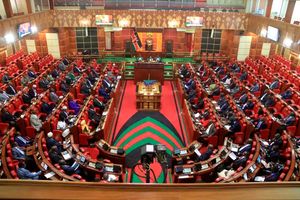
A bribery storm has hit two Senate committees, with governors resolving to boycott summons until members they accuse of corruption are removed.
The scandal took a twist during a closed-door meeting in Kilifi County on Monday, where more than 30 governors met to discuss their grievances against the Senate County Public Accounts (CPAC) and County Public Investments and Special Funds (CPISF) committees.
Governors resolved to snub summons by the CPAC, “which should be reconstituted immediately”.
The development rekindles memories of the bribery scandal that forced the reconstitution of the National Assembly Public Accounts Committee in 2015.
The allegations came after the two committee meetings were paralysed on Monday when seven governors failed to appear, opting instead to fly to Kilifi.
Those scheduled to appear before the CPAC, chaired by Homa Bay Senator Moses Kajwang, were Nandi Governor Stephen Sang and his Siaya colleague James Orengo.
Governor Joshua Irungu (Laikipia), Muthomi Njuki (Tharaka Nithi), Irungu Kang’ata (Murang’a), Issa Timamy (Lamu) and Cecily Mbarire (Embu) were to appear before CPISF, which is chaired by Vihiga Senator Godfrey Osotsi.
Both committees are reviewing Auditor-General Nancy Gathungu’s reports for the 2024/25 financial year.
The standoff comes at a critical time for public accountability, as several counties face scrutiny over stalled projects, rising debt and questionable spending.
The Daily Nation has learnt that the two-day Kilifi retreat, christened “Repositioning the Council for Effective Service Delivery in Light of the Political Environment”, was far from cordial.
Sources described it as heated and tense, with several governors recounting “extortion”.
Senate Committee on County Public Accounts, chaired by Homa Bay Senator Moses Kajwang' during a past session at Bunge Tower, Nairobi. The committee has warned that county governments risk losing Sh533 billion.
Photo credit: Dennis Onsongo | Nation Media Group
A governor from one of the coastal counties said he had been asked for Sh9 million, while another from Nyanza talked of a Sh12 million demand.
A county boss from the northeast said some senators in the CPAC keep demanding millions of shillings from his executives.
The governors agreed to defy appearance before the senators, saying some committee members use their constitutional mandate as a tool for bribery, extortion and blackmail.
Governors are now seeking engagement with the Senate leadership, but insist that CPAC must first be restructured to restore confidence in its work and until four senators are removed.
Council of Governors Chair Ahmed Abdullahi addresses journalists in Nairobi on December 5, 2024.
Photo credit: Billy Ogada | Nation Media Group
According to Council of Governors Chairman Ahmed Abdullahi, some CPAC members have been demanding bribes from governors and county officials in exchange for favourable reports or clearing audit queries.
“Enough is enough. If we have to go back to court to seek interpretation of what oversight entails and what governors’ appearances before the committee mean, we will. We will also ask the courts to clarify the political responsibilities of governors,” the Wajir governor said.
“There are many other senators who can sit on this committee. Four committee members are notorious for blackmail and extortion,” the Tharaka-Nithi governor said.
“Their personal interests and political manoeuvres are giving the Senate a bad name, yet this is supposed to be a House of noble men and women.”
The decision by the governor sets the stage for a standoff between county executives and Parliament, threatening to undermine one of the Senate’s core constitutional roles of overseeing public resources.
CPAC is among Parliament’s most powerful committees as it is tasked with scrutinising reports by the Auditor-General and summoning accounting officers to explain expenditure at county level.
However, governors now say the committee has abused its authority, using summonses as leverage for intimidation.
The Senate CPAC leadership has pushed back strongly, saying the team has been and will remain central to parliamentary accountability.
Through Mr Kajwang, members said attempts to delegitimise the committee amount to an assault on checks and balances in government.
“We welcome the governors to submit any evidence of extortion and harassment to the relevant institutions. In their statement, they imply they will only appear before Senate oversight committees under their terms. They want to choose who sits in the committees, when they should appear and how they should be questioned. I have never witnessed a situation in which suspects demand to empanel the bench,” the Homa Bay Senator said.
“Article 229 and 125 of the Constitution have given the Senate the power to consider the reports of the Auditor-General and to summon any person for purposes of giving evidence. This is exactly what the Senate has been doing.”
“Accountability is not a favour to the Senate; it is a duty to the public,” Mr Kajwang added.
Observers warn that the boycott could escalate into a constitutional crisis, highlighting tensions between the Senate powers to summon public officials and governors’ constitutional duty to manage county resources responsibly.
Nandi Senator Samson Cherargei.
Nandi Senator Samson Cherargei – a member of CPAC – accused governors of “prioritising leisure” over accountability for billions of shillings allocated to counties every year.
Mr Cherargei said the Kilifi retreat was not a constitutional obligation and that governors should have appeared before the Senate to account for taxpayers’ funds.
“It is very unfortunate that governors have called an urgent meeting not to discuss the problems counties face or to account for billions of shillings sent to them, but to discuss the Senate because they say we have been hard on them. It is the Constitution, not senators,” Mr Cherargei said.
“Most of the governors running away from accountability are accused of corruption. The guilty are always afraid. The Senate does not have a problem with governors. We give them billions of shillings. Let them come and account for that money.”
The senator criticised the expenditure on the retreat, saying the money could have gone to drought relief or support students unable to advance to Grade 10.
Nominated Senator Raphael Chimera proposed punitive action against the governors, including withholding county funds until they appear before the committees.
For the Mr Osotsi-led panel, governors complained of being summoned repeatedly on county investment issues, including funds for hospitals and municipalities.
“The council reaffirms its commitment to accountability and prudent use of public resources, but emphasises that oversight must be exercised lawfully, ethically and without abuse of office,” he said.
Mr Osotsi said his team has 150 reports to consider this financial year, averaging four per meeting, leaving no room for postponements. He told governors not to scandalise lawmakers while eyeing Senate seats in 2027.
Governor Mbarire said she did not boycott any meeting but requested postponement due to the two-day Kilifi retreat, “which focused on strategic issues, including the Kenya-US Health Cooperation framework”.
Governor Kang’ata said rescheduling would allow technical teams to prepare adequately for audit queries on hospitals and other county investments.
A ruling in October 2024 by the High Court barred Parliament and County Assemblies from considering any audit reports more than three months after their tabling.
Since that ruling, governors and senators have been embroiled in a war of words over the former’s appearances in the Senate.
The ruling also threatened to stall activities of Senate committees, with governors playing a cat-and-mouse game, citing prior appointments on the days they were scheduled to appear before the panels.
Last month, Senator Kajwang noted that some governors were content paying the Sh500,000 fine imposed after a summons, while also blaming the police for failing to effect arrests.
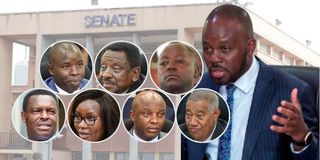
Governors notorious for snubbing Senate sumons Abdulswamad Nassir (Mombasa), Abdi Guyo (Isiolo), Lati Lelelit (Samburu), Simba Arati (Kisii), Gideon Mung’aro (Kilifi) and Fernandes Barasa (Kakamega). On the right is CPAC chairperson and Homa Bay Senator Moses Kajwang.
Photo credit: Nation Media Group
That followed Isiolo and Mombasa governors Abdi Guyo and Abdulswamad Nassir, respectively, snubbing a CPAC appearance by writing to the committee on the morning of the scheduled sitting to communicate their non-appearance, despite a public notice from the Senate requiring requests for non-appearance at least a week in advance.
They are among six governors who risk arrest for repeated failure to appear before Senate watchdog committees.
Other defaulting governors are Lati Lelelit (Samburu), Simba Arati (Kisii), Gideon Mung’aro (Kilifi) and Fernandes Barasa (Kakamega).
“The excuse that the Inspector-General (IG) of Police is unable to find the governor is not convincing. We also need to summon the IG as he is in contempt of Parliament,” Nyamira Senator Okong’o Omogeni said.
Added his Nairobi counterpart Edwin Sifuna: “The IG must appear before us and explain how and why it is impossible to locate a governor of such prominence, yet he can travel all the way to Homa Bay to arrest Albert Ojwang.”
He was referring to a blogger who died in police custody in Nairobi last year, triggering deadly street protests.
Article 125 of the Constitution empowers either House of Parliament or any of its committees to summon any person to appear for the purpose of providing evidence or information.
Section 18(1) of the Parliamentary Powers and Privileges Act gives Parliament and its committees the same powers as the High Court, with sub-section (3) authorising them to order the arrest of anyone who fails to honour a summons.
In a public notice issued last month, Senate Clerk Jeremiah Nyegenye stated that governors would no longer be allowed to arbitrarily postpone appearances before watchdog committees.