The High Court has ordered the government to purchase all locally produced rice from farmers nationwide before permitting duty-free imports.
In its ruling, the court mandated a 30-day nationwide mop-up as a precondition for further imports, criticising the State for weak and selective purchasing that excluded thousands of local producers while allowing cheaper foreign rice into the market.
The exercise must include cooperatives, individual farmers, traders, and millers across all major rice-producing regions, including Mwea, Bura, Ahero, Nyatike, Bunyala, Kuja and Kano.
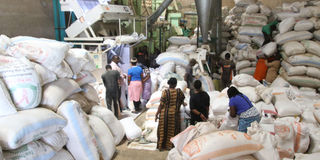
Philgona Anyango Ochieng' (left) and Susan Ouma at a rice farm in West Kano irrigation scheme in Ahero, Kisumu County. They earn a daily wage of Sh600 doing what is locally known as dino ochele ( the manual removal of rice husks). Many women do the work to be financially independent.
Photo credit: File | Nation Media Group
The court directed that the purchases must be made at farm-gate or wholesale prices based on prevailing market rates. It further cautioned that premature imports would distort prices and harm farmers' incomes.
The order followed a petition by Kirinyaga Senator Kamau Murango and Baragwi Ward Representative David Mathenge, who challenged the government’s July 2025 decision to allow duty-free imports of 500,000 tonnes of rice to address an alleged national supply deficit.
They argued that the policy disregarded large unsold local stocks and endangered farmers' livelihoods.
While permitting the government to proceed with the remaining 254,000 tonnes of imports authorised under a July 2025 gazette notice, the court imposed strict conditions to safeguard local producers.
The mop-up order was directed to the Cabinet secretaries for National Treasury and Agriculture; the Agriculture and Food Authority, commissioner for customs and border control, attorney-general, and the Kenya National Trading Corporation.
The legal dispute arose after the government gazetted plans in July 2025, allowing traders to import 500,000 tonnes of Grade 1 rice duty-free to stabilise consumer prices.
Farmers, led by Senator Murango, contested the move, arguing that imports were approved without adequately clearing local stocks, violating constitutional protections on property rights, fair administrative action and economic rights.
In August 2025, the court issued conservatory orders restricting imports to half the approved quantity (250,000 tonnes) and requiring officials to first mop up local stocks and submit progress reports.
By October 2025, officials reported importing 254,828 tonnes duty-free while purchasing only 514 tonnes from local farmers—figures petitioners cited as evidence of weak compliance.
The Agriculture and Food Authority claimed the mop-up was conducted primarily through cooperatives partnered with the Kenya National Trading Corporation.
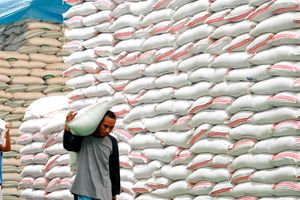
Kenya imports rice to supplement local production.
Photo credit: Pool | AFP
However, petitioners disputed its effectiveness, citing 65,000 unsold bags of rice in stock and an additional 71,000 tonnes expected from the November–December harvest.
Millers in Mwea alone reportedly held nearly 100,000 unsold bags. They argued that further imports under these conditions demonstrated "fundamental disregard for local farmers and businesses."
The dispute escalated in January 2026 after four companies imported 55,000 tonnes of duty-free rice from India and Thailand valued at Sh5.5 billion. The cargo was cleared at the Port of Mombasa amid claims that local stores were already stocked with unsold rice.
The government defended its actions, insisting Kenya faced a genuine rice deficit and that duty-free imports were necessary to stabilize prices and prevent shortages.
Officials contended that the mop-up focused on cooperatives because rice held by traders and millers was destined for alternative markets.
The court rejected this justification, ruling that the mop-up was narrow, selective and inconsistent with its earlier directives.
"There was no demonstration of an offer to buy such rice and a rejection by farmers or traders," the judge noted, emphasising that individual farmers outside cooperatives were excluded.
Acknowledging competing interests, the court recognized food security as a public priority while affirming farmers' economic rights and consumers' entitlement to affordable food.
It accepted the government’s demand-supply projections but warned that unchecked duty-free imports would "undoubtedly depress prices for farmers’ existing stocks and upcoming harvests," violating constitutional safeguards.
To balance these concerns, the court ordered a 30-day nationwide mop-up before imports could resume.
The remaining 254,000 tonnes must be imported in three equal tranches (85,000 tonnes each) starting March 1, April 1, and May 1, 2026, to prevent market dumping and price collapses.
The judge emphasised that protecting farmers’ incomes aligns with the State’s duty under Article 43 of the Constitution to ensure food access.