A black Subaru had been tailgating the businessman’s Toyota Harrier as he drove on the Thika Superhighway on October 19, 2025, and was still behind him when he parked his vehicle off Mirema Drive in Nairobi County.
He took note of the black Subaru with foreign number plates, but it did not alarm him. At least not before three men jumped out of it, one of them brandishing an AK47 assault rifle.
With the gun pointed at him, the men ordered the businessman to open the door of his car and hand them cash and a set of documents that were on the passenger seat.
The three men counted the money, $16,000 (Sh2.06 million) and Sh500,000 in Kenyan currency, before driving towards Lumumba Drive in Roysambu, with the businessman bundled into the Subaru’s boot.
They abandoned him near Jessekay Hospital in Roysambu. He hopped onto a boda-boda, which dropped him off at Kasarani Police Station where the incident was recorded and an investigation launched.
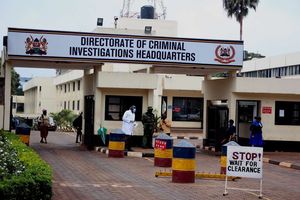
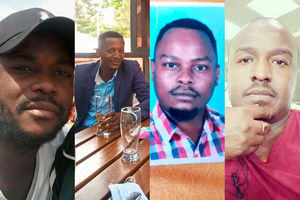
The investigation led to the arrest of three men, two of whom are DCI officers, in connection with the robbery with violence incident.
The two DCI officers are attached to the Operations Support Unit (OSU), a special squad created in 2022 to combat complex and violent crimes that are a direct threat to national security.
The regimes of Daniel Arap Moi, Mwai Kibaki, Uhuru Kenyatta and William Ruto have all faced backlash stemming from elite squads accused of going rogue with the blessings of the administration of the day.
Photo credit: File | AFP
Investigations have revealed that the third individual is a former police officer linked to other criminal activities over the years.
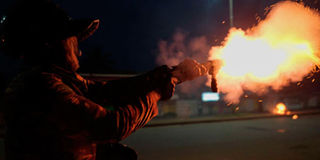
Various leads and tip-offs led police to a house in Kitengela where the officers recovered multiple vehicle number plates, seven mobile phones, a teargas canister, ID cards and a pair of handcuffs that detectives believe have been used in many unlawful detentions and to intimidate victims.
Later on, two other police officers attached to the OSU were also arrested in connection with the businessman’s robbery.
Investigations show that the Mirema robbery was executed using an official DCI vehicle. The individuals responsible for protecting civilians turned their guns on their employer and traumatised the businessman.
Police Spokesperson Muchiri Nyaga termed the incident as “another isolated case that should not be used to define an entire police unit”.
“When a few officers decide to go rogue, it should not be assumed that it’s the entire DCI that is rogue,” he said. “They play a critical role in maintaining security but this function too at times has a timeline.”
While the arrests are a sign that in many instances, the police will not shield even their own, they have resurrected ghosts of other elite squads in Kenya’s history that were tied to subjective political activities, extra-judicial killings and other criminal activities.
Patrick Shiundu, the director of Spyglass Investment, a security consultant firm based in Nairobi, believes that the public does not understand the role of the specialised police units.
Mr Shiundu added that many officers who have served in these units are never appreciated for their sacrifice.
“They (special units) should not be disbanded at the pleasure of an individual. However, it is important to note that the commanders have close supervision of their officers to make sure that they do not go rogue,” he said.
Elite police squad officers at the scene where five suspected criminals were killed in Mombasa on March 27, 2021.
Photo credit: File | Nation
Njoki Wamai, a human rights activist, said the special units are just killer squads that reign terror and abuse human rights, hence they should be disbanded.
She added that officers who have served in the special units should be investigated for human rights abuse.
The OSU was formed after President William Ruto disbanded another elite squad – the Special Service Unit (SSU) – formed for similar reasons.
The SSU was linked to the murder of Mohamed Zaid Sami, Zulfiqar Ahmed Khan and Nicodemus Mwania in July 2022.
Sami and Khan were IT specialists, part of Dr Ruto’s campaign and election strategy team in the run up to the 2022 General Election. Mwania was their taxi driver.
The regimes of Daniel Arap Moi, Mwai Kibaki, Uhuru Kenyatta and William Ruto have all faced backlash stemming from elite squads accused of going rogue with the blessings of the administration of the day.
In the 24-year Moi era, the Special Branch of the Kenya Police Service reigned terror on political dissidents. Abductions, torture and even murders of individuals that challenged Moi’s authoritarian rule were normal.
Politicians Koigi wa Wamwere and Raila Odinga and lawyer Mirugi Kariuki were among those arrested and tortured by Special Branch officers.
Student leader Titus Adungosi and musician Ochieng Kabaselleh are among many others who died after a date with officers from the Special Branch.
While there are usually whispers of the Special Branch’s involvement in the murders of former Cabinet Minister Robert Ouko and priest Anthony Kaiser, it has never been proven that the unit’s officers were directly behind those incidents.
During Moi’s reign, the Flying Squad was formed from an amalgamation of the Anti-Robbery Unit and Anti-Motor Vehicle Theft Unit.
While the Flying Squad is credited with foiling numerous violent crimes, a dark cloud of extrajudicial killings will always hang over its head.
Officers from the unit opted against prosecution of eight suspected carjackers as they fled from a stolen vehicle on March 24, 2000. A section of the civil society criticised the killings.
The unit’s members tortured Duncan Ndegwa, a police officer, in April 1999.
Silla Muhia Kinyanjui was arrested by Flying Squad officers on September 22, 1997 alongside his wife Ruth Wangu and brother Henry Nduguta. They were arrested on suspicion of killing the wife of Kinyanjui’s brother, Josephine Wanjiru.
The trio sued the government in 2019 for torture that left all of them with lifelong physical and psychological injuries, which included Nduguta becoming partially deaf.
In September 2020, Justice J.A. Makau ruled that the three had proven their case, but that the petition was filed inordinately late hence declined to award any compensation.
“Had the petitions not been found to be time barred, they would have succeeded. I would have awarded each petitioner Ksh5,000,000 as general damages with costs,” the judge said in his determination.
An elite police squad officer arrives to calm the situation after demonstrators stormed Parliament Buildings in Nairobi during the anti-Tax Bill protests on June 25, 2024.
Photo credit: Dennis Onsongo | Nation Media Group
When Kibaki assumed office in 2002, his administration would form several special squads.
On March 2, 2006, an 11-member team dubbed Kanga squad, which drew membership from the General Service Unit, raided the Standard Group’s newsroom.
The squad had been formed to tackle complex gang crimes, undercover operations and to get hands dirty by killing criminals who were unlikely to face justice in the conventional sense.
The Standard Group had published a story stating that Kibaki had held a secret meeting with Kalonzo Musyoka. Both leaders later denied having a secret meeting.
The Kanga Squad officers assaulted staff, carried away broadcast equipment and set thousands of newspaper copies on fire before leaving.
Then Internal Security minister acknowledged the government’s hand in the raid and justified the action, infamously stating that “if you rattle a snake, you must be prepared to be bitten by it”.
Kanga Squad was disbanded in October 2006 following public outrage and criticism by many across the world. But that only paved the way for Kwekwe Squad, a unit formed to eradicate the outlawed Mungiki sect.
The 2009 UN Special Rapporteur’s report stated that Kwekwe Squad was behind dozens of extrajudicial killings, enforced disappearances and torture of suspected Mungiki members.
In reality, it was a death squad that left a trail of widows and orphans, some of whom had nothing to do with the Mungiki sect.
The squad was disbanded on March 3, 2009.
Barely 10 years after Kwekwe Squad ceased to exist, DCI head George Kinoti disbanded the Moi-era Flying Squad.
But that would turn out to be a mere rebranding of the dreaded Moi-era relic, which had long been forgotten.
Following suspicion that businessman Dafton Mwitiki was at the centre of the kidnap of a former Cabinet minister’s daughter, the SSU was activated.
The former minister’s family allegedly paid a ransom to get their kin back despite ongoing investigations by police.
During another kidnapping incident, the SSU believed they had found evidence linking Mwitiki to the new kidnap plot.
Mwitiki was picked up by individuals believed to be SSU officers on March 11, 2020. He is yet to be found five years later. However, his car was located in a farm in Juja, Kiambu County days after his disappearance.
In July 2022, Mohamed Zaid Sami and Zulfiqar Ahmed Khan landed at the Jomo Kenyatta International Airport, ready to join then Deputy President William Ruto’s election campaign team.
The IT experts were being driven by Nicodemus Mwania when individuals believed to be members of the SSU abducted them. Mwania’s abandoned car was found in Nairobi, but the three individuals have never been seen since.
After being sworn in as Kenya’s fifth President, Ruto said that the three were killed by the SSU. In one of his first executive decisions, Ruto ordered the disbanding of the SSU.
Since then, 15 former SSU members have been charged with the murder of the three.
But even before their case proceeds to trial, the new Operations Support Unit has found itself on a path its predecessors walked before – accusations of rogue officers defying the oath taken to protect Kenyans.