In 2023, Cup of Joe, a Kenyan tea exporter, sealed a $20 million (Sh2.6 billion) deal with Debsh, an Iranian firm, for the supply of tea.
One of Cup of Joe’s directors, Mr Kamau Kiminda, was no stranger to the tea trade. The agreement appeared lucrative, and the company promptly shipped the consignment.
But this was no ordinary transaction. Debsh was at the centre of a corruption scandal that would ultimately claim casualties in both Iran and Kenya.
Iranian authorities say that upon the shipment’s arrival in Tehran, they uncovered fraud. The tea, officials said, was not the premium product Debsh had claimed but a low-grade consignment.
Cup of Joe was accused of importing low-grade tea into Kenya, blending it, and re-exporting it to Iran as premium Kenyan tea.
Tehran protested to Nairobi, demanding investigations into Cup of Joe and its dealings with Debsh, as Iranian authorities began to unravel the firm’s criminal activities.
According to court proceedings in Iran, Debsh obtained $3.37 billion from the government’s foreign exchange reserves at subsidised rates, ostensibly to import tea and processing machinery.
Prosecutors said the company misled officials by claiming it would import premium Indian tea and machinery. Instead, it purchased cheaper Kenyan tea and imported no equipment.
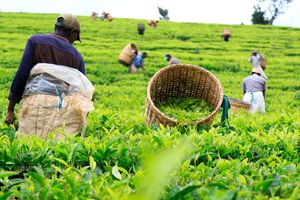
Workers pick tea leaves at a tea plantation.
Photo credit: File | Nation Media Group
Some of the foreign currency was sold on the open market, generating huge profits that were shared among members of the syndicate.
Investigations uncovered widespread fraud, including tea smuggling, currency manipulation and illegal acquisition of foreign exchange.
Last year, two former Iranian ministers were jailed for their roles in one of the country’s largest corruption scandals involving Debsh.
Former trade minister Reza Fatemi-Amin received a one-year sentence, while former agriculture minister Javad Sadatinejad was sentenced to two years.
Debsh president Akbar Rahimi-Darabad, identified as the mastermind, was jailed for 66 years and ordered to repay $2.38 billion to the state.
The scandal strained Kenya-Iran trade ties, with Tehran imposing a ban on Kenyan tea imports.
In 2024, Iran ranked among Kenya’s top 10 export destinations for tea, purchasing 13 million kilogrammes valued at Sh4.26 billion, according to the Tea Board of Kenya.
The loss of this market dealt a major blow to the sector, which provides income and employment to more than 750,000 smallholder farmers across 19 tea-growing counties.
The industry also supports the livelihoods of over 6.5 million people — about 13 per cent of Kenya’s population — according to the Kenya Tea Industry Policy 2023.
The ban imposed in 2023 has had significant financial implications for hundreds of thousands of small-scale farmers. Kenya Tea Development Agency (KTDA) national chairman Chege Kirundi told Daily Nation this week that the restrictions have made life increasingly difficult for growers, whose earnings have been severely affected.
Impact on farmers’ earnings
Mr Kirundi said Kenya has not exported any tea to Iran since 2023, resulting in sustained losses for farmers.
“This has had a major impact on farmers’ earnings and bonuses,” he said.
Several high-level meetings involving senior officials from both countries have failed to resolve the standoff. As the stalemate persists, Mr Kirundi warned that farmers remain the biggest losers as losses continue to mount.
Kenya has repeatedly petitioned Tehran to lift the ban. In response, the Iranian government demanded investigations into the alleged links between Cup of Joe and Debsh, and claims of low-grade tea exports.
On August 12 last year, Prime Cabinet Secretary Musalia Mudavadi and Agriculture Cabinet Secretary Mutahi Kagwe said the government was working to have the ban lifted.
Agriculture Cabinet Secretary Mutahi Kagwe.
Photo credit: File | Nation Media Group
“Kenya’s tea sector is one of our largest foreign exchange earners, and we must protect it from unscrupulous traders who damage our reputation,” Mr Kagwe said.
Following diplomatic exchanges, the Foreign Affairs ministry wrote to the Directorate of Criminal Investigations on September 25, 2025, seeking investigations into the matter.
The DCI’s Economic Crimes Unit later summoned Mr Kamau for questioning, and Cup of Joe’s licence was subsequently cancelled. The Tea Board of Kenya also deregistered the company.
However, Mr Kamau has denied any wrongdoing. In an interview with the Daily Nation, he dismissed claims that Cup of Joe imported low-grade tea and re-exported it as premium Kenyan tea, saying the firm had no direct dealings with the Iranian government.
“We were contracted by Debsh to source tea, which we did in line with our clients’ instructions,” he said.
A worker picks tea leaves at a farm in Nyeri County.
Photo credit: File | Nation Media Group
He said that after signing an agreement with the Iranian firm, Cup of Joe delivered the agreed quantities of tea. What Debsh did with the consignment after delivery, Mr Kamau added, could not be attributed to Cup of Joe.
It has since emerged that the Directorate of Criminal Investigations (DCI) has completed its probe into the matter, although the findings are yet to be made public.
Last Sunday, the Daily Nation sought clarification from Mr Kagwe on the status of negotiations to have the ban lifted and the measures the government had taken to eliminate rogue traders from the tea sector.
The CS acknowledged receipt of the queries via WhatsApp but had not responded by the time of going to press.
In his response, however, Trade Cabinet Secretary Lee Kinyanjui said Kenya was keen to expand its export markets to match growth in tea production recorded in recent years, noting that Iran remains a key destination due to its strong tea-drinking culture and high consumer spending.
Investments, Trade and Industry Cabinet Secretary Lee Kinyanjui make his remarks during the signing of the Host Agreement for the 24th Comesa Heads of State and Government Summit at KICC, Nairobi, on September 18, 2025.
Photo credit: Lucy Wanjiru | Nation Media Group
“Iran remains a strategic market for Kenya, and we are at the tail end of resolving a trade dispute that arose from unprofessional conduct by a few exporters,” Mr Kinyanjui said.
He said the government was strengthening compliance systems to ensure the smooth flow of trade and prevent a recurrence of similar incidents.
According to the CS, technical teams from both countries have exchanged visits and made the necessary adjustments to facilitate the resumption of normal trade.