President William Ruto has questioned how much “constitutional space” an elected government should have to implement the manifestos on which it won power, in remarks that could reignite debate over the Judiciary’s role in reviewing some of his administration’s flagship policies.
Speaking Thursday during the commemoration of Katiba Day in Nairobi, the Head of State wondered where the line should be drawn between judicial review of government action and policy choices that, under the constitution, belong to elected institutions.
How much constitutional space must an elected government have to implement the programme upon which it was elected?” Dr Ruto asked.
“When that programme is challenged, how should courts distinguish between reviewing constitutionality and making policy choices constitutionally entrusted to elected institutions?”
The remarks come against the backdrop of a series of court battles that have always disrupted or halted elements of the Kenya Kwanza administration’s agenda since it came to power in 2022.
President Ruto, however, was careful to acknowledge the Judiciary’s constitutional mandate, saying judicial independence was not in question.
“These questions do not constitute an infringement on the Judiciary. Judicial independence is non-negotiable. Courts must remain free to interpret the Constitution, protect rights, and invalidate unlawful action,” he explained.
He also appeared to recognise the obligation of the Executive to comply with adverse court decisions.
“Where government acts unlawfully, it must obey the courts and correct its course,” the President said.
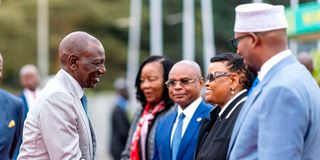
President Willam Ruto, Deputy President Prof Kindiki Kithure, Prime Cabinet Secretary Musalia Mudavadi, Senate Speaker Amason Kingi, and Interior CS Kipchumba Murkomen after the commemoration of the 16th anniversary of the promulgation of the 2010 Constitution, at the Kenyatta International Convention Centre, Nairobi.
Photo credit: PCS
However, he argued that the same constitutional order should protect the democratic space of elected institutions where they are exercising lawful policy choices.
“Where a lawful policy choice falls within the constitutional authority of elected institutions, that democratic space must also be respected,” he added.
The President’s comments effectively placed the question of the relationship between electoral mandates and constitutional limits at the centre of this year’s Katiba Day celebrations.
He observed that political parties present manifestos to voters, who then elect a government based on competing visions. That mandate, he said, carries both democratic legitimacy and an obligation to deliver on campaign promises.
“The ballot gives direction. The Constitution establishes the boundaries. Public institutions ensure that both are respected,” Dr Ruto said.
The Head of State linked the argument directly to his administration’s Bottom-Up Economic Transformation Agenda, saying the programme was designed to translate constitutional obligations into practical benefits.
He cited universal healthcare, affordable housing, food security, education and social protection as central pillars of the administration’s transformation plan.
Several of these flagship programmes have, however, faced legal challenges, putting the courts and the Kenya Kwanza administration on opposite sides of questions involving constitutional rights, public finance and the limits of executive power.
It is this tension that Dr Ruto appeared to address in his Katiba Day speech, asking whether judicial review could sometimes have the unintended effect of stalling the government’s plan.
“How do we preserve judicial review without unnecessarily paralysing legitimate government action? How do we ensure that checks and balances remain instruments of accountable government rather than pathways to institutional deadlock?” he asked.
And as Dr Ruto’s administration enters the homestretch of its first term, the question he posed on Katiba Day is likely to remain central to the political and legal contest over how much of its manifesto it can deliver and how much constitutional scrutiny its programmes must withstand along the way.
The remarks, made during the commemoration of the 16th anniversary of the promulgation of the Constitution, contrast sharply with the President’s description of the protests at their height, when he termed the events as “treasonous” and warned of a tough security response.
On June 25, 2024, Dr Ruto said: “I assure Kenyans that we shall provide a full, effective and expeditious response to today’s treasonous events.”
President William Ruto with Mama Ida Odinga at the commemoration of the 16th anniversary of the promulgation of the 2010 Constitution, at the Kenyatta International Convention Centre, Nairobi.
Photo credit: PCS
The protests were triggered largely as opposition to proposed tax increases contained in the Finance Bill 2024, but quickly evolved into a broader expression of anger over governance, accountability and the cost of living. The demonstrations were predominantly led by young Kenyans and spread beyond Nairobi. Parliament passed the bill, but after the breach and the resulting deaths, President Ruto did not assent to it.
And during the Katiba Day speech, he offered a significantly more sympathetic characterisation of the protesters and their grievances.
Reflecting on the protests, Dr Ruto said young Kenyans and other citizens were exercising rights guaranteed by the constitution.
“During the protests of 2024 and those that followed, young Kenyans and other citizens exercised their constitutional freedoms to speak, assemble, demonstrate, picket and petition public authorities,” he said. “Their message was clear: they wanted to be heard. They demanded greater accountability, better government, and a meaningful place in shaping the future of their nation.”
It was a striking reframing of a movement that had placed his administration under its most severe political pressure since it took office in 2022.
The June 2024 protests were initially triggered by opposition to the Finance Bill 2024. But it soon broadened to challenge to the government itself.
On June 25, 2024, protesters breached the Parliament compound and parts of the building were set ablaze as police fired tear gas and live ammunition. Several people were killed that day, and rights groups subsequently documented wider allegations of unlawful arrests, abductions and killings linked to the protests.
Dr Ruto on Thursday acknowledged the pain left by that period, including allegations of unlawful arrests, enforced disappearances and excessive use of lethal force.
“We cannot honour the Constitution by looking away from such allegations. Every credible allegation of a human-rights violation must be investigated independently, thoroughly, and transparently. Where wrongdoing is established, those responsible must be held accountable in accordance with the law,” he said.
The Head of State, however, maintained that the constitutional right to protest does not extend to violence, looting or destruction of property.
The Deputy President Kithure Kindiki, on his part, said it was a good time for the country to reflect on the strides it has made, how far it has maintained unity, and how far it has travelled in forging tolerance and finding strength “as a nation in our diversity”.
“Looking at the constitution, a relationship is envisaged between those who act on behalf of the State and the people… It is about how the three arms of government and the two arms of government at the county level relate to one another, and especially how they relate to the citizens of Kenya,” Prof Kindiki said.
The 2010 constitution of Kenya was the product of a decades-long quest for a new constitutional order.
By and large, it sought to restrain the concentration of State power while strengthening citizens’ rights and institutional checks and balances.
Kenyans endorsed the draft in a referendum on August 4, 2010, before President Mwai Kibaki promulgated it on August 27, ushering in a new order in which State power was expressly divided among the Executive, Parliament and Judiciary, while sovereignty was vested in the people.
Some 16 years ago, Wiper Patriotic Front party leader Kalonzo Musyoka, then a vice president of Kenya, stood at Uhuru Park and watched President Kibaki sign and promulgate the Constitution of Kenya, 2010. To his side, he recalled, stood the then Prime Minister Raila Amolo Odinga.
The 21-gun salute that followed, he said, was not just a ceremony but “a nation exhaling after a very long time holding its breath.”
On Thursday, however, he said, 16 years on, many Kenyans feel “ours is a first-class constitution, served by second-class compliance.”
“When court orders are treated as suggestions, that is not politics; it is an assault on the rule of law. When young Kenyans are tear-gassed, abducted, disappeared, shot in the leg or killed for exercising rights guaranteed under chapter four, the bill of rights is being edited by brute and deadly force. When chapter six on leadership and integrity is applied to the weak and suspended for the powerful, we are not fighting corruption; we are licensing it. And when independent commissions are captured, starved of funds, or quietly bent to serve the appointing authority, the Constitution is not amended; it is being ravaged from the inside,” Mr Musyoka explained.
The Wiper leader traced the constitution directly to the collapse of the 2007 tally, and the violence that followed. Several people died and many were displaced, he said, adding that elections in the country are a security matter, having previously turned deadly.
"A stolen or mismanaged election does not remain a legal problem," he said. "It becomes a security problem, then a humanitarian one, and then a scar that outlives the people who caused it. We must not be taken there again."