When President William Ruto announced that he had graft a dossier on lawmakers two weeks ago, everyone expected the House to fight back. It was not immediately clear in what format it would be.
Now, two arms of government--the Legislature and the Judiciary have found a common enemy in the head of state, whom they accuse of over-reaching.
The duo is citing budgetary constraints orchestrated by the Executive, independence of the institutions, and the principle of separation of powers as some of the points of convergence.
Ruto to MPs: Some of your colleagues pocketed Sh10m to pass anti-money laundering law
Around the same time, he was charging at the MPs, Dr Ruto also picked a fight with the Judiciary, saying they were the weakest link in the fight against corruption.
“A corrupt person goes to court and gets anticipatory bail. This makes it impossible for such a person to be arrested and prosecuted. How does that help fight corruption?” He said on August 13, in Homa Bay at the Devolution conference.
The leadership of Parliament and the Judiciary have vowed to work closely to strengthen governance as well as to fend off what they call Executive overstretch.
“They know how important we are because everything they want to do must come through this parliament. Let them have their say; we will have our way,” said Minority Leader Junet Mohamed.
“The executive cannot operate without parliament. They can say whatever they like, but they will still come to us. We will deal with them,” Mr Mohamed charged.
MPs say they are waiting for government-sponsored bills to be brought before them, promising to shoot them down.
In a first-of-its-kind retreat that brought together the two most important arms of government, the two institutions agreed to work together in discharging their constitutional mandates without interfering with each other's independence. A rare show for two entities always at loggerheads.
While the National Assembly has always accused the Judiciary of throwing injunctions in its way, restraining it from performing its legislative work, the Judiciary, on the other hand, has been accusing the lawmakers of denying it the necessary budget.
Sources within the meeting told the Nation the National Assembly took issue with the same case filed at many stations and therefore impending parliament from sending their lawyers to argue their cases.
“You find that the same case with the same prayers has been filed in Kiambu, Machakos, Mombasa and other parts of the country. How do you dispatch lawyers to appear for you? We gave them these statistics and they could not believe it,” said the source.
Public participation is another area that has caused friction between the two institutions, as the courts have nullified some laws passed by parliament on account of a lack of adequate public participation.
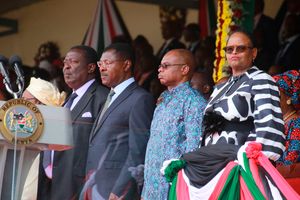
The situation National Assembly Speaker Moses Wetang’ula found himself in when he was required to guide the country on the majority side in the House is not unique in the history of Parliament.
Photo credit: Nation Media Group
Speaking during the retreat in Mombasa, Speaker of the National Assembly Moses Wetang’ula accused the judiciary of not understanding what participation means.
“We have been struggling with public participation and one entity that does not understand public participation is the judiciary,” Mr Wetang’ula said.
Mr Wetang’ula said the House will prioritize the Public Participation Bill, 2025, currently before the Justice and Legal Affairs that will clearly define and provide a detailed understanding of what the exercise entails.
The speaker regretted that most of the laws passed by the House have been thrown out by the courts due to what the courts have termed as ‘lack of adequate public participation’
“We must harmonize and pass the Bill, over 70 percent of our Bills have been struck out due to public participation. When I ask the Chief Justice, she says where is the law that guides my judges on the depth and extent of public participation,” Mr Wetang’ula said.
According to the speaker, A Bill that has already undergone public participation in the National Assembly need not be subjected to the same exercise in the Senate.
“If a Bill has come to the National Assembly who then conducts public participation, does the Senate need to do the same? I don’t think so. Public Participation doesn’t need to be an opportunity to squander public resources,” Mr Wetang’ula said.
Parliament has been grappling with what exactly constitutes public participation, a question that has led to some of the laws being nullified by the courts for failing to consider the views of the public during the legislative process.
Article 118 (1) (b) of the constitution provides a framework for the enactment of laws to facilitate effective and coordinated public participation, which requires that all public processes from policy formulation to legislation and final decision-making be subjected to public participation.
To cure the questions that have been raised by the courts, Mr Wetang’ula said the National Assembly has been using the constituency offices to take public participation exercises as close to the people as possible.
Chief Justice Martha Koome speaks during the swearing-in of the new IEBC Commissioners at the Supreme Court in Nairobi on July 11, 2025.
Photo credit: Bonface Bogita | Nation Media Group
So significant was the meeting that Chief Justice Martha Koome, in her speech, said that had it been convened earlier, then the two institutions would not have had misunderstandings between them.
“I must appreciate speaker for conceiving this idea and initiating the need for such an engagement, in my view this conversation is overdue, had we convened such engagement earlier, some of the misunderstanding and instances of working at cross-purposes between our two institutions might be well have been avoided,” Ms Koome said.
Ms Koome, while defending the meeting, said the institutional independence as outlined in the constitution does not prescribe isolation but an invitation to consultative and cooperative governance grounded in Article 6 (2) of the constitution.
“It is true that each arm of government has a distinct mandate, but when these functions are exercised in mutual suspicion or through adversarial relations, the result is paralysis and missed opportunities. When exercised in the spirit of respect, consultation and shared commitment, the result is social transformation,” Ms Koome said.
“We have institutional independence and decisional independence. At an institutional level, the arms of government can engage, however, decisional independence must always remain sacrosanct,” the CJ added.
Ms Koome decried that the Judiciary has not been receiving budgetary allocation commensurate with the constitutional obligation.
Ms Koome, for instance, told the top parliament leadership gathering that the judiciary's goal is to establish a magistrate court in every constituency, as currently there are only 143 such courts against the 210 constituencies.
“Adequate resourcing of the Judiciary is therefore a safeguard for the rights of the people, your constituents to access justice by ensuring the infrastructure of justice from court buildings to the digital transformation of our system is sustained,” Ms Koome said.
Ms Koome urged the lawmakers to consider the Judges’ Retirement Benefits Bill, 2025, saying judges in neighbouring countries such as Uganda and Tanzania already have such a law in place.
“I must note that efforts to secure a retirement benefits framework for judges has been ongoing since 1992, yet to date unlike in neighbouring Uganda and Tanzania, we lack a tailor made legislative framework to guarantee dignity for judges in retirement,” Ms Koome said.
Judiciary Chief Registrar Winfridah Mokaya urged the National Assembly to reflect on a new approach to funding the Judiciary-one that recognizes justice as a public good, to be financed with the same seriousness as health and national security.
Ms Mokaya said it is time for a new paradigm where budget allocation is guided by rational parameters, whether the number of cases filed, the number of judges, or other measurable indicators of judicial workload.
Ms Mokaya said such a framework ensures that resources grow in proportion to the Judiciary’s burden, moving us away from the arbitrary blanket allocations to principled and predictable models of financing.
“Just as no nation can secure its future without funding health or security, so too can no democracy thrive without adequately financing justice. Justice is the oxygen of governance, its financing must reflect this reality,” Ms Mokaya said.