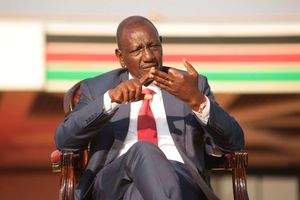
President William Ruto has mounted a vigorous defence of his administration’s record on public debt, arguing that Kenya has finally broken the cycle of rapid borrowing that characterised the previous two regimes.
Dr Ruto says the most important measure of his government’s fiscal record is not whether Kenya has stopped borrowing; it has not, but the pace at which public debt has accumulated.
He argues that while the country’s debt stock was projected to rise from about Sh10.3 trillion inherited in 2022 to roughly Sh13 trillion by June this year, “the increase of about 27 per cent over five years” represents a fundamental departure from the multiples recorded under his predecessors.
“When (Daniel) Moi left office, we had a sovereign debt of six hundred and thirty billion. That is what (Mwai) Kibaki inherited. In ten years, Kibaki took that sovereign debt to Sh1.8 trillion. That is three times by multiple of three roughly,” President Ruto said.
“When my brother, President Uhuru (Kenyatta), left office in 2022, he left behind a debt of 10.3 trillion. It had grown by five times from what Kibaki left.”
“In my five years, that debt has grown from 10.3 trillion to 13 trillion. In five years, that debt has not grown by multiples. It has grown by 27 per cent.”
The comparison forms the centrepiece of the President’s argument that his administration has delivered on one of the promises he made during the 2022 election campaign; to stop what he described as a runaway borrowing culture.
“I remember myself saying, ‘When you find yourself in a hole, the first thing to do is to stop digging.’ And that is where we found the country,” Dr Ruto said.
“I was serious about slowing down on borrowing and changing the way we develop our country so that we don’t depend so much on debt or borrowing or even on taxes, but we do it differently.”
The approved 2022/23 budget, passed before he assumed office in September 2022, provided for Sh862.92 billion in financing for the fiscal deficit — comprising Sh280.73 billion in external borrowing and Sh582.19 billion in domestic financing.
Treasury records indicate that about Sh740.33 billion of the planned financing was ultimately raised during the financial year.
The significance, in Dr Ruto’s account, is that a substantial portion of the financing requirement was already embedded in the fiscal programme inherited by his administration.
He says his government has continued to invest heavily in infrastructure and social programmes without allowing conventional sovereign debt to rise at the pace witnessed during the previous decade.
“When I talk about managing debt, it is not the same as stopping infrastructure development,” he said.
“Uhuru administration did not invest in the wrong things. The growing of that debt was building infrastructure, which is the right thing to do. But, in my administration, we have built infrastructure, maybe more, but we have not grown debt. Because we decided to do this different.”
Among the major projects being pursued are the Rironi-Nakuru-Mau Summit road corridor, the Northern Kenya Gateway, the extension of the standard gauge railway towards Kisumu and Malaba, water and irrigation schemes, energy projects and the planned development of major public facilities.
An artist’s impression of the Nairobi-Mau Summit Superhighway.
Photo credit: File | Nation Media Group
The government has simultaneously rolled out its Affordable Housing Programme, with about 300,000 units at different stages of development, alongside student accommodation and hundreds of modern markets.
The Head of State says combined investments in housing, markets and student hostels are now worth about Sh1.2 trillion.
His administration has also sought to reduce the cost of agricultural production through subsidised fertiliser, while expanding investment in irrigation and agricultural value chains.
“The commitment I made [was] that while we will continue to invest and develop our country, we will do it in such a manner that we reduce on borrowing, we reduce on debt, and we grow our economy sustainably,” he said.
They argue that the headline public debt figure does not necessarily capture all the financial obligations being accumulated by the State through alternative financing mechanisms.
One of the most contentious examples is the securitisation of future Road Maintenance Levy revenues to raise money for road projects and settle contractor obligations.
Critics contend that borrowing against future public revenues remains a financial commitment even if it does not immediately appear in the conventional sovereign debt stock.
The International Monetary Fund (IMF) has similarly pushed for greater recognition of such arrangements, including securitisation of future government revenues and certain liabilities arising from public-private partnerships, when assessing the broader public-sector debt position.
This raises a central question about Dr Ruto’s debt narrative as to whether Kenya genuinely reduced its dependence on borrowing, or has some of the borrowing simply moved into different financing instruments.
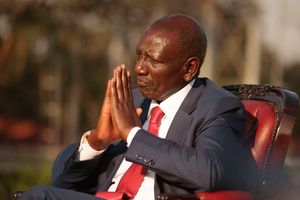
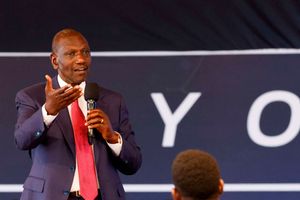
President William Ruto.
Photo credit: Bonface Bogita | Nation Media Group
The President’s administration argues that the answer lies in changing the model through which infrastructure is financed.
At the centre of that strategy is the proposed National Infrastructure Fund, which is intended to attract private and institutional capital into commercially viable infrastructure projects rather than relying exclusively on taxation or sovereign borrowing.
The administration says the Fund could mobilise trillions of shillings over the next decade by leveraging public assets and attracting pension funds, development finance institutions, sovereign investors and private capital.
In his interview, President Ruto described the approach as the practical expression of his pledge to “change the way we develop our country”.
Its success will depend on the governance of the Fund, transparency surrounding public assets used as seed capital, the commercial viability of projects and whether taxpayers are ultimately left carrying hidden or contingent liabilities.
Safina Party leader Jimi Wanjigi is among those who have mounted a much more fundamental challenge to the Government’s debt policy.
Mr Wanjigi argues that Kenya’s problem is not simply the speed of borrowing but the legitimacy and utilisation of some of the debt accumulated over the years.
He has called for a comprehensive audit of public debt, arguing that loans that were not legally approved or did not finance development should not be imposed on taxpayers.
“In this country, if it continues paying its debts, we are dead. If we don’t, we survive,” Mr Wanjigi said, while invoking the philosophy of Burkina Faso’s late revolutionary leader Thomas Sankara.
He has proposed identifying what he calls “odious debt” and removing illegitimate obligations from the national books rather than defaulting on legitimate debt.
Photo credit: Nation Media Group
His argument is that Kenya’s debt-service burden is crowding out resources that could otherwise finance healthcare, education and job creation.
People’s Party of Kenya leader Ndindi Nyoro has also warned about the country’s debt burden, although his prescription is less radical.
Mr Nyoro has called for an immediate audit of public debt after the 2027 election, reduction of wasteful expenditure, restructuring of domestic debt and expansion of the tax base without necessarily increasing tax rates.
He has also proposed redirecting more resources towards infrastructure, including upgrading thousands of kilometres of low-volume roads into all-weather roads.
For the President, the issue is whether Kenya has moved away from the rapid accumulation of conventional public debt.
For his critics, the broader test is whether the country’s total financial obligations; including those arising from alternative financing arrangements, are sustainable and transparent.
President Ruto points to the roads, housing projects, railway investments, markets, classrooms, water projects and other infrastructure being developed across the country.
His critics, however, maintain that the benefits must be measured against the rising cost of living, taxation and the amount of government revenue consumed by debt service.
The President nevertheless insists that his approach has already begun changing the country’s fiscal trajectory.
He says the debt-to-GDP ratio has declined and wants it eventually brought towards the statutory 55 per cent threshold.
“My target is that we must continuously bring down debt as a percentage of GDP,” he said.
“We found it at 72 per cent. We are now at 68 per cent. It is my plan that we slowly take it all the way to what the law says in Kenya, 55 per cent of GDP.”
His broader economic argument is that the Government had to make painful decisions after inheriting an economy under severe pressure, including removing some subsidies and restraining expenditure.
He says the result has been stronger foreign-exchange reserves, lower inflation, a more stable exchange rate and reduced interest rates.
Yet the debt question will remain central to how Kenyans assess Dr Ruto presidency as the country heads towards the 2027 election.
The President is, however, not promising to end borrowing altogether.
“I am not saying that we are going to completely not borrow. We’re going to borrow money. But you see, borrowing must be, as you grow the economy,” he said.
President Ruto’s claim is not that Kenya has escaped its debt problem, rather, it is that he has slowed the growth of conventional public debt while maintaining an ambitious development programme and laying the foundations for alternative financing.
Whether that amounts to a genuine break from Kenya’s borrowing culture will ultimately depend on what happens to the debt-to-GDP ratio, the transparency of new financing arrangements, the success of the National Infrastructure Fund and the economy’s ability to grow faster than its obligations.
President has, however, urged Kenyans to judge his record not simply by the Sh13 trillion headline debt figure, but by the pace at which that figure has grown and what the country has built along the way.
“When people say, William Ruto has grown debt to 13 trillion. Compare apples and apples, my friend,” he said.
“Where were we? What have other administrations done? And I have lived to my commitment that we are going to manage debt.”