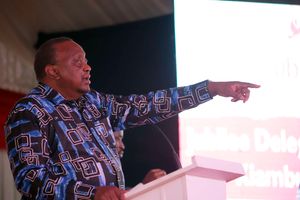
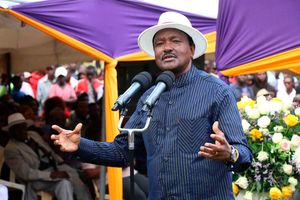
President William Ruto has lifted the lid on a decade-long political marriage that collapsed in a heap, describing in unusual detail how he travelled to his predecessor's rural home, hosted him at State House, and repeatedly asked Uhuru Kenyatta to rise above politics — only to be rebuffed each time.
In a rare exclusive interview with the Sunday Nation at State House, Nairobi, on Friday, August 21, the President offered a front-row view of a rapprochement that failed, with the late Prime Minister Raila Odinga at the centre of the talks.
President Ruto: Uhuru Kenyatta chose to become an opposition leader
It is no secret that there is no love lost between Ruto and Kenyatta, once described as a dynamic duo. What the interview reveals is how hard, and how often, the incumbent says he tried to close the distance.
"I went to see him in Ichaweri and also at his office next door here (next to State House) and sought to persuade him that as a former head of state, the only one living now, please help us forge a new vision for the country, but he was reluctant. He wasn't sure he wanted to do that. Well, those are choices people make. He chose to organise the opposition, sponsoring them…"
For the President, the hostility is no longer about the 2022 election. It is about his belief that the two men could have worked together for the country's unity after the transition of power — only for his predecessor to remain active in opposition politics.
Dr Ruto says the idea began not with Mr Kenyatta but with Mr Raila Odinga. He recalls sitting down with the former Prime Minister, who died in October 2025, arguing that Kenya's senior political figures should look beyond the next election.
"We are now the elders," Dr Ruto recalled telling him. "We are the leaders of this nation. Why don't we work together, grow a bigger vision that then we can hand over to the next generation of leaders?"
According to the President, Mr Odinga embraced the idea and agreed they should seek out Mr Kenyatta together. That is where, in President Ruto's telling, the story took a different turn.
"I went out of my way and looked for him," he said.
On December 9, 2024, Ruto travelled to Kenyatta's Ichaweri home in Gatundu, Kiambu County, for a rare face-to-face meeting after years of estrangement. The visit was read as an attempt to reopen channels between the two former allies, and was followed by the appointment of perceived Kenyatta allies to the Cabinet.
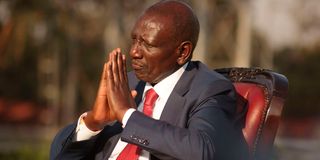
President William Ruto after an interview at State House in Nairobi on August 21,2026.
Photo credit: Evans Habil | Nation
Months later, the symbolism was reversed. Mr Kenyatta returned to State House in August 2025 for private discussions that included the DRC peace process. Dr Ruto did not merely host his predecessor — he personally showed him around the compound, a striking display of reconciliation between two men whose relationship had collapsed after the 2018 handshake.
The warmth of those encounters and the estrangement that survived them sit side by side in the President's account. He asked, he says, for something specific: that a former head of state use his experience to help build a long-term vision for Kenya. The request, he insists, was not an offer of alliance for 2027.
It was, in his words, "about national leadership."
"My predecessor had an option to become a statesman and rise above politics and become a unifying factor in our country," he said. "But he chose to climb down and become an opposition leader. He's the chairperson of Azimio up to now. He's busy organising the opposition against me."
"So of course he chose to be … organising the opposition," he said.
Mr Kenyatta chairs the Azimio la Umoja One Kenya Coalition's top decision-making organ, the Azimio Council, and leads his former ruling party, Jubilee. Since Mr Odinga's death he has installed Wiper Patriotic Front leader Kalonzo Musyoka as coalition leader, and is fronting former Interior Cabinet Secretary Fred Matiang'i to dislodge Ruto from power in next year's poll.
The disappointment is personal. President Ruto did not simply accuse his predecessor of opposing the government; he expressed regret that a man he once regarded as his political mentor and former boss declined the invitation to become an elder statesman.
The irony is difficult to miss. The two were once inseparable, fighting two presidential elections together, in 2013 and 2017, under the Jubilee banner.
Their alliance was born of the fallout from the 2007-2008 post-election violence and the political realignment around the International Criminal Court cases at The Hague. They presented themselves as victims of an establishment determined to block their ascent, mobilising supporters around political persecution, economic empowerment and generational change. This pushed Mr Kenyatta to an unlikely victory as president in 2013 with Dr Ruto as his deputy.
The relationship deteriorated during Mr Kenyatta's second term. The March 2018 handshake between Mr Kenyatta and Mr Odinga reshaped the political landscape and left Dr Ruto increasingly isolated. The fallout culminated in 2022, when Mr Kenyatta declined to back his deputy and supported Mr Odinga of Azimio for President instead. Dr Ruto won anyway.
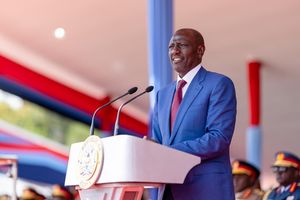
resident William Ruto during an interview at State House in Nairobi on August 21,2026.
Photo credit: Evans Habil | Nation
He had spent a decade as Kenyatta's deputy, the political lieutenant who defended the Jubilee administration through its most difficult moments. He expected, by his account, that the relationship would evolve into something different once both were out of that arrangement.
Instead the former deputy became president, and the former president became an increasingly influential figure in the opposition camp.
Nothing in the interview appears to irk the President more than what he says was his predecessor's forecast that the new administration would collapse almost immediately.
"Kenya was facing foreign-exchange pressures, high inflation, expensive credit and fears over its ability to meet external obligations. Uhuru predicted that my administration would not survive the economic crisis," he says. "If you ask the Azimio people, they will tell you the former president, my predecessor, told them that it would only take three months and the economy would come down."
"William Ruto was going to fail, within three months," he said, recounting what he described as the prediction. "He knew about the default, he knew about the state of the economy."
Then the political punchline: "I am sure he has a problem that… well, I managed the country and we did not default."
Survival, in his telling, became proof that those who expected him to fail were wrong.
On debt — one of his administration's biggest vulnerabilities — Ruto acknowledges the figure has risen but insists it must be measured against the size of the economy and against the borrowing record of his predecessors.
"When you find yourself in a hole, the first thing to do is to stop digging," he said, repeating an argument he made before taking office.
By his figures, Daniel arap Moi left office in 2002 with debt of about Sh630 billion and Mwai Kibaki with about Sh1.8 trillion. Kenyatta left with about Sh10.3 trillion; the figure is approaching Sh13 trillion under Ruto.
"If debt grew at the rate at which Uhuru's administration grew debt, we would be at Sh25 trillion today," he said. "We are not at 25 trillion."
He stops short of calling his predecessor's borrowing misguided. "Uhuru's administration did not invest in the wrong things," he said, acknowledging that much of it went into infrastructure. The distinction, he argues, is that his government is pursuing alternative financing rather than relying entirely on sovereign borrowing.
President William Ruto during an interview at State House in Nairobi on August 21,2026.
Photo credit: Evans Habil | Nation
There is something deeper in the President's repeated references to his predecessor. He is not merely defending an economic record; he appears determined to prove that the political establishment underestimated him.
With the 2027 election approaching, Ruto appears increasingly conscious of the influence Kenyatta still commands. His administration faces a fragmented opposition searching for a vehicle capable of uniting voters against his re-election, and he sees his predecessor's hand in the effort.
"Don't they look sponsored? Don't they look hired?" he asked rhetorically of opposition politicians campaigning against his programmes.
“In your own assessment, these people in the opposition, do they look like they have any idea where they are going? Can you explain how people who’re supposed to be intelligent have no plan, no vision, no agenda. If you ask this one, He says he will abolish SHA (Social Health Authority) without giving alternative. Another one says he will abolish housing programme without offering alternative. The other one’s only problem is that chicken cannot limb the stairs, how absurd! Don’t they look sponsored; don’t they look like stooges or puppets?”
The accusation places the former president at the centre of a wider opposition project in Dr Ruto's narrative. It also exposes his anxiety about that continued influence. He insists he is not afraid, and says Kenyans will ultimately judge competing programmes.
From the economy to housing, education, agriculture and healthcare, President Ruto has embarked on a detailed defence of his four-year record, insisting that he has delivered on the promises that took him to State House.
He says his government has stabilised the economy, increased foreign-exchange reserves, reduced inflation and restored investor confidence. He also points to housing construction, education reforms, agricultural interventions and job-creation programmes as evidence of progress.
His argument is essentially that the government that Mr Kenyatta allegedly expected to collapse has instead survived and, in his telling, performed.
President William Ruto (left) being interviewed by Nation Media Group Journalists Justus Ochieng (right) and Justus Wanga at State House in Nairobi on August 21,2026.
Photo credit: Evans Habil | Nation
You promised to put money in the pockets of Kenyans but they say life is unbearable. Where’s the money?
It depends on who you’re talking to. If you talk to two million Kenyans who didn’t have a job before 2022 and now do, they have money in their pockets. We’ve reduced the out-of-pocket expenditure by citizens, When I came into office, unga was retailing at sh250, today it’s at sh150-sh140, a sh100 saving. Because of interventions we’ve done in the dairy sector, they now do more silage because we’ve reduced the cost of fertiliser. We’ve reduced the cost of semen. Milk production has now moved from4.6 billion litres to 5.5 billion. We have put in the pockets of dairy farmers an extra sh50 billion a year. That’s how it’s done. I can go to tea, macadamia etc. We have expanded markets for our products in the Europe and China among others.
Some don’t feel that way though.
I’m not saying we have gotten to everybody, there’s still work cut out for us to do but we’re somewhere.
President William Ruto(left) being interviewed by Nation Media Group Journalists Justus Ochieng(right) and Justus Wanga at State House in Nairobi on August 21,2026.
Photo credit: Evans Habil | Nation
There’s massive mobilisation by the united opposition and a growing wave by Linda Mwananchi led by Nairobi Senator Edwin Sifuna to deny you second term. Aren’t you scared they’ll make you one term president?
I’m not scared at all. In your own assessment, these people in the Opposition, do they look like they have any idea where they are going? Can you explain how people who are supposed to be intelligent have no plan, no vision, no agenda? If you ask this one, he says he will abolish SHA without giving an alternative. Another one says he will abolish the housing programme without offering alternative. The other one’s only problem is that chicken cannot climb the stairs, how absurd! Don’t they look sponsored? Don’t they look like stooges or puppets?
Where is the evidence that they’re being sponsored by Uhuru, Mr President?
You work for the Nation right? Can you check the Sunday Nation headline of August 2. What was the headline? It says ‘Uhuru super coalition against Ruto’. You answered yourselves. Despite everything he did, I won the elections.
When was the last time you spoke to your former boss Uhuru Kenyatta?
I went to see him in Ichaweri and also at his office next door here and sought to persuade him that as a former Head of State, the only one living now, please help us forge a new vision for the country, but he was reluctant.
Ruto claims Uhuru predicted his administration would not survive economic crisis
During your visit to Ichaweri, we saw you in a symbolic gesture take goats as an act of rapprochement, but it seems this hasn’t helped much. What is the root of your disagreement with him that seems so difficult to forgive?
It’s an open secret that my predecessor has not gotten over what happened in 2022. He had his candidate. That despite all he did, I won the elections. Secondly, he made a prediction himself, in public that William Ruto was going to fail within three months because he knew very well that the country was in dire straits. He knew about the default, the state of the economy and so sure he has a problem that I managed. That the tattered economy he left today is in a different place.
There’s been so much criticism about the timing of the beyond 2030 vision with some saying it’s all about politics. Why now?
Kenyans must answer the question about what kind of country they want to have after Vision 2030. If we don’t do this now, the current Medium-Term Plan Five which ends next year will hang. It’s a five-year cycle plan. It will go up to 2032 when Vision 2030 ends. Long-term planning cannot begin when the previous plan has already ended, particularly when government is required to prepare and implement five-year development programmes.
The general feeling is it’s about your re-election campaign. What do you say about that?
Elections will come and go. Kenyans will make their decision and the country will move on. Vision 2030 was not about Mwai Kibaki. It wasn't about an administration. Beyond Vision 2030 is not about William Ruto and it's not about my administration.