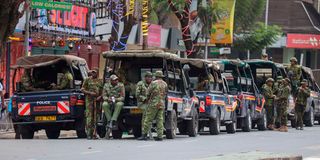
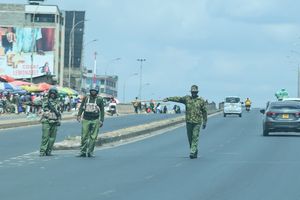
Police sealed off major roads leading into Nairobi’s Central Business District (CBD) during yesterday’s Saba Saba protests, disrupting transport, keeping businesses shut and preventing most demonstrators from reaching the city centre.
Officers mounted roadblocks on major highways, blocked key entry points and subjected motorists and pedestrians to security checks, leaving thousands of commuters stranded and many workers unable to report to their jobs. Public transport into the CBD remained severely disrupted until early evening, while traders counted heavy losses after spending much of the day without customers.
By the end of the day, Nairobi Regional Police Commander Issa Mohamud described the operation as a success, saying only a handful of protesters had attempted to gather in the city and that 10 people had been arrested in Nairobi and its environs.
Police officers arrest a protestor on Harambee Avenue, Nairobi, on July 7, 2026 during demonstrations to commemorate Saba Saba Day.
Photo credit: Lucy Wanjiru | Nation Media Group
Days before the protests, organisers had said they expected at least 1,000 demonstrators in the CBD after issuing what they described as a notification to police. The National Police Service rejected the claim, maintaining that it had not received the notice required under the law.
By Tuesday morning, however, only small groups of protesters had appeared along Harambee Avenue, Wabera Street and at the junction of Parliament Road and City Hall Way. Police quickly moved in, bundling them into marked and unmarked vehicles before they could assemble.
Commuters walk long distances after matatus blocked from Nairobi CBD
The turnout contrasted sharply with last year’s Saba Saba demonstrations, when prolonged confrontations between protesters and police brought much of the capital to a standstill.
As they did during the June 25 protests, police stopped commuters and motorists long before they reached the city centre.
Along Jogoo Road, traffic flowed normally until motorists approached the City Stadium roundabout, where police had erected a major barricade. Beyond the checkpoint, vehicles were barred from accessing Landhies Road, the main route into the CBD. Passengers were left with two options: turn back or proceed on foot after undergoing security screening. Many chose to walk, joining streams of commuters carrying bags and office files as they trekked several kilometres into the city.
The disruption was felt across other major entry points. Along Mombasa Road, police maintained a visible presence at the Mlolongo Expressway entrance and exit, the Mlolongo-Kitengela interchange, Bunyala Road roundabout and the Haile Selassie-Uhuru Highway intersection.
On Thika Road, roadblocks at Kimbo, Kihunguro and the Eastern Bypass junction disrupted public transport, with dozens of matatus turned away and hundreds of commuters stranded for hours. “I have been here for two hours, and there are no matatus. The few that show up say they are not going to town. It is unfortunate. Most of us live hand-to-mouth. We must show up to earn something, but the police have now held me hostage. I cannot go to work,” said Martin Oduor, who was stranded in Githurai 45.
Others eventually abandoned their search for public transport and walked long distances into the city.
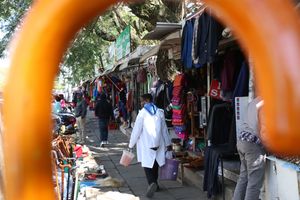
Nairobi’s Central Business District, usually busy from sunrise with office workers, traders, hawkers and shoppers, was unusually quiet as many businesses remained closed and streets were largely deserted.
Those who ventured into the city encountered a heavy police presence, with officers in uniform and plain clothes patrolling in marked and unmarked vehicles. Traders and workers moved cautiously as uncertainty persisted over the protests.
The disruption dealt a major blow to transport operators, whose earnings depend on daily passenger numbers. Many matatu operators said they lost a day’s income after police restrictions reduced movement into the CBD.
Police say no notice received for Saba Saba protests
“This is too much. We are making losses every day, and it is sad. Last time, on June 25, we did not work, and today the police have blocked us again. I have not carried a single passenger. Fuel prices are still high. How are we expected to service our loans?” said matatu operator John Mwai.
The impact was also felt among boda boda riders, whose livelihoods rely almost entirely on daily earnings.
Mr Alex Kulema, chairperson of the Kenya Boda Boda Association’s Nairobi branch, said thousands of riders remained idle because customers stayed away from the city.
“These demonstrations are affecting us very adversely. There are no people in town because of the protests. We depend on our daily income, and when people do not come to town, we go back home empty-handed, and our families sleep hungry,” he said.
Mr Kulema said deserted streets also exposed riders to security risks, including robbery and theft of motorcycles.
Police on standby at Free Area along the Nakuru–Nairobi Highway on July 7, 2026. As Kenyans marked the annual Saba Saba commemoration, traffic along the Northern Corridor and activities across Nakuru remained largely uninterrupted.
Photo credit: Boniface Mwangi | Nation
“It is very risky for us when people are not on the streets because we can easily be robbed or our bikes stolen when we drop off passengers in isolated places,” he said. While acknowledging the need for security measures, Mr Kulema questioned the economic impact of repeated disruptions.
“On the issue of blocking roads, it has affected us in more ways than one, but we appreciate that security must come first,” he said. He added that many boda boda operators were servicing motorcycle loans and could not afford repeated losses. The disruption in Nairobi had implications beyond the capital, Kenya’s main commercial hub and a key link between businesses across the country through transport networks, financial services and wholesale markets.
Traders and business owners said interruptions to movement affected deliveries, customer access and supply chains. Delayed transport, cancelled trips, and reduced activity in the CBD disrupted businesses that depend on Nairobi as a market and distribution centre. The slowdown also affected workers and small enterprises that rely on daily transactions, with traders warning that repeated disruptions could deepen losses for businesses already facing high operating costs and weak consumer demand.
Elsewhere in the country, the protests had limited impact, with businesses remaining open and normal activities continuing in several towns amid heightened security.
Anti-riot police patrol Eldoret City streets on July 7, 2026.
Photo credit: Jared Nyataya | Nation Media
In Eldoret, businesses operated as usual, and traffic flowed normally despite the deployment of anti-riot police at areas identified as possible protest hotspots, including Huruma, Baniyas Square and Kisumu Road.
Uasin Gishu County Police Commander Wilberforce Sicharani said no notification had been received for demonstrations and warned residents against disrupting public order.
Saba Saba: Police confront NMG journalists filming barricade at Allsops
“Due to fear instilled in us by goons sponsored by local politicians, we are silent. But come 2027, they will see our true colours through our votes,” said boda boda rider Moses Korir.
In Nakuru, supermarkets, banks, pharmacies and restaurants operated normally under a heightened police presence. Similar calm was reported in Nyahururu, Ol Kalou, Kericho, Bomet and Narok, where many traders said they chose to remain open after suffering losses during previous demonstrations. “We have learnt that the protests attract goons who cause massive destruction to property. As traders, we felt that we needed to abandon the protests and address our challenges at the ballot,” said trader Reuben Kuria.
Bomet branch chairman of the Kenya National Chamber of Commerce and Industry, Leonard Langat, said traders had opened their businesses as usual, adding that protests had not been part of the region’s culture.
Nairobi Regional Police Commander Issa Mohamud addresses the press at Kencom in Nairobi on July 7, 2026.
Photo credit: Wilfred Nyangaresi | Nation Media Group
In Nairobi, Mr Mohamud defended the police operation, saying officers had prevented unlawful demonstrations after organisers failed to issue the legally required notice.
“There is no country that operates without public order. If you love your country, you must have public order,” Mr Mohamud said.
He defended the roadblocks, saying they were necessary to prevent criminals from infiltrating demonstrations and damaging property. “We decided to do that so that we control access. We regret that perhaps in the process we were slow because of the number of vehicles and people. Our intention is not to harm or block people from coming to the CBD. It is a win-win for the business community,” he said.
Police officers redirect matatus while allowing other motorists to proceed at Githurai after partially closing a section of the Thika Superhighway amid heightened security and fears of possible Saba Saba anniversary protests.
Photo credit: Willfred Nyangaresi|Nation Media Group
However, critics questioned whether repeatedly restricting access to the capital was a sustainable approach to maintaining public order.
Siaya Governor James Orengo criticised the roadblocks, saying they had disrupted economic activity. “There are roadblocks everywhere, and there is no activity in town. This is shameful conduct by the government,” he said.
Wiper Patriotic Front leader Kalonzo Musyoka called for the release of arrested protesters, saying peaceful demonstrations were protected under Article 37 of the Constitution.
“Peaceful protest is not a crime. It is a right expressly guaranteed under Article 37 of the Constitution, and no Kenyan should be detained for exercising that right,” Mr Musyoka said in a statement. At All Saints Cathedral, activists including Elisha Ochieng Alam, James Mulamba, Sailel Mankuyio and Joshua Nyanjom accused police of preventing them from accessing Parliament, where they intended to present a petition.
The Kenya Private Sector Alliance has previously estimated that a day of nationwide protests costs the retail, transport and banking sectors about Sh3 billion, while the Kenya Revenue Authority reported Sh6 billion in lost revenue during past demonstrations, according to Government spokesman Isaac Mwaura.
Although yesterday’s disruption was concentrated in Nairobi, the capital’s role as the country’s economic hub means its shutdown affects businesses nationwide.
Reporting by Steve Otieno, Daniel Ogetta, Kevin Cheruiyot, Ndubi Moturi, Titus Ominde, Mercy Koskei, Waikwa Maina and Vitalis Kimutai