The country’s security sector scooped a massive Sh463.65 billion injection in the proposed Sh4.8 trillion budget for the fiscal year 2026/27, trailing only the education sector’s Sh784.5 billion in the national spending priorities currently under consideration in the National Assembly.
This, as the Independent Electoral and Boundaries Commission (IEBC) got Sh24.97 billion largely to support electoral activities ahead of the August 2027 General Election.
The Budget and Appropriations Committee (BAC), in a report on the budget estimates for the fiscal year 2026/27, notes that the increase in the national security sector, which includes the Ministry of Defense, National Intelligence Service (NIS) and the National Police Service (NPS), is to enhance border and homeland security.
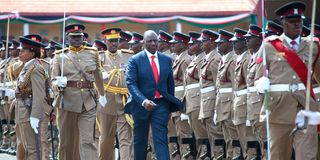
The Kenya Defence Forces soldiers during a past function.
Photo credit: File | Nation Media Group
The Ministry of Defence, NPS and NIS constitute the country’s security sector with the mandate to ensure the country’s security against threats emanating from within or outside Kenyan borders, defend the country and support the civil powers in maintaining peace and order.
The BAC report shows that the sector’s combined budget exceeds the Sh454 billion that was approved by the House in the Budget Police Statement (BPS) in March, 2026.
The estimates show that the Ministry of Defense gets Sh252.15 billion, which is more than the Sh241.37 billion in the BPS, NPS Sh147.41 billion above the Sh139.19 billion in BPS and NIS Sh64.09 billion compared to the Sh58.62 billion.
“The increased allocation to the security sector is meant to support strengthened intelligence gathering, analysis and operational capabilities,” the BAC report before the House.
The report also justified the enhanced allocation to the Department of Defence “to facilitate ongoing modernisation programmes aimed at improving equipment, infrastructure and overall defence capabilities in response to evolving security threats and emerging geopolitical dynamics.”
But even before the fiscal year 2026/27 starts for the government Ministries, Departments and Agencies (MDAs) to start spending what the National Assembly would have appropriated, NIS already has an eye for supplementary budget, which violates fiscal discipline as provided for in the Public Finance Management (PFM) Act.
“To effectively address these challenges, the NIS will collaborate with the National Treasury to secure additional resources,” the budget books read.
The education sector has the highest allocation, going to the Teachers Service Commission (TSC) at Sh424.25 billion for teacher resource management, State Department for Higher Education Sh163.91 billion, Basic Education Sh136.55 billion, TVETs Sh58.49 billion and Science, Innovation and Research Sh1.3 billion.
“The funding is intended to support critical areas such as infrastructure development, capitation and teacher recruitment in line with the Competency Based Education,” the BAC report reads.
Of the allocation to the education sector, Sh54.6 billion is for Free Day Secondary Education (FDSE), Sh30 billion for Junior Secondary School (JSS) capitation and Sh7 billion for Free Primary Education (FPE).
This also includes Sh56.7 billion to the Higher Education Loans Board (Helb) to support student financing in institutions of higher learning.
Further allocations include Sh4.9 billion for the conversion of 20,000 intern teachers into permanent and pensionable terms.
This is aimed at addressing staffing gaps in schools and improving employment stability in the teaching profession.
Junior Secondary School (JSS) intern teachers march along Nairobi streets on May 5, 2026 to demand the implementation of a court order regarding their pay and employment terms.
Photo credit: Lucy Wanjiru | Nation
The sector has also been allocated Sh9.9 billion for the administration of national examinations and invigilation fees under the Kenya National Examinations Council (KNEC).
“The substantial allocation underscores the government's continued prioritization of access to education, teacher recruitment and support for the transition and implementation of the Competency-Based Curriculum.”
IEBC gets Sh24.97 billion to facilitate among others, voter registration and verification, procurement of electoral materials, logistical planning, civic education and strengthening of institutional and operational capacity “to ensure the timely and credible conduct of the 2027 general election.”
The allocation to the security sector, dwarfs previous years’ budgets, even as audit reports point fingers at the usage of the confidential expenditures, with the Office of the Controller of Budget (OCoB) querying low absorption levels in some critical programmes.
Data from the National Treasury shows that the Ministry of Defence was allocated Sh139 billion in the 2022/23 financial year, Sh159.1 billion in the 2023/24 period and Sh179.7 billion in the fiscal year 2024/25.
In the current financial year, the Ministry of Defence was allocated Sh200.3 billion before it was enhanced by Sh25 billion in the supplementary budget I passed in March this year.
Notwithstanding the allocation and its clamour for enhanced budget, the Department of Defence did not absorb all its funds as budget, with the National Treasury data showing that in the fiscal year 2022/23, Sh138.9 billion was absorbed, Sh158.2 billion in the 2023/24 period and Sh177.1 billion in the financial year 2024/25.
Despite the increased allocation, Defence continues to face a myriad of challenges, which include rapid advancement in military technologies leading to a high rate of equipment obsolescence and high cost of modification, porous borders and a human resource capacity gap, among others.
According to the OCoB’s National Government Budget Implementation Review Report for the first three months of the fiscal year 2025/26 of November 2025, the Ministry of Defence recorded an overall absorption rate of 24 percent.
“Military modernization and general administration recorded lower absorption at 19 and 23 percent, respectively, while defence industrialization reported an exceptionally high absorption of 6,182 per cent, indicating expenditure far above the approved estimates,” says the OCoB report.
The Ministry of Defence includes the Kenya Army, Kenya Air Force, Kenya Navy, Defence Forces Constabulary and Civilian Staff.
Its primary mandate is to defend and protect the sovereignty and territorial integrity of Kenya, with its secondary mandate involving assisting and cooperating with other authorities during emergencies or disasters and restoring peace in any part of Kenya affected by unrest or instability, “as directed.”
The growth in the budget allocation for the national security sector is attributed to increased funding requirements for military modernization, enhanced territorial defence capabilities and strengthened intelligence-gathering operations.
The National Treasury documents list rapid advancement in military technologies, leading to a high rate of equipment obsolescence and high cost of modification as one of the challenges the Ministry faced.
The others are porous borders, increased humanitarian emergencies and disasters, land disputes and costly land acquisition and compensation.
“The Ministry has made efforts to mitigate these challenges through the recruitment of staff, mobilization of resources, infrastructure expansion and enhanced military operations,” says the Treasury document.
The NIS is tasked with the responsibilities of security intelligence and counter-intelligence, aimed at enhancing national security in line with the constitution, as well as executing any additional functions as prescribed by the law.
During the 2022/23 financial year, NIS was allocated Sh37.6 billion before escalating to Sh52.6 billion in the fiscal year 2022/23 and Sh58.7 billion for the fiscal year 2024/25.
In the current financial year, the spymaster got Sh51.5 billion before it was enhanced by Sh10 billion in the supplementary budget I for the current fiscal year, bringing the total budget so far to Sh61.5 billion.
In terms of budget expenditures, NIS absorbed Sh35.9 billion in the 2022/23 financial year, Sh52.5 billion in the subsequent year and Sh58.6 billion in the period 2024/25.
The budget allocation to the NPS for fiscal year 2025/26 amounted to Sh127.09 billion, compared to Sh108.68 billion allocated in the period 2024/25.
Auditor-General Nancy Gathungu.
Photo credit: Wachira Mwangi | Nation Media Group
A report by Auditor-General Nancy Gathungu on the accounts of the Department of Defence for the fiscal year 2024/25 shows that it had not taken action to implement audit recommendations regarding confidential expenditure “to foster trust and ensure funds are utilized responsibly without compromising State security.”
“As previously reported, there is a need to enhance accountability of confidential expenditures through review of the Regulations to clearly define entities eligible for confidential security-related expenditures and to specify what constitutes security-related operations,” the audit says.
The Regulations also require responsible government agencies to establish internal oversight mechanisms and processes “that include detailed budget projections and post-operation financial summaries to address risks and ensure responsible use and accountability of the funds, beyond the certificate.”