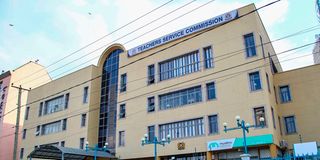
The government’s failure to allocate Sh5.3 billion towards comprehensive insurance cover for teachers under the Teachers Service Commission (TSC) has left them exposed, according to the National Assembly Committee on Education.
The committee made the revelations in a report, as questions abound whether the over 400,000 TSC teachers got a raw deal when they transitioned from a private scheme funded by the taxpayer to the government-owned Social Health Authority (SHA).
The Group Life, Group Personal Accident (GPA) and Work Injury Benefits Act (Wiba) scheme which they enjoyed before the transition, was provided by Minet-Kenya, an insurance and risk management solutions provider, under the repealed National Health Insurance Fund (NHIF).
The failure to allocate the insurance funds comes as it emerged that their monthly pay is deducted twice to finance their Social Health Insurance Fund (SHIF) and the Public Officers Medical Scheme Fund (POMSF), all under the SHA.
“There is no provision in the budget for group life, group personal accident and Wiba covers for teachers,” the committee, chaired by Tinderet MP Julius Melly, observed in a report on the TSC estimates for 2026/27 to the Budget and Appropriations Committee (BAC).
National Assembly's Departmental Committee on Education Chairperson and Tinderet Constituency MP Julius Kibiwott Melly.
Photo credit: Dennis Onsongo | Nation Media Group
“It is critical that resources are made available to the commission to cater fully for this medical cover since it touches on the well-being of the teachers,” the committee’s report reads.
Despite the transition, Minet is still owed Sh4.4 billion by the government, which has not been factored into the Sh422.6 billion allocated to TSC for the 2026/27 financial year.
The TSC budget will largely cater to teachers’ remuneration and implementation of the Comprehensive Bargain Agreement (CBA) obligations.
The TSC budget is a deviation from the Sh422.9 billion in the Budget Policy Statement (BPS), which the National Assembly approved in March this year.
The Melly-led committee noted that after the commission shifted from the private insurance to SHA in the provision of medical cover for teachers, “a saving of Sh4 billion was realized” and “if this saving is provided by the National Treasury, it could be directed towards providing for group life cover for teachers.”
The committee reveals that although the commission submitted that it had no historical pending bills, it noted that Sh7.4 billion remained outstanding after the expiry of the contract for the provision of medical cover for teachers under MINET.
Of the outstanding amount, Sh3 billion was paid in the current financial year through supplementary budget, leaving a balance of Sh4.4 billion due for Minet, but “which has not been factored in the 2026/27 estimates” for the commission.
The Sh4.4 billion owed to Minet is part of the Sh12.7 billion in funding gaps to the TSC for the 2026/27 period that also includes the Sh5.3 billion for enhanced insurance cover for the teachers, Sh2.2 billion acting allowances for administrators and Sh800 million for field operations.
All teachers employed by TSC used to enjoy a medical allowance that would later be converted into a private medical scheme provided by a consortium of insurance service providers and administered by the defunct National Hospital Insurance Fund (NHIF).
But under the deal that TSC signed with SHA that became effective December 1, 2025, the private medical scheme, which was financed by their medical allowances, was abolished, a claw back on the teachers’ medical cover.
This means that TSC teachers are now required to pay out-of-pocket “fees for service” under the POMSF, administered through the SHA, notwithstanding the 2.5 percent SHA statutory deductions from their monthly pay.
The TSC/SHA deal strips teachers of all the medical privileges they previously enjoyed, either through allowances or the private insurance cover, while imposing new financial burdens with no corresponding benefits.
Kitutu Chache South MP Anthony Kibagendi, a member of the House’s Committee on Health, warned that unless teachers have private medical insurance, they may be exposed to increased out-of-pocket expenditures to settle medical bills, especially for those with chronic illnesses.
“There is the threat of increased financial burden as individuals who rely on health insurance may face higher out-of-pocket costs, leading to increased financial hardships, especially for low-income families,” says Mr Kibagendi.
Acting TSC CEO Evaleen Mitei did not respond to our inquiries about how the deductions under POMSF and service fees align with constitutional requirements and labour protection.
Teachers Service Commission CEO Evaleen Mitei speaks to the media at the Ministry of Health offices in Nairobi on March 10, 2026.
Photo credit: Bonface Bogita | Nation Media Group
Former Public Service Regulatory Authority (PSRA) Director-General Fazul Mohamed, in documents presented to parliament, questioned the TSC/SHA medical deal.
“It is incomprehensible that a Kenyan teacher is required to pay statutory deductions to SHA and still pay at the point of service under POMSF. That is the very definition of double taxation,” Mr Mahamed, a policy analyst, who has publicly criticized the TSC’s administrative actions, said.
Mr Mohamed further notes that the transition of TSC teachers to SHA was executed without adequate consultation, public participation or protection of teachers’ welfare, despite affecting more than 400,000 teachers and their dependents.
According to Mr Kibagendi, the vulnerable sector of the TSC workforce may also experience worse health outcomes due to decreased access to necessary treatments and preventive care, exposing them to medical facilities that are not sufficiently equipped to handle the range of services the members need.
“A reduction in health insurance coverage may lead to a rise in the number of uninsured individuals, placing additional pressure on emergency services and public health systems,” says Mr Kibagendi.
Mr Mohamed, however, assured that all is not doom and gloom as he challenged the teachers’ unions to ensure that their members and dependents “get a deal that is good.”
He argues that if private medical insurance is being phased out, then medical allowances must be reinstated to cushion teachers, as he blamed the teachers’ employer for violating constitutional principles, including the right to fair administrative action, public participation in policy changes and the economic rights of workers.