As the race to succeed Faith Odhiambo as President of the Law Society of Kenya enters the homestretch, contenders have cast themselves as the steady hands best suited to lead the society and defend the public interest.
Each sought to persuade lawyers and the wider public that they possess the conviction, experience and temperament required to steer LSK at a time of heightened legal and political scrutiny.
The contest has pitted Senior Counsel Charles Kanjama, Peter Wanyama and LSK Vice President Mwaura Kabata in a high-stakes battle marked by bold pledges and sharp rebuttals.
LSK presidential candidates respond to lawyers' questions
Wanyama promised to protect the interests of lawyers and safeguard the Constitution. Kabata said he was not vying for self-actualisation, pledging accessibility and responsiveness. Kanjama maintained that his experience makes him best placed to lead.
“If you want an LSK led by a tried and tested leader… then I want to tell you, the time is right for Charles Kanjama to steer the LSK,” Mr Kanjama said.
“When you will need LSK, I will be accessible to each one and you. I will protect you all. I will always be a phone call away,” promised Kabata, who noted he was vying for the first time, unlike his competitors who have previously sought the seat unsuccessfully.
Who carried the debate? | LSK presidential debate analysis
“LSK needs a leader that will ensure there is a cohesive bar. LSK needs a leader who is not afraid to push when need be… I’ll be there to serve you fully,” Mr Wanyama said, urging the public not to lose hope in the LSK.
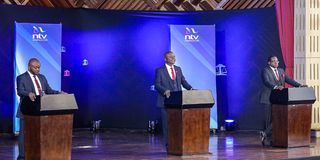
The three were speaking during a televised debate on NTV, where they tackled issues affecting the legal profession and the society.
Millions spent in campaigns
The months-long campaign has seen the contenders spend millions in a bid to woo more than 27,000 members. Kanjama said he has spent approximately Sh6 million. Wanyama, after initially hesitating, put his expenditure at about Sh12 million while Kabata said he had spent Sh5 million.
Wanyama fiercely dismissed allegations of dishing out handouts, while Kanjama was pressed to explain the source of his campaign funds.
Lawyer Peter Wanyama during LSK's presidential candidates debate at the Catholic University of Eastern Africa, Nairobi on February 16, 2026.
Photo credit: Lucy Wanjiru | Nation Media Group
“It is not true. I don’t hand over cash,” Mr Wanyama said, explaining that he only gives books “as a way of mentoring”.
Kanjama said he funds his campaign through income from the law firm where he is a managing partner, as well as donations from colleagues.
On tackling quacks infiltrating the profession, Kanjama said he would go after them head-on. Wanyama vowed to “fiercely” and “vigorously” protect the profession, while Kabata proposed embracing technology.
“We have to embrace technology so as to lock out those who are not legally mandated to practice law,” Kabata said.
Law Society of Kenya presidential debate candidate Mwaura Kabata during the debate at the Catholic University of Eastern Africa, Nairobi on February 16, 2026.
Photo credit: Lucy Wanjiru | Nation Media Group
He added that technology could help curb corruption in the Judiciary. “If we harness technology, we will remove human intervention [that abets corruption],” he said.
Wanyama proposed publishing a “list of shame” targeting judicial officers implicated in corruption, promising swift action if elected.
Corrupt judicial officers
“Corruption within the judiciary affects our bread and butter. We will fight corruption in a serious and consequential way,” Wanyama said.
“Corruption is a threat to the rule of law… We will have a list of shame for members of the executive as well,” he added.
Senior Counsel Charles Kanjama during LSK's presidential candidates debate at the Catholic University of Eastern Africa, Nairobi on February 16, 2026..
Photo credit: Lucy Wanjiru | Nation Media Group
Kanjama struck a different tone, saying: “We are going to make noise about it. It is only when you make noise and shine light on it that we can deal with it,” he said, adding that his leadership would also prioritise engagement with the Judiciary.
Wanyama has faced criticism over claims that his legal work involving high-profile political figures suggests closeness to powers that-be.
“Yes, I participated as a lawyer advising on impeachment of DP,” Mr Wanyama said. “But as a lawyer whenever you wear the views of a client, those are not your views.”
Kanjama, responding to suggestions that he is conservative, questioned whether his competitors “have the wherewithal to resist interference?”
In rebuttal, Wanyama promised to stand firm on principle, while Kabata said he would not shy away from speaking truth to power.
The next LSK President will serve a two-year term through 2028, a period that will include the 2027 General Election and potential presidential petitions. This is usually a moment when the society’s voice is often thrust into the national spotlight.
Law Society of Kenya president Faith Odhiambo follows proceedings during LSK's presidential candidates debate at the Catholic University of Eastern Africa, Nairobi on February 16, 2026.
Photo credit: Lucy Wanjiru | Nation Media Group
Kanjama said the outgoing president had elevated the society’s role, particularly during the 2024 Gen Z protests, but argued that “LSK needs to go beyond the nearly reactive approach” and adopt a more proactive stance built on partnerships.
Wanyama said his tenure would see more advisories issued to government agencies, while Kabata maintained that LSK “must be built on leadership that is proven”.
Speaking earlier, the outgoing president said she was proud of the legacy she was leaving behind even as the curtains draw on her tenure.
“I leave behind a stronger LSK that Kenyans can trust,” she said.