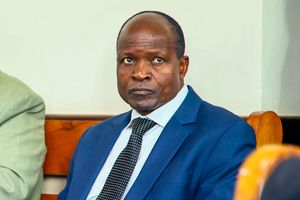
On the morning of September 5, 2018, the country woke up to the brutal killing of a 26-year-old university student, her body found dumped in a thicket in Owade village in Homa Bay County.
That discovery set off one of Kenya’s most gripping murder trials, drawing in power, love, money, politics and a chilling account of abduction and death.
Nearly eight years later, the High Court is set to deliver judgment on May 29, 2026, in the case against former Migori Governor Okoth Obado, his aide Michael Oyamo and ex-county clerk Casper Ojwang Obiero.
At the centre is Sharon Belyne Otieno , a Rongo University student who was 28 weeks pregnant when she was killed alongside her unborn child. A post-mortem revealed she had possibly been sexually assaulted and stabbed eight times in the neck, abdomen and back.
The prosecution argues the three men acted with a common intention to eliminate her and silence a protected witness to avert political embarrassment.
Ms Sharon Otieno who was killed in 2018.
Photo credit: Pool
“The evidence demonstrates planning, facilitation, execution and cover-up,” prosecutors told the court in final submissions.
They argue that Sharon’s pregnancy posed “a real and imminent threat” to Mr Obado’s public standing.
"The three accused persons jointly planned and acted in concert to execute connected and strategic roles which eventually culminated in the abduction and subsequent murder of the late Sharon Belyne Otieno (Sharon) and her unborn baby," prosecutors submitted.
Mr Obado, once a powerful county boss serving his second term at the time, admits the love affair with the slain student but denies any role in the killing.
During trial, he did not deny being the father of the unborn foetus and had promised to continue fully supporting her.
The trial, heard before Justice Cecilia Githua, has revolved around several key issues that will now determine the verdict.
First is whether the prosecution proved a joint criminal enterprise linking the three accused to the murder.
Investigators presented call data, witness testimony and circumstantial evidence to show coordination before and after the killing.
But the defence insists the case rests on suspicion, not proof beyond reasonable doubt.
“We submit that the prosecution has painted the first accused (Obado) with the colours of suspicion,” Mr Obado’s lawyers argued.
Second is the question of motive. The State maintains that Sharon intended to go public with the relationship, triggering a plan to silence her.
Evidence showed she had contacted journalists and was in communication with a key witness, who later escaped from the abductors.
She was abducted alongside a journalist, who later managed to jump out of the moving car, after leaving a hotel in Rongo. They were sandwiched between two men in the car's back seat, the court heard.
Mr Obado, however, told the court the relationship was not a secret and was known to his family and staff.
“By that time, it was no longer a secret. Social media was abuzz with the relationship,” he testified.
He said he had taken responsibility for the pregnancy and even planned to buy her land and build a house in Homa Bay.
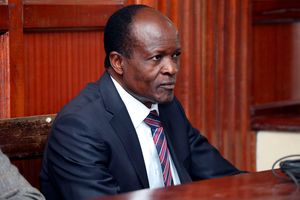
Migori Governor Okoth Obado at Milimani Law Court on July 14, 2022 during the hearing of a case he is charged alongside two others with the murder of a former Rongo University student Sharon Otieno.
Photo credit: Dennis Onsongo I Nation Media Group
Third is the reliability of the prosecution’s witnesses and exhibits. The State called 42 witnesses and produced 81 exhibits, including forensic evidence and testimonies placing the co-accused near the scene.
But the defence attacked the investigation, alleging key gaps and inconsistencies.
“There is no direct evidence on the identity of the killers,” the defence argued, adding that the actual perpetrators were never arrested.
Fourth is the role of the co-accused, Mr Oyamo and Mr Obiero. The prosecution described them as “trusted insiders” who allegedly coordinated logistics, including movements and communication.
Caspal Obiero (left) and Michael Oyamo who are suspects in the murder of Ms Sharon Otieno. They now want Justice Jessie Lessit, who is presiding over the case, to recuse herself.. PHOTO | FILE | NATION MEDIA GROUP
They were said to have been near Graca Hotel in Rongo on the night Sharon and the witness were lured into a vehicle and abducted.
The defence disputes this, claiming the evidence placing them at the scene is unreliable.
Fifth is the credibility of the surviving witness, who escaped by jumping from the abductors’ vehicle.
His account forms a crucial link in the prosecution’s narrative of abduction and execution. After jumping out of the car, he reported the incident to the police, while Sharon's body was discovered a day later with stab wounds.
Sixth is Mr Obado’s alibi. He told the court he was in Nairobi preparing for an official trip to Rwanda when the crime occurred.
The seventh issue is the broader question of whether circumstantial evidence meets the threshold for conviction.
The law allows such evidence, but only if it forms an unbroken chain pointing to the accused and excludes any other reasonable hypothesis. The court will weigh whether that threshold has been met.
Earlier, the accused faced two counts of murder for Sharon and her unborn baby, but the court found the prosecution failed to establish a prima facie case against them in relation to the second count.
The court found that the unlawful killing of an unborn child does not constitute the offence of murder.
"It is clear that Sharon’s baby was a foetus which had not proceeded from its mother’s body in a living state at the time it was killed. The baby did not, therefore, fit the definition of a person capable of being killed within the meaning of Section 203 as read with Section 214 of the Penal Code," the court said.
The case has unfolded over the years, marked by dramatic testimony and intense public interest.
Ms Sharon Otieno. PHOTO | FACEBOOK
Sharon disappeared on September 3, 2018, after being lured to a meeting at Graca Hotel in Rongo.
She was abducted alongside a journalist, and her body was found by a peasant farmer grazing his cattle near Owade River the following day, with signs of assault.
Investigations led to the arrest of Mr Obado, Mr Oyamo and Mr Obiero later that month.
They were charged with murder and initially denied bail before being released under strict conditions.
The trial began in earnest in 2019, with witnesses recounting the final hours before Sharon’s death.
In January 2025, the court ruled that the prosecution had established a prima facie case, placing the three on their defence.
Mr Obado then took the stand, admitting the affair but rejecting any link to the killing.
“I generally feel very sad. She did not have to die,” he told the court. "I congratulated her when she disclosed to me that she was pregnant."
As the judgment date approaches, the case stands as a test of Kenya’s criminal justice system.
It pits political power against forensic scrutiny, and emotion against evidence.
On May 29, the court will answer the central question that has lingered for years.
Who killed Sharon Otieno, and did the former governor play any role? The country waits.