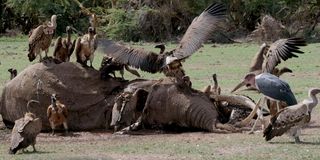
The Kenya Wildlife Service (KWS), in collaboration with the Tanzania Wildlife Management Authority (TWMA), has intensified investigations following the poisoning of six lions and 32 vultures in the Amboseli ecosystem along the Kenya–Tanzania border.
The incident occurred on January 7 in Kitenden Conservancy, at a time when human–wildlife conflict has escalated due to a severe shortage of pasture and water caused by the ongoing drought.
Kitenden Conservancy is a vital community-led conservation area that protects a crucial wildlife corridor linking Amboseli National Park in Kenya and Mount Kilimanjaro National Park in Tanzania. The corridor supports the movement of elephants, lions, giraffes and other species, while enabling local communities to sustainably benefit from eco-tourism.
The Assistant Director in charge of the Amboseli ecosystem Paul Wambi told the Daily Nation that preliminary investigations indicate the lions were poisoned after preying on three bulls in a village across the border in Tanzania.
The six lions comprised two adult males, two lionesses and two sub-adults. Authorities believe they belonged to the same pride, though identification has been hampered by the advanced state of decomposition of the carcasses at the time of discovery.
“Our veterinary doctors have established that the animals died after consuming poisoned meat from the three bulls they had earlier killed in a neighbouring village. The vultures also died after feeding on the contaminated carcasses,” Mr Wambi said.
Vultures, often referred to as nature’s cleanup crew, play a critical role in maintaining a healthy ecosystem due to their specialised scavenging function, particularly in wildlife parks.
A pride of lions at Amboseli National Park.
Mr Wambi said a cross-border multi-agency approach had been adopted, with several suspects now on the radar of law enforcement agencies.
“So far, Tanzanian herders have been restricted from grazing in the affected areas. Investigations have zeroed in on several suspects who will be apprehended in due course and arraigned in court,” he added.
He cautioned herders, who have historically coexisted with wildlife to exercise restraint especially during the ongoing drought.
“We urge our herders to remain vigilant and protect wildlife. We cannot afford to kill our pride, which remains a major pillar of our economy through tourism,” Mr Wambi said.
Human–wildlife conflict has recently escalated in Kajiado County which hosts three national parks and dozens of private wildlife sanctuaries. At least 400 elephants are reported to have strayed out of protected areas in search of food and water.
Earlier this week, lions strayed from Nairobi National Park into the neighbouring Sholinke village. They were later driven back into the park after a 24-hour operation.
In December, four people were trampled to death by elephants in Kajiado West Sub-county. The incident sparked public outrage, prompting the Kenya Wildlife Service in collaboration with the Kenya Police Service, to shoot the elephant involved.
Over the years, Kajiado County has witnessed multiple incidents of brutal lion killings. On May 13, 2023, six lions were speared to death by herders at the Big Life Foundation headquarters in Imbirikani Ranch within the Amboseli ecosystem.
A group of between 60 and 80 young morans armed with spears stormed the compound and killed the lions.
The incident came shortly after four other lions were killed in separate attacks, including Lonkiito, a 19-year-old lion believed to be the oldest in the ecosystem. Lonkiito was speared to death by herders at Olkelunyiet village after straying out of the park while attempting to prey on livestock.
The recent partial handover of Amboseli National Park to the Kajiado County government from KWS, two months ago, is expected to help reduce human–wildlife conflict through improved local engagement and management.