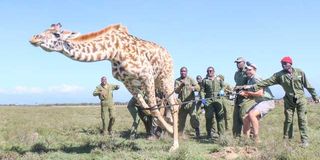
The Kenya Wildlife Service (KWS) has begun translocating wild animals from Kedong Ranch in Naivasha, Nakuru County, citing risks from poaching and uncontrolled land use.
KWS officials said the animals are being moved to Nairobi National Park and other conservation reserves as land division at the ranch is disrupting migration corridors.
Kedong Ranch, which stretches from Mt Longonot and Hell’s Gate national parks towards Suswa in Narok and Kajiado counties, is private property and has not been registered as a wildlife conservancy.
The operation, conducted in partnership with The Safari Collection, follows high-level stakeholder meetings over the fast pace of land sales in the ranch.
Kenya Wildlife Service (KWS) rangers restrain a Masai Giraffe during a mass capture and relocation of wildlife from the expansive Kedong Ranch in Naivasha in Nakuru County on November 10, 2025.
Photo credit: Boniface Mwangi| Nation Media Group
The animals being moved include giraffes, zebras, gazelles, elands and wildebeests.
Dr Dominic Mijele, a KWS veterinary officer, said the translocation would help protect animals from poachers and reduce human-wildlife conflicts.
“Most of the ranch has been sub-divided and sold, affecting wildlife habitats. Animals are displaced, water sources are scarce and human activity has increased insecurity,” he said.
The exercise began a month ago, with more than 200 zebras, 10 giraffes, 40 wildebeests, 20 elands and 100 gazelles moved so far.
The phased approach allows animals to return to thickets before the next move. KWS plans to relocate more than 1,000 animals in the exercise that continues into 2026.
For decades, Kedong Ranch has been an important corridor for wildlife moving between Mt Longonot and Hell’s Gate national parks, also connecting to Lake Naivasha for water and pasture.
KWS assessments indicate species risk becoming homeless without intervention, which would also affect predators like lions, leopards and cheetahs.
The Giraffe Conservation Foundation, with support from The Safari Collection, is fitting giraffes with Global Positioning System collars to monitor their movements and identify habitats for future protection.
“Without such intervention, Kenya risks losing entire wildlife populations,” Dr Mijele told the Daily Nation.