A parliamentary committee has lined up at least six questions it wants the Independent Electoral and Boundaries Commission (IEBC) to address as the agency prepares for the 2027 General Election.
The National Assembly’s Constitutional Implementation Oversight Committee (CIOC) has scheduled a meeting with the newly appointed IEBC commissioners in the last week of this month.
The committee chairperson, Caroli Omondi, said the engagement is part of its mandate to review constitutional implementation and to avoid last-minute lapses in election preparedness.
“We want IEBC to conduct credible elections, and this meeting is a step towards that. We would have met earlier, but a leadership retreat intervened. We have now set the last week of this month,” Mr Omondi told the Daily Nation .
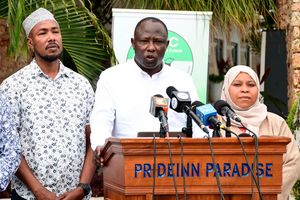
Independent Electoral and Boundaries Commission chairperson Erastus Ethekon (centre), flanked by fellow commissioners, addresses the media at Pride Inn Paradise in Shanzu, Mombasa County on July 19, 2025.
Photo credit: Wachira Mwangi | Nation Media Group
Top on the MPs’ list is how IEBC plans to navigate the pending boundary delimitation exercise, which was not undertaken as required by law. Mr Omondi warned that failure to complete the process could expose the commission to legal challenges over the 2027 election results.
During their induction in Mombasa last month, IEBC acknowledged delays in the exercise, which should have been concluded by March 2024.
Chairperson Erastus Ethekon said the commission has sought the Supreme Court’s advisory opinion after consultations with the Attorney General and pledged to engage stakeholders once a ruling is delivered.
MPs also want clarity on the timelines for mass voter registration and the clean-up of the voter register, both of which were suspended after the 2022 polls due to the lack of commissioners.
“This is a critical process that many young people are waiting for. The commission needs to give a definite date,” Mr Omondi said.
At the Mombasa retreat, Mr Ethekon announced voter registration would resume on August 5, following growing pressure from youth and political leaders. “A credible voter register is the foundation of free and fair elections,” he said.
Perhaps the toughest question for the new commissioners is how they intend to comply with the Supreme Court’s damning verdict that nullified the 2017 presidential election.
The court cited failures in results transmission and irregularities in forms used to declare results, faulting IEBC for conducting a process that fell short of constitutional standards. It warned that future elections would face the same fate unless the systemic issues were addressed.
“The election was nullified not because of numbers but because of the process. The courts have spoken clearly on what a verifiable election must look like,” he said.
The committee is also concerned about the perception that the new commissioners were politically favoured. Mr Omondi said IEBC must take deliberate steps to win back public confidence.
During their vetting in May, Parliament received three sworn affidavits challenging the suitability of some nominees, including Mr Ethekon, whose close ties with State House Deputy Chief of Staff Josephat Nanok raised concerns, whom he served as county attorney while the latter was Turkana governor.
Objections were also raised against Mary Karen Sorobit, a former Jubilee Party official, and Hassan Noor Hassan, whose name appeared on the shortlist through an addendum rather than the official process.
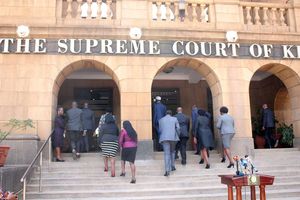
Mary Karen Sorobit takes an oath during the swearing-in of the new IEBC Commissioners at the Supreme Court in Nairobi on July 11, 2025.
Photo credit: Bonface Bogita| Nation Media Group
Despite the petitions, Parliament dismissed the objections and approved the seven nominees, noting they met constitutional requirements on regional balance, gender, technical expertise, and electoral management experience.
Another major question is the commission’s budgetary requirements. Earlier this year, Deputy Commission Secretary for Support Services Obadiah Keitany told MPs that IEBC needs Sh61.7 billion for the 2027 elections.
The plan is to spread funding over three financial years—Sh15.3 billion in 2025/26 for pre-election activities, Sh25.4 billion in 2026/27, and Sh21 billion in 2027/28.
The commission also projects to register 5.7 million new voters, mainly youth, and expand polling stations from 46,229 in 2022 to 55,393. It plans to procure new Kenya Integrated Election Management System (KIEMS) kits worth Sh7 billion, replacing the 45,352 bought in 2017. Only the 14,000 kits acquired in 2022 will be retained.
“The older kits have been used for 10 years. They can be repurposed for use in other government institutions. Technology has changed, and we must adapt,” Mr Keitany said.
Technology has been central to Kenya’s elections since 2013, when it was first deployed to address the flaws that contributed to the 2007/08 post-election violence. The Elections Act requires IEBC to procure technology at least 120 days before the polls and test it 60 days ahead.