The government says the contested Ebola patients hospital at Laikipia Airbase is not a quarantine centre for Americans only but one of 23 treatment and isolation units planned under a Sh2.68 billion preparedness programme.
Health Cabinet Secretary Aden Duale has asked the High Court to dismiss petitions challenging the facility, arguing that the petitioners are misinformed about the nature of the US-backed project.
He says the hospital is part of the government's implementation of a nationwide Ebola preparedness strategy designed to protect the country from a growing regional outbreak.
In a detailed affidavit filed in court, Mr Duale says the project forms part of a broader public health response triggered by an Ebola outbreak in eastern Democratic Republic of Congo that has spread into Uganda and placed Kenya on high alert.
He argues that the petitions filed by Katiba Institute and the Law Society of Kenya are based on misinformation and wrongly portray the facility as a special quarantine centre for American nationals.
“The proposed facility at Laikipia Air Base is one of 23 facilities identified for preparedness and response,” Mr Duale states.
“It is not intended exclusively for foreign nationals but forms part of Kenya's national public health preparedness and response framework.”
The affidavit marks the government's most comprehensive defence of a project that has sparked protests in Nairobi and Laikipia. The project also triggered a legal, political and public debate over transparency, public participation and Kenya's ability to manage a highly infectious disease.
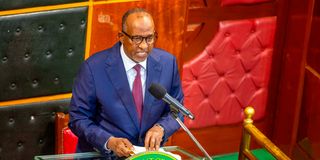
Cabinet Secretary for Health, Aden Duale addresses the media at Afya House in Nairobi on May 22, 2026.
Photo credit: Wilfred Nyangaresi | Nation Media Group
The petitioners contend that the arrangement was negotiated without public participation, parliamentary oversight and adequate biosafety safeguards.
They also question whether Kenya possesses the infrastructure needed to safely handle Ebola patients and prevent transmission.
However, the government says Kenya faces a genuine public health threat that requires urgent preparation.
Attached to the affidavit is Kenya's Ebola Virus Disease Preparedness and Response Plan, a May 2026 blueprint prepared by the Kenya National Public Health Institute to guide the country's response to the outbreak.
The plan classifies the country as facing a high risk of Ebola importation because of extensive movement of people and goods between the Democratic Republic of Congo, Uganda and Kenya.
According to the document, about 2,000 pedestrians and 1,000 commercial vehicles cross through Busia and Malaba daily, while regular flights connect Kampala and Nairobi.
“The Northern Corridor connects Mungwalu and Kampala directly to Malaba, Busia, Nakuru and Nairobi,” the preparedness plan states.
The government says the current outbreak is caused by the Bundibugyo strain of Ebola, for which no approved vaccine or specific treatment exists.
The preparedness plan notes that available vaccines and therapies developed for the Zaire strain do not work against the Bundibugyo variant.
As a result, authorities say early detection, isolation, contact tracing and infection prevention are the primary tools available to stop transmission.
Mr Duale says the government activated a national Ebola Incident Management System on May 20 and established a command structure involving surveillance teams, laboratories, rapid response units and emergency operations centres.
He says response teams have been placed on standby and high-risk counties identified for intensified preparedness measures.
Health workers dress up in personal protective equipment at the Evangelical Medical Center (CEM), one of the facilities at the forefront of the response to the Ebola outbreak, in Bunia, Ituri province, Democratic Republic of Congo, May 31, 2026.
Photo credit: Reuters
The plan requires contact tracing to begin within 12 hours of identifying a suspected case and mandates immediate isolation of anyone meeting Ebola case definitions.
Health workers are required to report suspected cases within hours and follow strict protocols on sample collection, transport and patient handling.
The government says Kenya has strengthened laboratory capacity through the National Public Health Virology Reference Laboratory and KEMRI facilities.
The preparedness plan states that Ebola test results can be released within four hours, while genomic sequencing can confirm whether samples contain the Bundibugyo strain.
Mr Duale argues that the court should lift the conservatory orders issued earlier and allow implementation of preparedness measures to continue.
He says the programme is consistent with Kenya's obligations under international health regulations and World Health Organisation guidance.
“The measures being undertaken are preventive and protective in nature and are intended to safeguard public health,” he says.
The State further argues that delaying preparedness efforts could expose Kenya to greater risk given the continuing outbreak in neighbouring countries.
The case has attracted significant public attention and now includes the Law Society of Kenya, Katiba Institute, the Kenya National Commission on Human Rights and the County Government of Laikipia.
The court previously ordered the government to disclose details of the arrangement and extended orders suspending implementation of the facility. The case is set or mention on June 23.
The court is expected to determine whether the government's public health obligations outweigh public concerns over transparency, public participation and constitutional oversight in responding to a regional disease threat.