A Court of Appeal judgment requiring rogue public officers to personally pay compensation awarded to victims, instead of leaving taxpayers to shoulder the burden, tightens accountability as more cases alleging State excesses reach the courts.
The Court of Appeal upheld a High Court ruling exposing rogue public officers to personal financial liability, dismissing former Rongai District Commissioner Joseph Mosigisi’s bid to block execution of a Sh4.8 million judgment against him.
Mr Mosigisi had argued, with the backing of the Attorney-General, that the Government should pay compensation awarded to six petitioners over a malicious prosecution linked to a political witch-hunt. Justice Joel Ngugi (now a Court of Appeal judge) rejected the claim to immunity by virtue of public office, a decision now upheld by the appellate court.
High Court Judge Justice Joel Ngugi. PHOTO | FILE | NATION MEDIA GROUP
Justice Ngugi said the case was intended to remind public servants that “political power and public office are transient”, a principle expected to have far-reaching implications.
Against the backdrop of rising cases of extrajudicial killings, abductions and enforced disappearances, human rights activists have argued that rogue police officers and other State officials should personally bear the consequences of constitutional violations instead of leaving taxpayers to pay compensation.
Justice John Mativo.
Photo credit: File | Nation Media Group
“Police officers and those responsible must be held accountable,” Human Rights activist Hussein Khalid of Vocal Africa said this week while announcing plans to pursue claims on behalf of victims of unlawful arrests and torture.
“Nobody deserves to be injured in pursuit of their constitutional and democratic rights to protest, picket and petition,” he added, referring to the alleged arbitrary arrest, detention and torture of demonstrators during the second anniversary of the 2024 Gen Z protests.
The appellate ruling reinforces the principle that public officials who act maliciously or outside the lawful scope of their office may be held personally liable for their actions. It also adds a new dimension to compensation claims arising from deaths and injuries during anti-government demonstrations, which critics say amount to an acknowledgement of atrocities committed by rogue police officers.
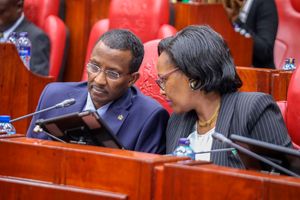
Justice Warsame Abdulahi Mohammed.
Photo credit: Billy Ogada | Nation
The three-judge bench of Justices Mohammed Warsame (now a Supreme Court judge), John Mativo and Mwaniki Gachoka rejected the appeal challenging a High Court finding that public officers acting outside the lawful scope of their office lose the legal protection ordinarily attached to public service.
The judges dismissed Mr Mosigisi’s appeal against Justice Ngugi’s November 2020 ruling declining his bid to transfer liability to the Government.
In the contested High Court ruling, Justice Ngugi held that public servants who maliciously abuse State power cannot automatically shift the financial consequences of their actions to taxpayers.
“Such an official is, in the famous torts-speak, on a frolic of his own. On such a frolic, he should expect consequences of his actions; consequences which are not inoculated by either the Constitution or statutory law,” Justice Ngugi said.
The judge said the ruling was intended to remind public servants that the authority vested in them must be exercised in accordance with the Constitution, the law and their oath of office.
“In announcing and applying this rule of law to the case at bar, the Court was reminding all public servants that their offices are clothed with public power to be exercised in accordance with the Constitution, the law and their oath of office,” he stated.
“Public officers should not excitedly and maliciously exercise power at the behest of the politically powerful to harm those perceived to be on the wrong side of the political divide at the given political moment,” the judge cautioned.
“The rule of law this court announced and applied was to remind public servants that political power and public office are transient. They pass. But the Rule of Law is, by our Constitution, enduring. The arc of history might be long, but it unfailingly arcs towards justice.”
The appeal arose after Mr Mosigisi challenged a November 2020 ruling rejecting his attempt to transfer liability to the Government after six Nakuru residents successfully sued him over malicious prosecution. He also sought a stay of execution and suspension of warrants issued for the attachment and sale of his movable property.
Kimunai Ole Kimeiwa, Dan Ashitiva, Sylvester Kibet, Musa Chemitei, Amos Kibet and Francis Mungai were arrested between December 7 and 15, 2011, and charged with hindering the burial of a body at Banita Farm in Rongai.
They said they had been used as “sacrificial lambs” in a political dispute involving then Rongai MP Luka Kigen, who they said had differences with Mr Mosigisi. They alleged the former District Commissioner wanted them to falsely implicate Mr Kigen in the alleged exhumation and charged them after they refused.
They were acquitted on October 31, 2013, after the trial court found the prosecution had failed to establish a prima facie case.
The six later petitioned the High Court, arguing that the prosecution was malicious and violated their constitutional rights. In a judgment delivered on February 16, 2018, Justice Ngugi awarded each petitioner Sh800,000 in damages, plus costs and interest, but declined to declare Mr Mosigisi unfit to hold public office for lack of sufficient evidence.
After the petitioners moved to execute the decree against his personal assets, Mr Mosigisi, with the support of the Attorney-General, argued that the Government should satisfy the judgment because the acts complained of arose while he was serving as a public officer.
The Attorney-General framed the issue as “whether execution of judgment against the applicant in his personal capacity is lawful and justified”.
“Personal liability should not attach to State officers sued in their official capacity,” the Attorney-General argued.
“The intended execution, warrant of attachment and sale of applicant’s property in satisfaction of the Court’s judgment and decree is premature, unwarranted, illegal and unlawful. It is a classic case of abuse of the court process intended to intimidate a former State officer who has since retired from the public service,” the Attorney-General submitted.
Justice Ngugi rejected the application on November 12, 2020, holding that the issue of personal liability had already been conclusively determined and could not be reopened. He said the proper remedy was an appeal, not a fresh application before the same court.
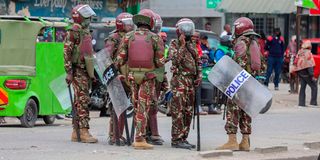
Police officers arrest protesters outside Parliament Buildings in Nairobi on June 25, 2026, during demonstrations marking the second anniversary of the 2024 anti-Finance Bill protests.
Photo credit: Bonface Bogita | Nation Media Group
“It is, with respect, too late in the day to seize the same arguments dismissed during trial and weaponise them in resistance to the execution of the unchallenged judgment,” the judge said.
He held that it was lawful to sue Mr Mosigisi in his personal capacity and found him personally liable for his actions against the respondents.
The Court of Appeal agreed that the High Court became functus officio after conclusively determining the issue of personal liability in its 2018 judgment and that Mr Mosigisi’s later application improperly invited the judge to sit on appeal over his own decision.
“We find no basis at all to fault the learned Judge. Accordingly, it is our finding that this appeal is devoid of merit,” the judges said in the judgment delivered in March this year.
The court dismissed the appeal with costs to the six petitioners, leaving intact the precedent that public officers who abuse public power may be held personally accountable for the consequences of their actions.