Marsden Madoka was the powerful Internal Security and Provincial Administration Minister in Daniel Arap Moi’s administration when terror struck at the heart of Nairobi after the US embassy was bombed in 1998. In this second installment of a three-part exclusive serialization of ‘At the Ready’, he goes behind the scenes to reveal the inner workings of the security and political system during the country’s worst crisis.
On August 7, 1998, our way of life, our very freedom, peace and tranquillity came under attack in a deadly terrorist attack on the US Embassy in Nairobi. Then the embassy was located at the roundabout of Haile Selassie and Moi avenues. At the very spot stands a memorial park today that draws a number of visitors, Kenyans and foreigners.
As the Minister for Internal Security and Provincial Administration, I was engulfed in grief but turned the hopelessness into resoluteness after I received news of the bombing. The blast that turned the city upside down had found me in Taita. I had left Nairobi by road a few days earlier accompanied by two aides; my driver and bodyguard, Chief Inspector Dickson Mjomba, to go to my constituency to inspect development projects and preside over the graduation ceremony at St Mary’s Teachers Training College, Bura. Before leaving, I went to State House to inform the President of my itinerary.
“It’s okay, Meja,” he said and wished me well. The State House visit was routine because I used to see him nearly every morning to brief him on the security situation in the country.
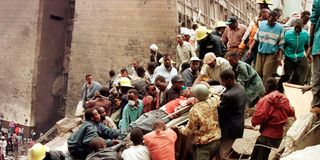
In this photo taken on August 8, 1998 firefighters and members of the public retrieve bodies after a bomb exploded near the US embassy and a bank in Nairobi, killing at least 60 people.
Photo credit: File | Nation Media Group
It was the third day of my stay in Taita when I received a call from the Commissioner of Police, Duncan Wachira, shortly after the blast had happened, around 10.30am. He told me, “Mheshimiwa Waziri, kuna bomu imelipuka US Embassy unahitajika Nairobi kwa haraka.” (Honourable Minister, the US Embassy Nairobi has been bombed; you are urgently required in Nairobi”).
He told me the US Embassy and the neighbouring Ufundi Sacco Building had been flattened and that the multi-storey Co-operative House building, also known as ‘Bell Bottom’ because of its shape, was extensively damaged and scarred with pieces of glass and documents from ripped offices flying into the air.
The US Ambassador to Nairobi, Prudence Bushnell, and my Cabinet colleague, Joseph Kamotho, who were in a meeting with officials in a neighbouring building, were also injured. I was jolted. Later, a police helicopter picked me up from where I was as I made frantic efforts to contact the Army and the Directorate of Security Intelligence (DSI), now National Intelligence Service (NIS), to know what steps were being taken. I learnt that the US Ambassador, who was in Pioneer House, was evacuated out of the building assisted by the US Commercial Officer Riz Khaliq, Foreign Service National, George Mimba and Foreign Service Officer, Steve Nolan, while Mr Kamotho was in the hands of bodyguards.
Marsden Madoka with President Daniel Arap Moi in State House, Nairobi.
Photo credit: File | Nation Media Group
Throughout the ride, I was unsettled with so much going through my mind. I knew I was in the eye of a storm. I thought about the victims and the terrorists, wondering how they escaped our intelligence radar. I was also thinking about President Moi and my Cabinet colleagues and what to tell them when we meet. After about an hour, we landed at the Forces Memorial Hospital along Mbagathi Road (now Raila Odinga Road). I opted to go straight to my home in Karen to get rid of the Taita dust and the casual clothes to be ready for the emergency Cabinet meeting at State House that was a few minutes away.
By this time, I was aware the President had gone to the scene of the blast accompanied by, among others, Kajiado North MP and former Vice President Prof George Saitoti, Kitui Central MP Charity Ngilu, Lang’ata MP Raila Odinga, Keiyo South MP Nicholas Biwott, Westlands MP, Fred Gumo, Prof Sam Ongeri, and Nairobi Provincial Commissioner Joseph Kaguthi.
I was among the last to arrive at State House for the special Cabinet meeting. President Moi had managed to get all Cabinet members, including Amos Wako, the Attorney General. The Head of Directorate of Security Intelligence (DSI), Brigadier Wilson Boinett and the Chief of the Defence Staff, General Daudi Tonje, were present. The meeting was called to order and prayers were said. He often led prayers in the Cabinet. President Moi was well informed by the time he entered the meeting room. Brigadier Boinett gave a blow-by-blow account of the tragedy. He informed us that a similar explosion had happened at the US Embassy in Dar es Salaam in Tanzania, about 670 kilometres from Nairobi, confirming that the attacks were coordinated and had nothing to do with Kenya. He said the search for the terrorists who fled the scene and members of the cell in Kenya had been intensified and crucial information would be made available fast.
In subsequent meetings, we learnt from Boinett that the attack involved a two-convoy vehicle carrying explosives from a house in Runda where they were assembled. The first was driven by a Comoros Island native Fazul Abdullah Mohammed, 23, and close behind him was a Toyota Dyna truck driven by Jihad Mohammed Ali (or simply Azzam), 24, a Saudi Arabian citizen, carrying a two-tonne TNT ammonium nitrate and other explosives packed into several cylinders neatly placed inside wooden crates.
The attacks, Brigadier Boinett explained, were linked to the terrorist group Al-Qaeda led by Osama bin Laden, an Islamic jihadist of Saudi Arabian descent believed to be living in Khartoum, Sudan or the remote hills of Afghanistan,
This was the worst terrorist incident on African soil. Not less than 212 people were killed and an estimated 4,500 wounded in Nairobi, while 11 people were killed and more than 85 injured in Dar es Salaam. Of those killed, 56 were US government workers and family members.
Like his predecessor Mr Kanyotu, Kenya’s longest-serving spymaster, Brigadier Boinett was highly trusted by the President. I also knew him as a highly knowledgeable spy who was well-informed of local and international affairs. I once visited Mr Kanyotu's house in Tigoni, Kiambu County, where I found several television sets tuned to all international media channels with officers stationed to monitor news. As Kenya's spy chief, Boinett knew what he was talking about. He spoke with authority and insight. Generally, there was no panic. The Cabinet largely focused on what had happened and how to assist victims as we awaited further reports on what was happening. The meeting agreed to put rescue efforts under the Army. Major General George Nadida Agoi was appointed to oversee the multi-agency rescue operation, assisted by Air Force Brigadier Samuel Thuita.
Marsden Madoka who once served as the Minister for Internal Security and Provincial Administration under Daniel Arap Moi’s administration.
Photo credit: File | Nation Media Group
Cabinet meetings were regularly called where regular briefings were provided by security chiefs. After the first meeting, I went straight to the bomb blast scene to join rescue efforts. Crowds of Kenyans had responded, crawling and sifting through the rubble of what was once Ufundi House with bare hands to evacuate victims trapped and crying for help. In some instances, the debris was repurposed as shovels and prybars. Pick axes, backhoes and ropes were also used to clear the rubble.
However, in terms of command of structure and protocol, there were a few challenges on the Kenyan side. Dr Bonaya Godana, who was Minister for Foreign Affairs, really wanted to run the show. I retreated to let him address his press conferences and held separate press briefings with Major General Agoi and Kenya Red Cross spokesperson, Nina Galbe, to give updates and field questions from local and international media. It is possible Dr Godana was doing this because of the need to continually engage the US government and the desire to protect Kenya’s image as a safe tourist destination and headquarters of the United Nations Environment Programme (UNEP). Soon after, Presidents Moi and Benjamin Mkapa of Tanzania met in Nairobi on August 13, 1998 to speak on terrorism following the twin bombings on Nairobi and Dar es Salaam US Embassies and had a public handshake to signify unity in the matter.
Besides supervising rescue efforts at the bomb blast site, I also made several visits to Kenyatta National Hospital, Nairobi Hospital, Aga Khan Hospital, Mater Hospital, MP Shah Hospital and Guru Nanak Hospital to ensure those who had been hurt were attended to. Indeed, the six city hospitals were overwhelmed as victims kept pouring into the facilities every minute. The government footed medical bills for all victims of the bombing.
At the Security Ministry, we remained united throughout the period. My assistant Minister, then Eldoret North MP, William Ruto and Permanent Secretary, Zackayo Cheruiyot, were of great support.