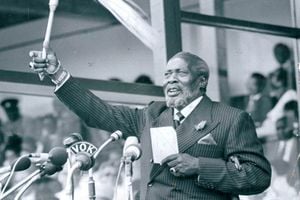
At just 22 years, Marsden Madoka, a rising star in the army, was thrust into the corridors of power after he was unexpectedly picked as President Jomo Kenyatta’s aide-de-camp in 1966. It was a role that not only turned him into a circumstantial insider and witness to significant moments in the post-independence Kenya but also unwittingly gave him a wife. He would later abruptly exit the military at the peak of his career to, over the years, become a corporate executive, MP, powerful minister in the Foreign Affairs and Internal Security dockets and board chairman of the Kenya Revenue Authority and Kenya Ports Authority among others. Here is the first instalment of the Nation’s three-part exclusive serialisation of 'At the Ready', his upcoming memoir that will be launched tomorrow.
As a young military officer, I wanted to go to the Royal Military Academy Sandhurst, a world-leading military academy in the United Kingdom, for the 44-week high-level cadet commissioning course, but the Army Commander then, Brigadier A.J. Hardy, asked me to wait for one year to make the cut.
That is how I ended up at Mon’s Officer Cadet School in Aldershot, UK.
When I returned from Mon’s, I reminded Brigadier Hardy of his promise to recommend me for training at Sandhurst He said, “Don’t worry, I will take you to the Defence College of Intelligence, UK. There was no specific training school for military intelligence in Kenya. Kenya’s Military Intelligence School, renamed Defence Intelligence Academy, was established in 1983. However, I had to do fieldwork first. I went to Mandera to fight the shifta, becoming a Battalion Intelligence Officer.
After my return from the field, Brigadier Hardy summoned me to his office, where he informed me that Kenya’s first President, Mzee Jomo Kenyatta, was scouting for an Aide-de-camp (ADC), and he wanted to send me to attend the interviews as a formality. I protested because we had a gentleman’s pact that he would take me to Sandhurst for further military training.
Aide-de-camp is a French word meaning “helper in the military camp.” An aide-de-camp is not a personal assistant or bodyguard but a military assistant to the President. He or she is a military officer who stands behind the President during official functions.
Then Kenya Ports Authority chairman Marsden Madoka during a Nairobi business associates luncheon at the Villa Rosa Kempinski on September 15, 2016.
Photo credit: File | Nation Media Group
In Napoleon Bonaparte’s army, ADCs acted as both his “eyes” and as readers of his mind to subordinate commanders and, on some occasions, exercised delegated authority. Therefore, the person serving in that position must be a highly-trained senior military officer of good standing because they form part of a president’s itinerary at all times and have special access to State secrets. Usually, visiting Heads of State or monarchs are also assigned an ADC.
In our discussion with Brigadier Hardy, I realised he was also not keen on having me serve as ADC. This is because prior to this request from President Kenyatta, the Kenya Army Commander used to select ADCs. However, the situation at hand was occasioned by the misbehaviour and subsequent dismissal from the military of Captain Reuben Muiu, the immediate former ADC of the president.
Eight officers who Brigadier Hardy sent for interviews had failed. President Kenyatta told him he hadn’t seen anyone he liked. I went for the interviews at State House, Nairobi, with Major Joseph Mbyati Musomba (later Major General), whom the Army Commander fronted and hoped would be picked to serve as ADC. When we arrived, we found Mzee Jomo Kenyatta with his Attorney General, Charles Njonjo. Mzee assessed me and said, Huyu ndio mtu wangu . (This is my person of choice).
However, something interesting happened that has remained in my memory to date. Towards the end of the interview, Njonjo gave me a passage in the newspaper to read aloud. After I read, Njonjo turned to the President and said: “That is English.”
After that, Brigadier Hardy told me, “Sorry, Marsden, your luck is not there,” referring to my desire to pursue further military training at Sandhurst.
I returned to the barracks and was immediately promoted to Captain at 22, making me the youngest holder of that rank in Kenya’s military history. The new status came with a good salary and made me the envy of many. Prior to my appointment as Aide-de-camp, President Jomo Kenyatta had been served by four other ADCs. The first ADC was 2nd Lieutenant Joseph Owino, who he had inherited from the last colonial governor, Malcolm McDonald.
He was followed by Captain Cromwell Oliver Mkungusi, Lieutenant Bernard Kiilu and then Captain Reuben Muiu. Captain Mkungusi was replaced after serving for six months as Aide-de-Camp to President Jomo Kenyatta. Mkungusi came from Kigombo near Voi and would, in later years, participate in my wedding as best man and eventually became a Brigadier. While serving as a Military Intelligence Officer, he survived a death trap laid for him at Westlands Roundabout, Nairobi, during the 1982 coup attempt.
I reported to work in March 1966 and was immediately allocated a three-bedroom house within State House. This was prestigious since Africans my age serving in the military had smaller houses. My father, still working in the military, had a house at what is now a bus park at Kenyatta National Hospital (KNH), having just been transferred to Nairobi from Nanyuki.
It was a big wooden house on stilts. I was young and dashy and had a man who would come to clean my house. I even purchased a 1962 Singer Vogue car to move around when off duty. My free time was spent playing at a Billiards table in State House. The job was quite involving. Besides the ceremonial tasks of standing behind the president and opening car and office doors for him, I managed Mzee Kenyatta’s diary and coordinated his movements with his security team. In this role, I met Heads of State and dignitaries and got to know the Kenyatta family well. I cordially worked with the First Lady, Mama Ngina Kenyatta.
One of the best things that came with the job was my interactions with members of the first Cabinet, senior government officials and State guests. For example, whenever the then Vice President, Jaramogi Oginga Odinga came to State House, he would always pass by my office, which was located next to the President’s to greet me. He would say, Habari ya ADC? (How are you doing ADC?). ADC’s role was rotational. After six months, I was ready to leave. Brigadier Hardy was pushing me to leave because, up to that time, there were no graduate military officers. A-level officers were only three; the rest were O-level certificate holders, so he needed to prepare me for future military leadership. And why not?
Since the six-month period had lapsed, I went to Mzee Jomo Kenyatta and told him my time to leave had come. He asked, Unasema nini? (What are you saying?) Kenyatta had a commanding tone. I froze. When the Army Commander, Brigadier Hardy, came to ask for my release, Kenyatta asked him: “Am I the Commander-In-Chief? My ADC is not going anywhere, and Yes, I want him promoted.”
I had not asked President Kenyatta for promotion. It also appears he did not know the ranks in the military and how the promotions were done. The Deputy Army Commander was a full Colonel. He wanted me to be given medals to become a “commander.”
Six-month period of extended service
At the time, the Head of Presidential Escort had two medals. As he walked out of President Kenyatta’s office, Brigadier Hardy told me, “Don’t you think I will ever make you a colonel at 23?” He later explained his discomfort to the President.
Mzee later summoned me and said, Hutaenda, unakaa na Army Commander ameniambia kwanini hutapewa cheo . (You will not leave, you will stay, and Army Commander has explained to me why you will not be promoted).
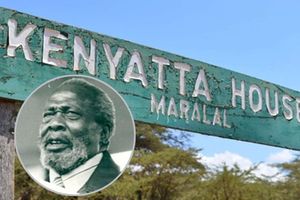
That is how I served as ADC for an additional six months. As ADC, I would see the Controller of State House, Eliud Mathu, at his office every morning to get a brief on the President’s diary. I would, thereafter, be on standby, waiting for the President to arrive from his Gatundu home in Kiambu. During his presidency, Mzee Jomo Kenyatta never slept in State House, Nairobi. He constantly commuted to and from his rural home.
Immediately Mzee Jomo Kenyatta arrived in State House, I met him at the main gate, saluted him and took him through the day’s events in his office. I then ushered visitors in the order of their arrival. The order would occasionally change if a more important person had come or if he needed someone urgently.
President Kenyatta’s lunches were organised around themes or programmes. Among others, he had a day for bankers, chief executive officers of state corporations, chief executives of private enterprises, top brass of the provincial administration and parliamentary leadership. I would personally have lunch at State House or my mother’s house in KNH. After lunch, Mzee would rest a bit and at 2.30 pm, he would start listening to Parliament. He was very keen on what was happening within the political space, perhaps because of the rich spectrum of parliamentary debate and competition of ideas among the political class.
Then Kanu national chairman Uhuru Kenyatta and his vice chairman Marsden Madoka sing during the party's National Delegates Conference at Kasarani Sports complex in Nairobi.
Photo credit: File | Nation Media Group
If bored, he buzzed me and said, ADC, nataka Kwenda nyumbani (Marsden, I want to go home). I then arranged his team, and off he left for Gatundu. I would then go to the State House Controller to review how the day went and plan for the following day. President Kenyatta was an interesting man and very sociable.
He once confided in me that he would remove Jaramogi and his friends, such as Bildad Kaggia and Achieng Oneko, saying, Wanasumbua sana . It appears something was bothering him and he wanted to deal with it. Mzee Kenyatta was also a man of routine. Due to health reasons, he always found ways of avoiding the cold season in Nairobi, which usually runs from mid June to August every year. Therefore, the cold season would find him in State House, Nakuru, and from there, he would head straight to Mombasa to open the Agricultural Society of Kenya (ASK) Show.
All his travels were by road. On our trips to the Coast, Mzee’s ceremonial motorcade would be transported by train to await us at Mariakani for a majestic entry into Mombasa. In one such trip, we left Gatundu early morning by road and just after we had passed Voi, the President asked me to instruct the motorcade to stop to allow him to empty his bowels. As he got out of his presidential limousine to pee, he told me: ADC, sikutaka kuharibia watu shamba lakini nimeshindwa kuvumilia . (ADC, I didn’t want to pee on people’s land, but I am unable to hold any longer). He was trying to be humorous.
Then, the six-month period of extended service lapsed. I went to inform the President that I wanted to leave. He said, Hapana! (No!). By then, changes had taken place in the military and Brigadier Joseph Ndolo, the commander of the Kenya Army had become the first African Chief of General Staff. He called for officers to interview as ADC, and the President, Mzee Kenyatta, asked if I could help him identify a suitable candidate.
Lieutenant Stephen Kimnyamis Kipsaita (later Major-General) was eventually picked as my replacement. The President then called me to ask if he had made the right choice and I said, “Yes” Eliud Mathu, the State House Controller, gave me a special letter of commendation, thanking me for my excellent service. President Kenyatta also gave me Ksh500, a lot of money then, as a sign of appreciation.
I consider myself a man who obtained favour from God. He gave me a good wife, a gift I have treasured from the first time I set my eyes on her. In our journey, we have experienced the oneness that He intended when we took our marriage vows. However, this story has a beginning, an attraction and a deeper understanding of each other that has enabled us to enjoy the gift of love and overcome challenges that came our way.
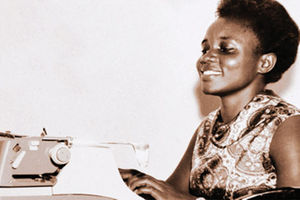
After I was hired in 1966 as Aide-de-Camp to President Jomo Kenyatta, Kenya’s first Prime Minister and Head of State, I was assigned a house and an office. In the course of my duties, I ran into and often interacted with the then Social Secretary, Elizabeth Mumbi. She was tall, charming in her smile with an artful appearance and polite in her mannerisms.
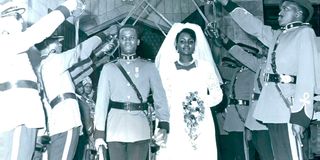
Major Marsden Madoka of the Kenya Army and Miss Elizabeth Mumbi on their wedding day.
Photo credit: File | Nation Media Group
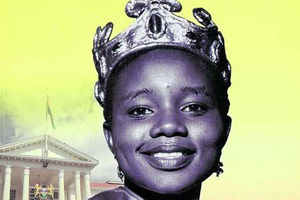
I had first seen her in a Nation newspaper front page article and photo published on Sunday, December 15, 1963, the day after she won the Miss Uhuru beauty contest at Donholm Road Stadium (now City Stadium), Nairobi I had visited my father at the Nanyuki Barracks and when the newspapers were brought home, the photo caught my attention and I immediately told myself the lady was worth marrying. I was also in love with her name.
The crown placed on her head during the beauty contest reminded me of her namesake, Queen Elizabeth of England, a global figure admired by many. I had also read somewhere that the Biblical meaning of the name Elizabeth is “God’s promise” or “God is my oath”. Was she God’s promise to me? It’s a question I sought to answer later.
Jomo Kenyatta, Mama Ngina Kenyatta, Pamela Mboya, Clement Lubembe, a trade unionist, Mohammed Amin, a renowned photographer and David Dunford, a public relations officer, were present at that event. Later, other articles featuring her were published following her Air-India sponsored trip to capitals in the Far East – Bombay in India, Bangkok in Thailand, the City of Victoria in Hong Kong and Tokyo and Osaka in Japan, as well as her presence at Governor-General Malcolm Macdonald’s evening cocktail party at The Stanley Hotel, a high-end facility at the junction of present-day Kenyatta Avenue and Kimathi Street.
Our first meeting was when I went to the State House for an interview for the ADC position. A colleague in the army gave me a letter to pass to her. I did and walked away without saying much. We lived within State House and got to know each other. In our free time, we would watch television together, play billiards or go swimming.
In those days, television sets were rare, and so mine came in handy for news and movies. Billiards or pool table games, as they are known today, were an important pastime for workers at the State House. I taught her how to play it and also how to swim. After some time, we became close and occasionally ventured out for movies in Nairobi’s CBD, Belle Vue Mombasa Road, or Drive-In Cinema along Thika Road and dances at Afric Club near Jeevanjee Gardens, Nairobi. This continued even after my 12-month tour of duty as ADC ended. I learnt much more about her family, background, education and career.
While in Nanyuki and Lanet Barracks, Elizabeth visited me. Around that time, a big ceremony took place at All Saints Cathedral, where Festo Olang’, the first African Archbishop of the Anglican Church of Kenya, was being installed. Elizabeth attended the ceremony and was impressed by my father, Cannon Rev Allen Madoka, who played a significant role in the installation event.
He was in the line-up escorting the new archbishop, Mzee Jomo Kenyatta attended the event. After the ceremony, Elizabeth called me in the evening for a review of the event and the role my father played featured prominently. I used this opportunity to set a date. The weekend that followed, she drove to Nanyuki and we went to Nanyuki Club, which became our regular meeting venue. Her bravery on the road, not fearing wild animals such as buffalos, common sightings along the stretch to Nanyuki was impressive.
Major Marsden Madoka of the Kenya Army and Miss Elizabeth Mumbi on their wedding day.
Photo credit: File | Nation Media Group
We also patronised Silver Crest Hotel and sometimes went to Mount Kenya Safari Club, which was a bit expensive. In Nairobi, we used to go out to entertainment joints along Waiyaki Way and cinema halls, where All Saints Cathedral Provost, Cannon Harris, spotted us and whispered to my father that our relationship was more than meets the eye. Other outings were at Panafric and the Intercontinental Hotel for tea or meals. Occasionally, we drove to Rift Valley Escarpment for picnics. These trips enhanced our relationship to the point I decided to introduce her to my family. I took her to my parents’ home for dinner. Our house stood at what is now a bus park at Kenyatta National Hospital in Nairobi. It was a big wooden house on stilts, raised high enough that my younger siblings could walk under it, play and even have lunch. The house used to be an army officer’s mess and was allocated to my father when he joined the military. It had seven rooms with a spacious dining room and kitchen.
However, my military commitments and postings outside Nairobi were coming in the way of my decision to settle, which made Elizabeth uncomfortable. For instance, from Nanyuki, I was posted to Wajir for six months. In Wajir, communication was difficult. I was to stay there for six months but was recalled to the headquarters in Nairobi after a month in the field. The recall was due to the attempted coup that affected General Joseph Ndolo and Chief Justice Kitili Mwendwa. I was ordered to report to Nairobi immediately to replace Bernard Kiilu, who happened to be an acquittance to my future wife, as military assistant to General Ndolo.
A Beaver aircraft was dispatched to pick me up the same day. We landed in Nanyuki, where I had left my car, packed my personal stuff and drove to Nairob. I reported to Defence Headquarters the day after. One day, I invited Elizabeth to Panafric Hotel for dinner, where I proposed. Her background in missionary schools and role at State House made her likeable. Equally, her family accepted me.
President Jomo Kenyatta and Mama Ngina remained family friends. Mzee had a sense of humour. One time, the First Lady, Mama Ngina and Elizabeth were coming back to Kenya from a foreign trip and I went to the Nairobi Embakasi Airport (now Jomo Kenyatta International Airport) to receive her. Coincidentally, Mzee had also come to the airport to receive Mama Ngina. When I stretched my hand to greet him, he asked, Sasa ADC, wewe umekuja kuchukua Mumbi na mimi nimekuja kuchukua Ngina. Sasa, hawa wengine wengi wamekuja kufanya nini? (Now ADC, you have come to receive Mumbi and I am receiving Ngina. Now, what are all the rest here for?) On another occasion, Mzee Kenyatta said, Mumbi, ADC bado amekonda, kwani wewe unakula chakula peke yako? (Mumbi, ADC is still slim, are you eating your food all alone?) Incidentally, President Kenyatta wanted me to return to State House as his ADC because the one he had misbehaved. Mzee asked Army Commander, Brigadier Jackson Mulinge, to take me back as his ADC, but he refused. From there, we continued with our lives and career goals, keen to nurture our family and raise children.
Elizabeth remained in State House as Social Secretary and travelled the world with Her Excellency Mama Ngina, and accompanying President Kenyatta on most of his local trips in Kenya. On a trip to Honolulu, Hawaii, in the US, Elizabeth told me two elderly whites approached Mama Ngina at the Intercontinental Hotel, where she was staying, asking her to help them find the father of their grandchild whom they had brought with them. These two turned out to be Stanley Armour Dunham and Madelyn Payne Dunham, the grandparents of Barack Obama, later the 44th President of the US. Kenya’s Ambassador, Leonard Kibinge, was present and may have played a role in facilitating their coming. Her position in State House gave her access to presidents, prime ministers, members of royal families, vice presidents, Cabinet ministers and senior members of the civil service, and members of the diplomatic corps.
Young Uhuru Kenyatta, later the fourth President of Kenya, and his siblings, Muhoho and Nyokabi, were under her care. Essentially, she was family to the Kenyattas for the 18 years she served as Social Secretary. And so, when Mzee Jomo Kenyatta died on August 22, 1978, Elizabeth was devastated. She had just left the country together with Mrs Mary Kamakiru, who was chairman of the Kenya Girl Guides Association (KGGA) to attend the 23rd World Conference of the World Association of Girl Guides and Guide Scouts in Tehran, Iran.
They stopped over in London for a brief stay and shopping. That is when she saw a newspaper headline announcing the death of President Kenyatta. All this time, I was making frantic efforts to reach her on the phone and had called my sister Elfreda and her husband, Dr Frank Njenga, who lived in London. They gave me the telephone number of the lady they had set out to meet in Scotland—Miss Bowman— who informed her of my calls. She then travelled back to London and took a flight back to Nairobi. I received her at the airport and took her to State House, Nairobi, to condole with her friend, Mama Ngina. I stood by her side during the entire mourning period.