The big divide: To cap IG retirement age at 60 or not?
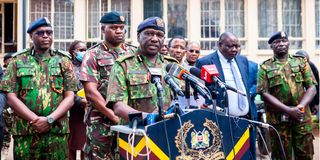
Inspector General of Police Douglas Kanja addresses journalists on June 9, 2025, at Central Police Station, flanked by his deputies Eliud Lagat (left) and Gilbert Masengeli (second left).

A sharp division has emerged on whether the retirement age of the Inspector-General of Police and his two deputies should be capped at 60 as proposed in a Bill before Parliament.
While the National Police Service Commission (NPSC) supports capping the age limit at 60, as proposed in the National Police Service (Amendment) Bill 2025, the Inspector-General (IG) of Police Douglas Kanja is of a contrary view.
Also supporting the proposed Bill by Teso North MP Oku Kaunya are the Law Society of Kenya (LSK) and Independent Policing Oversight Authority (Ipoa).


This as Ipoa seeks a reintroduction in the law of clear recruitment and removal processes of the IG and his two deputies that were controversially deleted in 2014.
Currently, the law allows the President to pick anyone for the position of IG, including civilians, and send the name to Parliament for vetting.
To lock out civilians from getting the IG job, the National Association of Retired Police Officers- Kenya (Narpok), an association of officers who have retired “honourably” from the service, wants the IG and DIGs to be individuals who have served in a senior command and leadership within NPS.
“The principal object of the Bill is to amend the National Police Service Act to provide for an age limit of 60 years for persons nominated and appointed to the offices of IG and DIGs,” the Bill reads.
The Bill also seeks to include a term limit for the DIGs as they are currently exempted from the mandatory retirement age of 60 years.
Article 245 (6) of the Constitution states that the IG shall be appointed for a single four-year term and shall not be eligible for reappointment.
“The proposed amendment should not affect the tenure of an Inspector-General appointed prior to attaining the age of sixty years,” NPSC says in a submission to the Administration and Internal Security committee of the National Assembly.
This implies that those nominated for the job must not run the risk of attaining 60 years before their four-year term is over, a position shared by Narpok, whose patron is IG Kanja.
“The association proposes that the appointment of IG be before his or her attainment of retirement age of 60 and after such appointment, should hold the office until completion of his four-year term unless otherwise removed,” says Narpok in its submission.
Committee members Dido Rasso (Saku) and Francis Sigey (Sotik) supported the capping of retirement age for IG and his two deputies at 60.
“If you do not have a retirement age for the IG and his two deputies, it will kill the morale of officers in the service who aspire to be IGs in the future. It will look like a club of a few individuals,” said Mr Rasso.
Best practices
Mr Sigey said that fixing the retirement age 60 is for posterity of the nation, with Mr Kaunya noting that although the IG is opposed to the retirement age limit, he had not given a suggestion comparatively in terms of the best practices.
According to LSK, “capping of retirement age at 60 for IG and his two deputies is progressive.”
“LSK supports the Bill. It will strengthen institutional integrity and ensure that leadership within the service is both competent and ethically grounded,” LSK submission reads, noting that if the IG serves a term before attaining 60, “should be redeployed.”
The NPSC also noted that the retirement age of the DIGs “shall be 60 years as their term limit is not fixed under the constitution.”
According to Ipoa, “the authority agrees with this proposal as it is in keeping with the age of retirement requirements in Kenya for public officers and is also in keeping with regional best practices.”
However, IG Kanja, through the NPS Legal Services Director Amos Omuga, who represented him before the committee, argues that age is not the determining factor for leadership.
“While age correlates with experience, it should not be used as a disqualifying factor for leadership. Competence, integrity, professionalism and strategic thinking should remain the principal criteria for appointment to the positions of IG and the two deputies,” said IG Kanja.
Read: Acquitted: Ex-governor Lenolkulal a free man after High Court overturns Sh84m graft conviction
According to the IG, “the service continues to benefit from seasoned leaders whose wisdom, foresight and maturity are essential for guiding younger officers and responding to the complex demands of modern policing.”
“Imposing a strict age cap may inadvertently exclude qualified, capable and visionary officers from contributing to national security leadership merely because of chronological age,” says the IG.
Article 245 (7) of the Constitution stipulates that the IG may be removed from office by the President only on the grounds of serious violation of “this constitution or any other law, including a contravention of Chapter Six.”
It also lists gross misconduct, whether in the performance of the office holder’s functions or otherwise, physical or mental incapacity to perform the functions of office, incompetence, bankruptcy “or any other just cause.”
However, NPSC decried the failure by parliament to enact legislation “to give full effect to this Article.”
“No specific statute has been enacted by Parliament to operationalize this constitutional requirement. Notably, the constitution recognises the office of the Inspector-General as a State office,” says NPSC.
NPSC notes that just as there are established procedures for recruitment and appointment to the office of IG, “there should equally be clear and consistent procedures for removal from office, ensuring parity of treatment with other State officers and upholding the principles of fairness, accountability and due process.”
Follow our WhatsApp channel for breaking news updates and more stories like this.