The National Police Service Commission (NPSC) yesterday went into a meeting expected to drag well into the night, to decide its next move following a court-ordered suspension of the recruitment of 10,000 police officers.
Before walking into the meeting, the National Police Service (NPS) issued a statement indicating that it was consulting with the NPSC on the “appropriate legal remedies to ensure the recruitment exercise can resume at the earliest opportunity”.
Justice Hellen Wasilwa’s order suspending the exercise triggered the meeting, which mirrored a similar gathering last month when two conflicting sides of the NPSC reached a truce that cleared the way for the recruitment.
The initial plan was to have the recruits join police training colleges by October 1. This means that the recruitment was already behind schedule, since before Justice Wasilwa’s orders, it was to run for six days starting October 3.
A few minutes to midnight on September 9, a cosmetic truce was reached in the NPSC boardroom to clear the way for the recruitment exercise. The commissioners met again on a later date to iron out the thorny issues.
The truce was cosmetic because it was only intended to fashion the NPSC as a united front for the recruitment, and thwart any court action with the potential of quashing the exercise.
On one side of the NPSC boardroom are the three senior-most police officers—Inspector-General of Police Douglas Kanja, his deputies Eliud Lagat (Kenya Police) and Gilbert Masengeli (Administration Police), and co-opted members Mohamed Amin (Directorate of Criminal Investigations) and Bernice Lemedeket (NPS accounting officer).
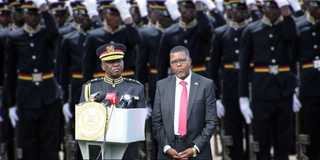
Inspector General of Police Douglas Kanja (left) with the Chairman of the National Police Service Commission (NPSC), Dr. Amani Yuda Komora addressing journalists during the 2025 National Police Service recruitment of police constables press conference held at the National Police Service Embakasi ‘A’ Campus in Nairobi on October 1, 2025.
Photo credit: Bonface Bogita| Nation Media Group
On the other side are NPSC Chairperson Yuda Komora, Vice-Chairperson Collete Suda, CEO Peter Leley and members Angeline Yiamiton, Edwin Cheluget, Benjamin Imai and Peris Muthoni—all civilians.
For years, different office holders from the two sides of the NPSC have spurred over the human resource function of the police service, including recruitment and control of the Sh60 billion payroll.
The police camp has always been of the opinion that the recruitment should be conducted by the NPS, not the commission. But NPSC has always maintained that recruitment and other human resource functions, such as the payroll, are core functions of the commission.
The Nation has learned that the police top brass won the payroll battle after the National Treasury in August dismissed a request by the NPSC to give the commission control.
NPSC wrote to Treasury on July 29 seeking the payroll transfer. But Treasury responded two weeks later, stating that the move would violate public finance principles as civil servants’ salaries are paid by the institutions they work for.
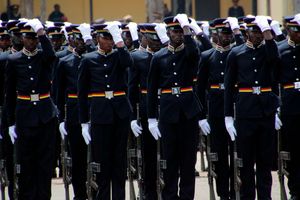
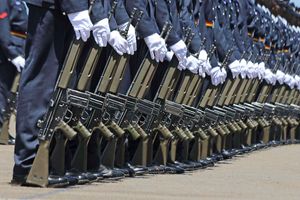
Recruits in a parade during a past pass-out ceremony at Kenya Police College Kiganjo
Photo credit: File | Nation Media Group
When former commissioner Eliud Kinuthia and five others exited office in March at the end of their terms, they warned their successors to be wary of a “coup” by senior police officers.
In an exit report handed over to President William Ruto, Mr Kinuthia’s team complained that the police commanders had continued to usurp their powers.
“Regrettably, however, the NPSC leadership has acquiesced to the continued usurpation of its functions by the NPS leadership, thereby exacerbating the vices that it was established to redress,” the report states. The comments were largely in relation to the recruitment and promotion of police officers.
The wedge between the civilian and police sides of the commission is thick. Not even President Ruto, who hosted the NPSC members twice—in Mombasa and in State House—could broker a ceasefire, with each faction insisting that the law is on their side.
During the September 9 meeting, the police side agreed with the civilians that the recruiters would be led by a joint team of Mr Kanja and the civilian commissioners.
It was agreed that Mr Kanja and his team would oversee the technical aspects of the recruitment, including checking the competence of recruits, while the civilian commissioners would provide general oversight.
The two sides also agreed that to enable the civilian commissioners to do their job well, the recruitment exercise would be conducted for a period of six days, unlike in the past when the exercise was conducted on a single day.
There had been a number of interventions by high-ranking government officials attempting to mediate the standoff.
A day before the night meeting, Interior Cabinet Secretary Kipchumba Murkomen, when attending a security baraza in Nakuru County, said he would meet the warring factions to iron out the issues stalling recruitment exercise.
After meeting Mr Kanja and Dr Komora, the CS, in a press statement, announced that they discussed several issues, including recruitment and the welfare of officers.
“I shared with the commission the key issues raised in our Jukwaa La Usalama forums, including officers’ strength and welfare, which require their input and implementation. They also appraised me of the preparations made for the upcoming police recruitment,” Mr Murkomen said.
Interior Cabinet Secretary Kipchumba Murkomen during a security forum at Sarova Woodlands Hotel in Nakuru on August 12, 2025.
Photo credit: Boniface Mwangi | Nation Media Group
Other officials familiar with the standoff said that Head of Public Service Felix Koskey had also held several meetings with Mr Kanja and Dr Komora.
On September 5, NPSC held a meeting at the Kenya School of Government in Mombasa. This full commission meeting failed to resolve the impasse. The meeting resolved that a technical committee, comprising police officers and officials from NPSC, be constituted to look into “technical issues” that had derailed the recruitment.
At a press briefing after the meeting, Dr Komora told journalists that the commissioners had agreed on a roadmap on how they will work in close collaboration with NPS.
Later, an advisory by the National Security Council that a new system of recruitment should be introduced to ensure hopefuls apply for police recruitment online further complicated matters.
At the time, NPSC was conducting public participation on guidelines for the recruitment exercise.
Mr Kanja’s camp disowned the guidelines, holding that the NPSC-proposed system for hiring had been shoved down the throats of the police bosses.
“We have just seen communication on issues that as a commission, we have never sat and agreed on. There are no minutes to show who attended the meeting that ratified these new recruitment guidelines,” said one commissioner who spoke on condition of anonymity.
“You cannot have one person driving an agenda and forcing the decision on other commissioners,” said another civilian member of the NPSC.