The last time Yvonne Akinyi heard her husband Vincent Otieno’s voice, he sounded happy. It was last Wednesday afternoon, and Otieno was calling from Nairobi, where he lived with their first-born daughter. He wanted to check in on Ms Akinyi and their six-year-old twin daughters in Rongo.
“He called us and greeted me and the twins. He told me to take the phone to his mother. He spoke to her, my sister-in-law, and even my younger sister. Then he said he would call again on Thursday evening because there was something we needed to discuss,” Akinyi told the Nation at Nairobi Funeral Home on Tuesday.
“I was at work and thought maybe he got busy,” she said. “But around four, I saw his photo on social media. People were saying he had been shot at Kasarani Stadium. I could not believe it. That was the same person I had spoken to the day before.”
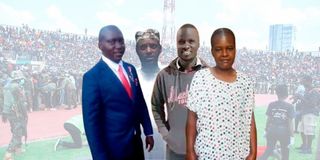
Vincent Otieno Ogutu who died on October 16, 2025 at Kasarani Stadium during the public viewing of the body of former Prime Minister Raila Odinga
Photo credit: Pool
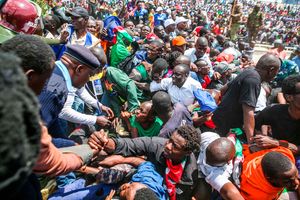
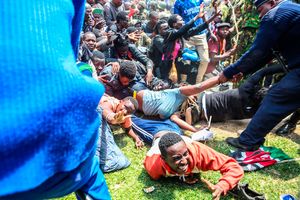
Otieno had travelled to Kasarani to view the body of the late former Prime Minister Raila Odinga , whose final journey had drawn thousands of Kenyans from all walks of life. What was meant to be a solemn farewell turned into a day of horror.
“What pains me most,” she said, her hands clasped tightly, “is that he was not rioting. He was seated calmly on the terrace, waiting to view Baba’s body. He was relaxed, just like many others who had come to pay their respects. He wasn’t part of any chaos.” She paused, wiping tears from her cheeks.
“Now, just like he went to see Baba in the coffin, we are also going to see him in one,” she said.
Otieno, the family’s sole breadwinner, leaves behind three young children.
“It is hard in Kenya. Someone can kill another person and still go home to their family. Yet they have destroyed another family completely. I don’t know if we will ever get justice. But I have to stay strong for my children. I want to give them a good life, like he always wanted,” Ms Akinyi said.
For Brenda Akoth, that Thursday began like any other day. Her husband, Evans Onyango Kiche, left home at half-past five for work at Pan Africa Christian University in Roysambu.
“We spoke several times that morning. At nine, at ten, and at eleven. He said he was fine. Around noon, he told me they would leave work early because of the viewing of Odinga’s body at Kasarani,” Ms Akoth said.
At two o’clock, Brenda called again. Kiche told her to “give him a minute” and hung up. It was the last time she heard his voice.
Evans Onyango Kiche who died October 16, 2025 at Kasarani Stadium during the public viewing of the body of former Prime Minister Raila Odinga
Photo credit: Pool
“By three, his phone was off. I thought maybe the network was bad. But when I called again at eight, it was still off. I got worried. I logged into Facebook Messenger and saw a message titled ‘Emergency, Evans Kiche.’ It had a phone number. When I called, a man asked who I was. When I said I was his wife, he shared another number- of a lady who had booked my husband’s body at the Nairobi Funeral Home,” she said.
The next morning, Brenda went to the mortuary.
“When I saw his body, my knees gave way. He had been shot in the head, right between the eyes. I couldn’t believe it. He left home to go to work, not to die,” she said.
Evans, like Vincent, was the family’s provider.
“I have three children. My eldest is in Grade Seven. Life is going to be difficult. I just want justice. Without justice, my husband will not rest in peace,” she said.
For Dr Jiddah Choke, the pain is still fresh. He lost his cousin, Jida Burkah, 42, a father of three.
Josfae Jida Burka who died October 16, 2025 at Kasarani Stadium during the public viewing of the body of former Prime Minister Raila Odinga.
Photo credit: Pool
“He was a very calm man. Deeply religious. He prayed every morning before leaving the house. That Thursday, after prayers, he told his wife he was going to view Raila’s body. He started from Parliament and later walked to Kasarani with thousands of others,” Dr Choke said. “
Dr Choke said he was watching the news when reports emerged that people had been shot at the stadium. It never crossed his mind that one of them could be his relative.
“Two days later, someone posted a photo on social media asking if that was Burkah. We rushed to the Nairobi Funeral Home and found him there. He had been shot in the head. The bullet entered through his left eye and exited at the back, damaging his brain and skull. It was brutal,” he said.
Burkah left behind three children aged 12, 10, and six.
“He was the breadwinner not just for his immediate family, but also for his sickly parents,” Choke said.
“Now the family has nothing. His parents are old and unwell. His wife is devastated. We are asking President Ruto to ensure justice is done. The officers who shot him should be found and prosecuted. There are cameras at Kasarani; they can be traced. We also demand fair compensation to help the family rebuild their lives,” he said.
At Nyayo Stadium, another tragedy unfolded last Friday when thousands convened to attend Odinga’s state funeral service and get a glimpse of their leader before his burial. The service had ended, and dignitaries left when a stampede that left several people dead happened.
Among them was Josephine Okengo, a single mother of three. Her daughter, Veronicah Kangwa, a first-year student at the Co-operative University of Kenya, spoke through tears as she recounted their final moments together.
“Before Mum left for Nyayo, we were doing laundry. Our neighbour came and convinced her to go and view Raila Odinga’s body. Mum hesitated at first. She even said she had a bad feeling that something might go wrong. But the neighbour insisted it would be fine,
They both wore blue dresses. “I remember she asked me which shoes to wear,” Veronicah smiled faintly.
“I told her to wear the ones she’d be comfortable in. She picked her crocs. I joked and asked, ‘Mum, can you really run if anything happens?’ She laughed and said she could run faster than anyone there.”
Josephine Okengo who passed away on October 17, 2025 at Nyayo National Stadium during the public viewing of the body of former Prime Minister Raila Odinga.
Photo credit: Pool
That was the last time she saw her mother alive. Later that evening, Veronicah and her siblings grew worried when calls to their mother went unanswered.
“We went to Nyayo Stadium, then to Kenyatta National, Mbagathi, and St Mary’s hospitals, but we couldn’t find her. Early the next morning, I got a Facebook message with a photo of my mother being carried by the crowd. Later, the police confirmed she was among those who had died in the stampede.”
“My mother was our world. She raised us alone, without complaining. Now she’s gone, and we don’t know how we’ll even afford the funeral. We are asking for help from the government, from well-wishers just to lay her to rest,” she said.
Pathologist Dr Bernard Midia, who conducted the post-mortem examinations on the four bodies, confirmed what three families feared most; their loved ones were killed by live bullets.
“Two of the bodies had gunshot wounds to the head. We retrieved bullet fragments from one. The other had an entry and exit wound where the bullet passed through the skull. For another victim, we found bullet remains lodged in the left chest. The fourth victim, a woman, died of asphyxia during the stampede. She could not get oxygen and died as a result,” Dr Midia said.
His findings align with what human-rights groups have long alleged - that police used excessive, lethal force during what should have been peaceful public events.
Vocal Africa Executive Director Hussein Khalid condemned the killings, describing them as “a stain on the conscience of the nation.”
“From what we’ve established. Three people were shot and killed in Kasarani. Vincent (Otieno) was shot on the left chest, with Evans (Kiche) and Jidda (Burkah) being shot on the head. Two others died in the Nyayo Stadium stampede. The post-mortem results show that those shot were targeted with precision, as if by expert marksmen. This was not random gunfire. These were calculated killings,” Mr Khalid said.
“Our trigger-happy police must find better ways to handle public order. In Kenya, we have a chronic problem where elite forces resort to deadly force even when there’s no threat to their lives. There are many non-lethal ways they could have managed the crowds, but they chose bullets.”
Khalid said his organisation was working with the Independent Policing Oversight Authority (IPOA) to push for accountability.
“We want proper investigations. We want justice. Those responsible must face the full force of the law. Families have been destroyed, and yet the government remains silent. We cannot normalise state violence,” he said.
Across Rongo, Lucky Summer, and Njiru, the families of the victims now share a common burden: the silence of justice. In Marera village, Otieno’s elderly mother still sits by the gate, waiting for a son who will never return. In Njiru, Ms Akoth struggles to explain to her children why their father’s phone will never ring again. And in Lucky Summer, Burkah’s parents stare at the empty chair he once occupied during evening prayers.
In Kibra, Ms Kangwa still pictures her mother in her blue dress, asking her if she was smart enough to give Odinga a final goodbye wave.
“She was my best friend. She didn’t deserve to die like that,” she said.
The deaths at Kasarani and Nyayo have once again raised serious questions about police conduct during public gatherings. That Kenyans attending a funeral viewing of a national leader were met with bullets and chaos reflects a deep moral and institutional crisis. The Independent Policing Oversight Authority has promised investigations, but for the families, promises are not enough. They want answers, they want accountability, and above all, they want their loved ones’ deaths to mean something.