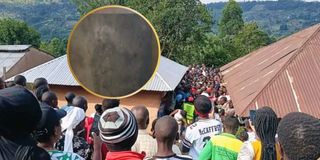
Kisii County was abuzz with whispers of miracles days ago. Crowds gathered at what some claimed was the image of the Virgin Mary, shimmering on a mud-walled house in Bobasi.
Videos went viral, sparking excitement, speculation and devotion. Amid the euphoria, the Catholic Church urged caution.
Fr Leo Mwenda Itabari, a Dominican friar and Deputy VC of Tangaza University, offered a perspective.
“I watched the clip but didn’t see any apparition,” he said.
“If God or the Virgin Mary are saying something, they will make it clear. The excitement brings many questions, but it has nothing to do with faith.”
For Fr. Leo, faith is not built on apparitions.
“We believe, with or without an apparition. If God is doing something there, it will be clear,” he said.
“Before the Church pronounces itself officially on a miracle or apparition, it takes time. Anything the Church has not declared officially really doesn’t matter,” the priest said.
He pointed to recognised apparitions such as Fatima in Portugal, Guadalupe in Mexico, Akita in Japan and Kibeho in Rwanda.
Statue of the Virgin Mary. PHOTO | FILE | NATION MEDIA GROUP
“These are official apparitions because the Church admits God has manifested Himself here through the Virgin Mary. When She pronounces Herself, she says it is safe to believe in this because there is nothing contrary to faith,” he said.
Fr Leo used the Shroud of Turin, believed by many to bear the face of Christ, to illustrate his point.
“The Church believes the shroud is authentic. It has been examined by scientists, and no one has disproved it yet. But this is not an article of faith. You may believe in the shroud or you may not. The Church does not require you to believe in all these things,” he said.
For Fr Leo, such signs are reminders of God’s presence, but not the foundation of belief.
“What the Church insists you believe is what you must believe for your salvation. Apparitions are gifts, not obligations,” he added.
On whether such an apparition may be visible to one with deep faith but hidden from other people, Fr Leo says genuine apparitions would be “even clearer to those who don’t have faith”.
His observation touches on a theological principle: Revelation is not confined to the already convinced. In Catholic understanding, God’s self-disclosure – whether through Scripture, miracles or apparitions – is oriented towards drawing humanity closer to belief.
“Believers already possess the foundation of trust in God’s presence. Apparitions, therefore, serve as invitations rather than confirmations,” he said.
When reports of apparitions surface, the Catholic Church follows a careful process before making a pronouncement.
The first is local investigation. The priest or bishop of the diocese begins inquiries, gathering testimony, examining evidence and consulting experts.
Then follows scientific analyses of the findings. These are studied to rule out fraud, illusion or natural causes.
After this is a theological review. The content of any messages is checked against Catholic doctrine to ensure nothing contradicts faith.
If all is in alignment, the Vatican – the seat of the Pope and the head of the Catholic Church – is involved. In significant cases, the Congregation for the Doctrine of the Faith may step in for deeper evaluation.
A crowd throngs a home in Bassi Central Ward, Kisii County, to catch a glimpse of an image resembling the Biblical Virgin Mary which allegedly appeared on a kitchen wall.
Photo credit: Pool
Finally, the Church may declare an apparition “worthy of belief,” “not supernatural,” or leave it undecided. Even approved apparitions are not binding articles of faith.
Charles Onsombi, the husband of Mary Onsombi, who first reported seeing the image, brought down the kitchen to keep away the hundreds of people who were streaming into his compound to catch a glimpse of the “miracle”.