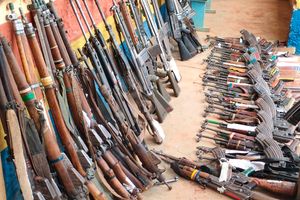
A criminal case that began with a tip-off about armed suspects, dramatic police operation and recovery of a Russian-made pistol hidden in a house ceiling has ended with a simple but troubling question: Whose gun was it?
The Senior Principal Magistrate’s Court in Malaba acquitted two men who had been charged with illegal possession of a firearm and ammunition after finding that prosecutors failed to prove they actually possessed the weapon.
The gun at the centre of the case was a Tokarev TT-33 pistol together with eight rounds of ammunition.
Police said they recovered it after arresting Boniface Masakari Nyongesa and Dennis Obelo Ekisa following intelligence reports that they were linked to a firearm.
The two were charged that on April 14 2025 in Achunet location at Teso North Sub-County within Busia County without reasonable excuse were jointly found in possession of a firearm namely Tokarev Pistol serial number 063368-1944.
The prosecution told court that they had the pistol in circumstances which raised a reasonable presumption that it was intended to be used in a manner prejudicial to public order and that they did not have a firearms certificate.
The accused persons were charged with a second count of being in possession of ammunition contrary to the law.
Investigators told the court that they arrested the two men at a bar in Malaba before being led to a house where the pistol was allegedly recovered.
The first accused, Nyongesa, worked as a caretaker at the property owned by retired police officer David Moses Gekara.
But as the trial unfolded, a different picture emerged.
Mr Gekara testified that he had lived in the house years earlier before relocating and leaving the caretaker in charge. He said he was surprised when investigators informed him that a firearm had been found there.
According to his testimony, he had surrendered his service weapon upon retirement and had not occupied the premises for years.
The prosecution argued that the accused men had possession of the firearm and were planning to sell it. Investigators also referred to a previous complaint in which the first accused had allegedly threatened another person.
However, crucial pieces of evidence were missing.
No fingerprints were lifted from the pistol. Ballistics experts confirmed that the weapon was functional and that the ammunition could be fired, but they could not connect the firearm to either accused person.
The court heard that by the time the exhibits reached ballistic examiners, they had passed through several hands, making fingerprint analysis difficult.
In his defence, Mr Nyongesa claimed he had discovered the pistol while checking a section of the house belonging to his employer. He said he informed the second accused and intended to have the weapon handed over to the authorities.
Mr Ekisa denied any knowledge of the firearm and insisted he had merely met the first accused at a bar shortly before the arrests.
When delivering judgment on August 20 2026, Magistrate A. Z. Ogange said the prosecution had proved only one thing beyond dispute — that a firearm and ammunition had indeed been recovered. What investigators failed to establish was who actually possessed them.
“The firearm was, however, not recovered from the person of the 1st accused or from a place shown to be under his exclusive control,” the magistrate said.
The court noted that while police showed that the first accused knew where the gun was located, that fact alone did not prove ownership or possession.
“Standing alone, however, that circumstance does not irresistibly establish that he knew of the firearm before the police operation or that it was in his possession,” the magistrate ruled.
The court was particularly concerned by unanswered questions surrounding the history of the firearm and the property where it was found.
“Mr Gekara’s connection to the premises raises a material evidentiary gap which the prosecution did not satisfactorily bridge,” the magistrate observed.
On the second accused, the court found the case even weaker.
“The mere fact of the 2nd accused's presence in the company of the 1st accused or his arrest pursuant to a tip-off cannot establish constructive or joint possession,” the magistrate said.
The prosecution's claim that the pair intended to sell the weapon also failed to convince the court. Investigators did not produce evidence of negotiations, buyers, agreed prices or any concrete step toward a sale.
Justice, the magistrate stressed, cannot be built on suspicions alone.
“A tip-off is a basis for investigation; it is not itself proof of the facts alleged,” he said.
“The accused persons are not required to establish who owned the firearm, how it came to be in the ceiling, or why it was there,” the magistrate said. “The ultimate burden remains with the prosecution.”
With those findings, both men were acquitted.
Yet the judgment leaves behind a mystery that the trial never solved. A loaded Russian-made pistol was found hidden inside a house. Everyone agreed on that. What nobody could prove was who put it there, who owned it, or who controlled it.
In the end, the case was supposed to be about illegal possession of a gun. Instead, it became a story about the unanswered question at the heart of the investigation: whose gun was it?