The high cost of living and salary commitments have caused state and public officers to avoid car loans provided by the government, leaving Sh4.3 billion idle, according to an audit report.
Tough global economic times, coupled with high inflation during the last financial year, have also been cited as reasons for the low uptake of the fund.
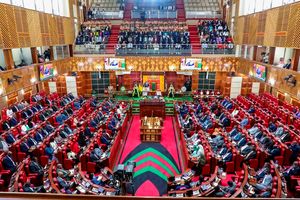
According to the latest report by the Auditor General for the financial year ending June 30, 2025, which was presented to the National Assembly, the low uptake of loans by state and public officers has forced the National Treasury to invest the idle funds in treasury bills.
“The fund has experienced low response from State and Public officers which compelled management to invest in treasury bills so that the funds do not lie idle,” Ms Nancy Gathungu says in her report.
Auditor-General Nancy Gathungu.
Photo credit: File | Nation
The report states that as at June 30, 2025, the fund had a balance of Sh4,355,166,574, with Ms Gathungu warning that with the low uptake of the loan, the main purpose for which the fund was created risk being missed.
“The objective and purpose for which the fund was established may not be achieved,” Ms Gathungu says.
Since inception, the fund has processed motor car loans amounting to Sh824, 260,060 for 389 applicants
According to the report, as at 30th June 2025, the fund had processed 113 motor car loan applications where Sh234,560,866 were issued while Sh148,395,403 was repaid during the same period.
In his report as the chairman of the State and Public Officers motor car loan scheme, National Treasury Principal Secretary Chris Kiptoo attributed the low uptake of the loan to lack of awareness, salary commitment, and the high cost of living, which has eroded the purchasing power of the beneficiaries
“This is worsened by the general global economic conditions such as inflation that made the cost of goods and service very high including motor vehicles. It is hoped that this situation will improve in the near future following extensive awareness creation by the fund,” Dr Kiptoo said.
Reduced worker earnings have depressed demand for goods and services in Kenya.
Photo credit: Shutterstock
The high cost of living, exacerbated by countless taxes introduced by President William Ruto’s administration, has not only left Kenyans with a thin paycheck but has also led to a vast majority struggling to afford the basics in life.
Those in employment have been forced to bear with the numerous deductions, such as the recently introduced mandatory Social Health Insurance Fund (SHIF), where employees are deducted 2.75 percent and another 1.5 percent which goes tothe housing levy
These deductions have already stretched the payslips of most Kenyans, with the majority of workers taking home less than two-thirds of their pay.
The Employment Act, 2007, forbids employers from deducting more than two-thirds of the basic pay from an employee.
The law requires employees to take home at least a third of their basic salary as net salary—what remains after all deductions, including statutory obligations.
According to the report of the Auditor General, Nancy Gathungu, for the financial year 2022/23, the state department has been flagged for having hundreds of employees receiving net pay below a third of their basic salary.
The government also raised pension contributions from Sh200 to 1.2 percent, half of which is paid by the workers and the other half borne by the employers.
The contribution is, however, capped at a maximum of Sh2, 160 for those earning more than Sh18, 000.
The State Officers and Public Officers Car Loan scheme was established in September 2015 under the Public Finance Management Act, with the main purpose of providing a car loan facility to State Officers of the National Government to purchase a motor car.
The chairperson of the fund is the Principal Secretary of the National Treasury, Chris Kiptoo.
The Cabinet Secretary for National Treasury is responsible for the general policy and strategic direction of the fund, while the Chief Executive Officer is the administrator of the fund.
The fund is administered by an advisory board, which is tasked with the responsibility of processing loans from applicants in accordance with laid-down regulations, setting up a revolving fund for the disbursement of loans, and supervising the day-to-day operations of the fund.