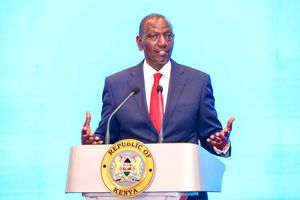
President William Ruto chats with Public Service CS Geoffrey Ruku at Runyenjes town in Embu County on April 4, 2025 during his tour of Mt Kenya region.

President William Ruto’s transfer of the national emergency response and disaster recovery function from the Ministry of Public Service to the Ministry of Interior has unsettled the plans of top officials in the former ministry who were allegedly seeking to benefit from procurement linked to natural disasters.
At the center of these lucrative procurements is the Sh13.5 billion set aside by the government for emergency interventions for victims of natural calamities, including mudslides, floods, droughts and other crises.
The funds cover cash grants, food supplies, tents, medicines, bedding and mosquito nets, among other items.
Flood victims pitch a temporary shelter at Simbi Kogembo dispensary in Central Karachuonyo Location, Homa Bay County on May 14, 2021.
A State House official, speaking off the record during a closed-door meeting with MPs, said President Ruto was “specifically pissed off” by the attempts of ministry officials to enrich themselves at the expense of victims.
“The President was concerned that top officers had strategically positioned themselves to benefit from disaster response procurements while victims continued to suffer,” the official told a National Assembly committee.
The official added that delays in delivering basic needs to affected Kenyans were partly due to disagreements among officials seeking personal gain from the disaster response process.
Cabinet Secretary Geoffrey Ruku has faced criticism from the opposition for allegedly using the transferred function to supply food and necessities to residents of Mbeere North constituency to garner political support ahead of the November 27, 2025, by-election.
When contacted, CS Ruku was cautious, noting only that Head of Public Service Felix Koskei’s March 9, 2026, executive action “is legit”.
The transfer, formalised under the March 9, 2026, executive action, moves the disaster response function to the Ministry of Interior and National Coordination headed by CS Kipchumba Murkomen.
CS Ruku’s docket now focuses on Huduma Centres, the Kenya School of Government, and the National Youth Service, spread across the State Departments of Public Service, Human Capital Development and Special Programmes.
Reasons for relocation
The executive action cites the “complex and time-sensitive nature of emergencies” and national security considerations as reasons for relocating the function.
It directs coordination of the National Emergency Response and Recovery Secretariat and the National Disaster Operations Centre under the Interior Ministry.
Executive Order No 1 of 2025 had established seven new State departments, including Special Programmes, tasked with coordinating national emergencies. The creation of the State department and its placement under CS Ruku was seen by some government insiders as a strategic move to lure him from his parliamentary seat in Mbeere North to Cabinet.
The National Assembly is processing Sh9 billion under Supplementary Budget I for 2025/26 for emergency relief, covering food, medicine, blankets, cash grants, tents and other necessities. Of this, Sh2.74 billion has already been disbursed in three tranches between November and December 2025, with Sh50.4 million allocated specifically for mudslide-related operations and burial expenses in Marakwet East.
The scope of the transferred function now includes coordination of disaster preparedness, response and recovery during floods, droughts, fires, disease outbreaks, pandemics, and other national emergencies.
It also involves working with county governments, mobilising volunteers, managing shelters and mobility solutions, establishing early warning and escalation protocols, and coordinating public and private assistance for victims.
Follow our WhatsApp channel for breaking news updates and more stories like this.