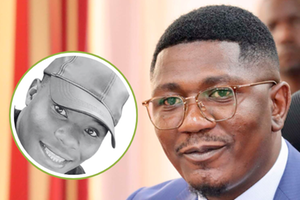
For nearly three months, Everlyne Chebet fought for her life.
She could barely walk. She could hardly speak. Relatives fed her by hand as she drifted between hospitals and homes, her body bearing the scars of a violent assault that neighbours say left her permanently broken.
When she died on February 26, 2023, her family not only lost a daughter and sister but also found themselves fighting a second battle: persuading authorities to take her case seriously.
The family got relief when the High Court in Kitale brought that long journey closer to an end by convicting her partner, Simon Kefue Ndung’u, of murder in June 2026, finding that he inflicted the injuries that eventually killed Ms Chebet.
Beyond the conviction, the judgment paints a disturbing picture of domestic violence, delayed justice and what the court described as a troubling failure by police to act decisively when the matter was first reported.
The prosecution's case relied heavily on testimony from neighbours and relatives who witnessed the victim’s deteriorating condition after the assault.
The first witness, John Kijabi, told the court that he returned home on the morning of December 7, 2022 after spending the night away. His wife immediately informed him that there had been a violent fight between Ms Chebet and the accused the previous night.
According to his testimony, Ms Chebet emerged from the house at around 10am looking visibly weak and struggling to walk.
He watched as she slowly made her way to a neighbour’s home belonging to a man known as Baba Kafu. There she remained for some time. Soon afterwards, Baba Kafu’s wife informed Kijabi and his family that the woman’s condition was worsening.
When he went to check on her, he found a woman in distress.
He told the court that one of her legs was swollen, she appeared extremely weak and was unable to speak. Efforts to give her tea failed as her condition continued to deteriorate.
Realising she urgently needed medical attention, neighbours mobilised and contributed money to help transport her to a health facility. She was first taken to Gituamba Dispensary where medical staff referred her to Kapsokwony Hospital because of the seriousness of her injuries.
During cross-examination, he remained firm that the assault had occurred on the night of December 6 and that by the following morning the woman was already showing signs of severe physical trauma.
The court then heard emotional testimony from Stephen Kimutai Chesiro, a security officer and the deceased’s brother-in-law.
He recalled that on December 8, 2022, while working at Kapsokwony Primary School, he received a distressing call.
The witness testified that he was informed she had been assaulted by her husband and could no longer stand on her own. He also confirmed that he knew the accused and the deceased as a couple who had been living together as husband and wife.
Recognising the urgency of the situation, Chesiro took her to Kapsokwony District Hospital and paid for her treatment.
However, even then, he feared she might not survive. When the hospital visit ended, he took her into his own home.
His wife became fearful of feeding the injured woman because of her fragile condition, forcing Chesiro to personally feed her.
The following day, he called his father-in-law and together they sought police assistance.
According to Chesiro, officers at Gituamba Police Post were uncooperative despite the obvious severity of the victim’s condition. Frustrated, they travelled to Saboti Police Station where they finally received assistance.
The witness later accompanied Ms Chebet to Kitale Referral Hospital where she continued receiving treatment until her death.
The victim’s father, Morris Ijaka, also testified, telling the court that he learned on December 9, 2022 that his daughter had been hospitalised.
When he visited her, he was shocked to find her unable to eat or talk. He later reported the matter to the police before returning home.
Days later, he received the devastating news that his daughter had died.
One memory remained etched in his mind: The last time he saw her alive, one of her legs was badly injured and oozing pus.
He also confirmed that she had been living with the accused and recalled seeing him visit the hospital carrying food for her during her admission.
When he conducted a post-mortem examination on March 10, 2023, he found extensive injuries consistent with a violent assault. Externally, the body showed signs of oxygen deprivation and bedsores resulting from prolonged illness and immobility. Internally, the findings were more disturbing.
The doctor found partially collapsed lungs, blood clots in the heart, severe scalp haematomas, a fractured skull and blood clots trapped between the skull and brain that had compressed brain tissue.
His conclusion was unequivocal that the cause of death was head injury and heart failure with blood clots from assault with a blunt object.
The judge described the investigations as poorly conducted and questioned why authorities failed to act promptly despite repeated reports from the victim’s relatives.
The judge noted that the Directorate of Criminal Investigations was never involved and criticised inconsistencies in official records, including errors regarding the date of the offence.
He suggested that the victim’s humble social background might have contributed to the apparent indifference.
“It is apparent that perhaps owing to the humble background of the deceased and her family the police never took the matter seriously,” the judge observed.
He further stressed that every Kenyan is entitled to equal protection under the law regardless of economic status.
The accused denied both assaulting the deceased and even living with her, but the court rejected his defence after finding that it contradicted multiple witness statements.
After reviewing all the evidence, the judge concluded that the circumstances pointed to no other person.
“The accused lived alone with the deceased and he is the only one who caused the fatal injuries that made the deceased unable to walk or talk the following day,” the judge ruled.
The court found that the severity of the injuries demonstrated an intention to cause grievous harm and therefore established malice aforethought.
“He caused the murder of his wife or partner for reasons best known to him,” the judge concluded before convicting him of murder.
For Everlyne Chebet’s family, the conviction finally delivers accountability. Yet the judgment leaves behind uncomfortable questions about how many vulnerable victims suffer in silence and whether quicker intervention might have saved her life.