In New York
President William Ruto spent last week in New York working two jobs at once. By day, he stood at the United Nations podium demanding reform of institutions built for a different era.
Away from the podium, he and his delegation ran a parallel campaign: signing agreements, courting investors and locking in partnerships meant to bring money, technology and institutions home to Kenya.
By the time the delegation packed up, Kenya had signed 11 major instruments and agreements, spanning diplomacy, technology, industrialisation, urban development and digital cooperation.
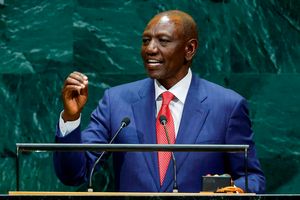
President William Ruto addresses the 81st United Nations General Assembly at UN headquarters in New York City on September 23, 2026.
Photo credit: Reuters
Some involve cash already moving. Others are frameworks and investment opportunities still waiting to become real projects.
On the economic front, the headline project remains the East Africa Refinery. President Ruto held direct talks with Aliko Dangote, chairman of Dangote Group, and Samaila Zubairu, CEO of the Africa Finance Corporation, on financing the $16 billion refinery project, expected to break ground on September 30.
Tied to those talks, the Africa Finance Corporation agreed to establish a regional office in Nairobi. That decision reinforces Kenya's bid to become East and Central Africa's leading financial centre, alongside its existing ambitions as a diplomatic and development hub.
According to a United Nations General Assembly (UNGA) communiqué by the Prime Cabinet Secretary and Cabinet Secretary for Foreign and Diaspora Affairs Musalia Mudavadi, Nairobi is positioning itself as "a leading regional financial centre, investment hub, development finance centre, diplomatic hub, and Gateway to East and Central Africa."
One of the week's more concrete wins came from the UN's industrial development body. Kenya signed a Country Partnership Programme with UNIDO for 2026 to 2030, aimed at mobilising approximately $750 million in associated investment for Kenya's industrialisation agenda.
“The programme is designed to support industrial investment, technology transfer, manufacturing development, industrial policy, enterprise development, job creation, and the integration of Kenyan producers into regional and global supply chains,” President Ruto said.
Dr Ruto also joined the "Africa We Build: Regulation, Risk, Reward" roundtable and the UNIDO High-Level Panel on the Future of Industrialisation, reinforcing the argument he made from the General Assembly podium: that Africa's resources should be "the beginning of African industry rather than the end of Africa's contribution to global value chains."
Kenya also used UNGA to keep pushing its clean cooking agenda, convening a high-level event with Norway, the International Energy Agency and the Clean Cooking Alliance and presenting an estimated $600 million investment opportunity to convert cooking systems in schools, health facilities and correctional institutions to cleaner energy. That pipeline is not financing secured; it is an opportunity Kenya is trying to make investable through local-currency financing, guarantees and risk-sharing tools.
President William Ruto presents a gift to the President and CEO of Dangote Industries, Aliko Dangote, on the sidelines of the United Nations General Assembly in New York on September 21, 2026.
Photo credit: PCS
Nairobi will host the Second Africa Clean Cooking Summit in January 2027 to try to convert political momentum into signed commitments.
Kenya additionally convened the Building Climate Resilience with the Urban Poor High-Level Special Event, tackling the overlap between urbanisation, climate change, housing and resilient infrastructure. Out of that event came a genuinely new institutional win: the signing of a Host Country Agreement between Kenya and United Cities and Local Governments of Africa, establishing its East African Regional Office in Nairobi, another organisation choosing to plant its regional base in the Kenyan capital.
The Susan Thompson Buffett Foundation elevated its Kenya partnership to a strategic level, focused on maternal, adolescent and newborn health infrastructure, while strengthening the capacity of SHA, DHA and Kemsa. UNESCO also confirmed a planned $10 million investment in Kenya, alongside Nairobi's confirmed hosting of the UNESCO World Conference on Education for Sustainable Development in January 2027.
Separately, at the ECAM Council Summit, Kenya put forward a $419 million programme to build 15 hospitals in 15 counties with Italy and Gruppo San Donato, an agreement still structured as a letter of intent rather than secured financing.
President Ruto used his General Debate address to place Kenya at the centre of the global push to reform multilateral institutions. His case: Africa has 54 member states, more than a quarter of the entire UN General Assembly, yet still has no permanent seat on the Security Council.
He pushed for reform of the Council, greater African representation in global decision-making, consistent application of international law, and reform of the international financial system so developing countries can access cheaper, longer-term, local-currency finance.
The official communiqué describing Kenya's week put it plainly: this "positions Kenya as an active advocate for Africa's voice, representation and agency in global governance."
President Ruto closed his address with a line meant to capture the whole pitch: a multilateral system where "every nation has a voice, every people has a stake, and every child has a future."
Kenya's technology diplomacy also expanded significantly in New York. On behalf of the government, two instruments were signed with the Emerging Markets Working Group at Stanford University's Hoover Institution, covering economic transformation, governance, technology and public policy, and cooperation in the ICT sector.
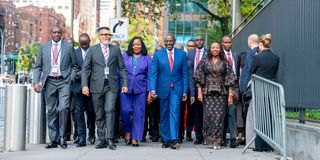
President William Ruto arrives for a meeting with Kenyans living in the United States in New York ahead of the ahead of the 81st United Nations General Assembly on September 21, 2026.
Photo credit: PCS
Separately, Kenya advanced a Joint Declaration on Responsible AI, Research and Innovation with Anthropic PBC, alongside earlier discussions with Cisco on the Moran AI and Cyber Center of Excellence, a Kenya Defence Forces initiative building AI and cybersecurity capabilities.
Kenya also co-hosted the launch of the 2026-2027 Roadmap for Children's Rights and Protection in the Age of AI, alongside France, Spain and Australia, focused on how AI systems interact with children online.
Taken together, the communiqué argues these engagements strengthen Kenya's ambition "to position itself as an African centre for responsible digital transformation and emerging technology, while attracting technology investment, expertise and partnerships."
What remains to be seen is whether that ambition shows up as legislation and budget lines at home, since no implementation timetable has yet been confirmed for the AI child-protection roadmap.
Kenya also used the week to push two international judicial candidacies: Judge Njoki Ndung’u for the International Criminal Court's 2027-2036 term, and Judge Phoebe Okowa for re-election to the International Court of Justice for 2027-2036.
President Ruto and his delegation worked through bilateral and multilateral channels throughout the week to mobilise support for both.
On the diplomatic front, Kenya signed a joint communiqué establishing formal diplomatic relations with the Solomon Islands, extending its reach into the Pacific for the first time, alongside political consultation agreements with the Maldives, North Macedonia, Croatia and Trinidad and Tobago.
Dr Ruto also met the presidents of Sierra Leone, Liberia and Ghana on trade, air connectivity and coordinated pushes for Security Council reform, and held talks with Iraq's prime minister on labour mobility for Kenyan professionals.
With US Secretary of State Marco Rubio, Kenya discussed the extension of AGOA and deepened cooperation on AI in health, education and financial services, alongside talks on critical minerals and nuclear energy.
Away from the conference rooms, President Ruto met with more than 1,000 Kenyans living across the United States, reaffirming the diaspora's role as a development partner and discussing investment opportunities and stronger government-diaspora engagement.