ICJ judges: Kenya on the edge as UN votes
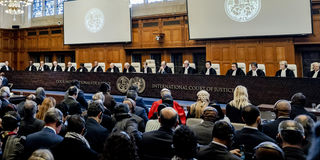
ICJ President Joan Donoghue (C) speaks at the International Court of Justice (ICJ) before the announcement of the verdict in the genocide case against Israel brought by South Africa, in The Hague on January 26, 2024.

Kenya may be waiting for the spinning coin today as the UN votes for five judges to sit on the International Court of Justice, the global tribunal that decides on disputes between states.
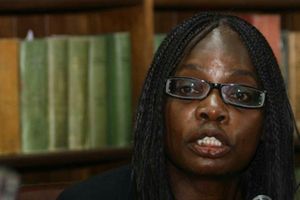
Kenya’s Judge Phoebe Okowa is seeking re-election to bench of this Court, which should not be confused with the International Criminal Court (ICC), the non-UN court that decides on liabilities of individuals in serious crimes.
Why is this election important to Kenya?


Nairobi is keen that Judge Okowa is re-elected to the bench to serve a full nine-year term. She was first elected last year to replace Somali judge Abdulqawi Ahmed Yusuf who had resigned earlier. She is thus serving the remainder of his term until January 2027.
Last week, Kenya closed the campaigns, telling the UN member states that Prof Okowa represents expertise that can guide the global court to the rules-based world order.
“Our submissions urged the members of the UN present to reflect on the kind of Court our international community needs,” said Korir Sing’oei, Kenya’s Principal Secretary for Foreign Affairs, at the end of campaigns in New York on Wednesday.
“The principles that must guide its composition; and the qualities required of those entrusted with interpreting and applying international law at this consequential moment in our shared history. Prof Okowa answers these demanding standards admirably and we commended her candidature to all.”
Once elected, she won’t be a Kenyan judge, however. Judges of the Court must come from member states, but they may also sit on benches hearing cases involving their home countries. This explains why the Somali judge, for instance, sat on the Somali cases against Kenya over the maritime boundary.
Nonetheless, Kenya says Okowa’s presence on the bench can be evidence of Kenya’s ability to defend a rules-based international order, rather than an expectation that she would serve national interests on the bench.
How are the judges elected?
To be elected to the International Court of Justice (ICJ), a candidate must obtain an absolute majority in both the UN General Assembly and the UN Security Council, which is about 106 votes in the Assembly and at least 8 votes in the Council. Both organs vote separately but at the same time. And unlike elections for the UN Secretary-General, elections for ICJ judges are not subject to a Security Council veto, although it is possible for one person to win in the Assembly and fail in the Council. Last year, Prof Okowa won on the floor of the General Assembly after four rounds of voting, defeating Sierra Leonean jurist Charles Chernor Jalloh. Jalloh is competing again against her, which raises the stakes for a rematch.
Who else is competing?
There are ten candidates overall, coming from the UN’s informal geographical distributions. They are competing for five positions to be vacated by Brazil, India, Kenya, France, and Jordan. Jalloh and Okowa come from the Africa Group, which is the informal group of members of the African Union. The entire list is:
- Phoebe N. Okowa (Kenya)
- Charles Chernor Jalloh (Sierra Leone)
- Dapo Akande (United Kingdom)
- François Alabrune (France)
- Taoheed Olufemi Elias (Nigeria)
- Mahmoud Daifallah Hmoud (Jordan)
- Luz del Carmen Ibáñez Carranza (Peru)
- Rena Lee (Singapore)
- Paik Jin-Hyun (Republic of Korea)
- Marcelo Vázquez-Bermúdez (Ecuador)
While each contender seeks majority endorsement from the UN, it is often tradition that regional groups galvanise local support. A divided Africa group, for instance, can make the race harder for contenders because they use the home support to trade off with other candidates.
The ICJ, what powers does it have?
The Court, an organ of the UN, has automatic jurisdiction to hear disputes pitting member states of the UN. It has 15 judges who are elected in a staggered fashion to ensure there are enough judges at any time to hear a case. Each judge has a protected tenure of nine years.
The Court has been active lately in Africa, hearing a case between Somalia and Kenya, the Democratic Republic of Congo and Uganda and Cameroon against Nigeria. It also heard a case between Gabon and Equatorial Guinea, Gambia versus Myanmar and Sudan versus the United Arab Emirates. Its verdicts are final and cannot be appealed. However, the ICJ can also give advisory opinions as in the case of Mauritius’s Chagos Islands. The Court doesn’t have its police though and enforces decisions only through the mutual trust of member states.
The current bench of the ICJ:
Judge | Country | Status |
Yuji Iwasawa | Japan | President |
Julia Sebutinde | Uganda | Vice-President |
Peter Tomka | Slovakia | Judge |
Ronny Abraham* | France | Judge |
Xue Hanqin | China | Judge |
Dalveer Bhandari* | India | Judge |
Georg Nolte | Germany | Judge |
Hilary Charlesworth | Australia | Judge |
Leonardo Nemer Caldeira Brant* | Brazil | Judge |
Juan Manuel Gómez Robledo | Mexico | Judge |
Sarah H. Cleveland | United States | Judge |
Bogdan-Lucian Aurescu | Romania | Judge |
Dire Tladi | South Africa | Judge |
Mahmoud Daifallah Hmoud* | Jordan | Judge |
Phoebe N. Okowa* | Kenya | Judge |
Follow our WhatsApp channel for breaking news updates and more stories like this.