For nearly five decades, Kenyan athletes have gone to the United States of America in search of university scholarships, degrees and better training opportunities.
Increasingly, they have returned with something more, a set of racing drills, tactical lessons and competitive experience that have become a powerful launch pad for success on the global stage.
From legendary runners Henry Rono and Paul Ereng to the current generation of Kenyan athletes, the American collegiate system has proved more than an academic pathway. It has become a finishing school where raw Kenyan talent is shaped into championship-ready athletes.
On Saturday night, US-based Dorcas Ewoi will be the latest Kenyan to showcase the fruits of that system and despite running an impressive race where she bagged a silver at the 2025 World Athletics Championships in Tokyo last year, she has had a great season in her event.
The 25-year-old middle-distance runner is the sole Kenyan woman representing the country in individual races at the inaugural World Athletics Ultimate Championships in Budapest. She will compete in the women’s 1,500m final at the National Athletics Centre.
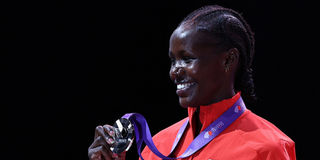
Kenya's Dorcus Ewoi reacts after winning silver medal ahead of Australia's Jessica Hull in the women's 1500m final at the World Athletics Championships in Tokyo on September 16, 2025.
Photo credit: Reuters
The race, scheduled for 9:36pm Kenyan time, is one of the highlights of the second day of the three-day championships, which also features the men’s and women’s 100 metres, 400m, and 800m finals.
Ewoi arrives in Budapest as Kenya’s leading hope in women’s 1,500m following the premature end to Faith Kipyegon’s season after injury.
And if her performance at last week’s Wanda Diamond League Final in Brussels is anything to go by, Ewoi has every reason to believe she can challenge for the biggest prize of her season.
She clocked a huge personal best of three minutes, 54.72 seconds to finish second behind Poland’s Klaudia Kazimierska, who produced a world-leading 3:54.05, also a meet and Polish national record. Australia’s Jessica Hull was third in 3:54.73, while Britain’s Georgia Hunter Bell was fourth in 3:56.40.
“I felt super good tonight and I ran a personal best. I’m really happy with that and the season has been great for me because it’s the first year that I got to run the full Diamond League,” Ewoi said after the race in Brussels.
Her campaign began with victory in indoor races in Boston before she won the B.A.A. Road Mile and collected podium finishes in Prefontaine Classic in Oregon and Silesia Diamond League. She was fourth in Xiamen.
She also arrived in Budapest with the confidence of being the reigning world silver medallist after running 3:54.92 behind Kipyegon at the Tokyo 2025 World Athletics Championships.
On Saturday night, she will renew her Brussels battle with Kazimierska, Hull and Hunter Bell in a compact field assembled for the Ultimate Championships.
The new $10 million (about Sh1.3 billion) World Athletics season finale brings together the best athletes in the world in 28 events, with fields restricted to between eight and 16 competitors comprising world champions, Olympic champions, Diamond League winners and the highest-ranked athletes.
For Ewoi, however, the challenge is not only about speed but it is also about the racing education she acquired in the United States.
Born in Kitale, Ewoi attended St Francis Girls High School before earning scholarships to South Plains College and later Campbell University.
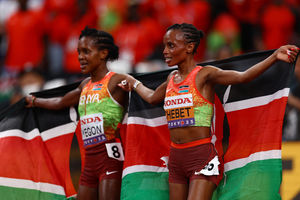
Kenya's Faith Kipyegon (centre) celebrates with her gold medal alongside silver medallist Dorcus Ewoi and fourth placed Nelly Chepchirchir after winning the women's 1500m final at the World Athletics Championships in Tokyo on September 16, 2025.
Photo credit: Reuters
She competed for the South Plains Texans and Campbell Fighting Camels before finishing fifth in the 800m at the 2023 National Collegiate Athletics Association (NCAA) Championships and turning professional with Puma.
The American system gave her what many young athletes need after leaving high school, a structured environment combining training, competition, sports science, facilities and education but perhaps most importantly, it taught her how to race.
The NCAA system exposes athletes to rounds, tactical races, crowded fields and the pressure of delivering when it matters and for a Kenyan middle-distance runner, that experience can be invaluable when moving from junior and collegiate competition to the ruthless environment of Diamond League and championship racing.
Her silver medal in Tokyo demonstrated that tactical maturity. Rather than getting drawn into an early battle, she stayed behind Kipyegon before making her move in the final 300 metres.
The late Henry Rono arrived at Washington State University in 1976 and two years later produced one of the most remarkable seasons in athletics history, setting four world records within 81 days in 1978 and winning double Commonwealth gold.
Rono, who died in February 2024 aged 72 in Kapsabet, Nandi County, was honoured last year with a bronze statue at Washington State University.
Paul Ereng offers another remarkable example of the opportunities created by the American system and after he received a scholarship to the University of Virginia, he went ahead to become the 1988 Olympic Games champion in the 800m race in Seoul before winning the World Indoor title in 1989 and 1991.
Three-time Boston Marathon champion Ibrahim Hussein was a product of the University of New Mexico, while Athletics Kenya Youth Development Chairman and NOC-K first vice-president Barnaba Korir built part of his athletics management experience at the Iowa States University in the United States.
Patrick Sang, the coach behind Eliud Kipchoge’s marathon success, also developed his own athletics career at the University of Texas, where he competed in the steeplechase.
On Saturday, the pipeline remains strong, with more than 250 Kenyan student-athletes pursuing university opportunities in the United States.