How lucky can Ruth Chepng’etich be after being convicted of doping? She gets to keep all her accolades, including the women’s marathon world record that had not even lasted for a year, before her doping bubble was busted.
Athletics Integrity Unit (AIU) can be lenient to athletes convicted of doping by reducing the sanction period if they admit to taking banned substances, which spares the organisation waste of time in investigating cases.
AIU issued Chepng’etich with a Notice of Charge seeking a four-year sanction on August 22, and she accepted the proposed sanction within 20 days.
The impending four-year ban on the two-time Chicago Marathon champion was then reduced by a year as per clause 10.8.1 (Early Admission and Acceptance of Sanction provision) of the Anti-Doping Rules (ADR).
AIU rules indicate that one can only be sanctioned based on the time and duration the anti-doping violation happened. Since Chepng’etich’s case dates back to March 14, this year, she gets to keep all her previous titles.
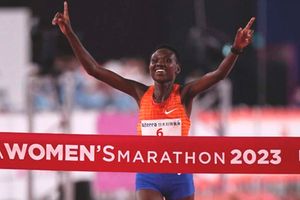
Ruth Chepng'etich wins Women's Marathon in Japan in 2023.
Photo credit: Pool
Chepng’etich had competed only once this year, at Lisbon Half Marathon on March 9, where she finished second in 1:06:20, before she was flagged down for the use of the prohibited
Chepng’etich, the Rosa Associati athlete, had withdrawn from this year’s London Marathon held April 27 alleging that she had not prepared well only for AIU to suspend her on July 17, this year, for the presence and use of Hydrochlorothiazide (HCTZ).
Chepng’etich had denied doping, but later admitted it, saying she mistakenly took her housemaid’s medication, a statement AIU deemed “hardly credible.”
In the past, AIU has been ruthless with Kenyan athletes who had been previously flagged down for doping but opted to challenge the positive tests with falsified documents. The heavy sanctions range from five years to 10 years, which is outside the official sanction period of between two to four years.
So far, 2019 Africa Games Half Marathon champion Titus Ekiru, who was banned in 2023 for 10 years, is the Kenyan athlete serving the longest ban.
Titus Ekiru celebrates after winning the Milano Marathon men's race in Italy in a new personal best time and course record of 2:02:57 on May 16, 2021.
Photo credit: Pool
The 2016 Olympics Marathon champion Jemimah Sumgong who was handed an eight-year ban from 2019 follows closely.
Sarah Chepchirchir, who was banned for four years from 2019 to 2023, was subsequently handed an eight-year ban in 2023 for using banned Testosterone alongside James Mwangi Wangari and Michael Njenga Kunyuga who also got eight years each in 2022.
Kenya's Jemima Sumgong celebrates after winning the women's marathon race at the Rio Olympic Games at Sambodromo in Rio de Janeiro on August 14, 2016
Photo credit: File | AFP
Also banned in 2019 for eight years were distance runner Salome Jerono Biwott and middle distance runner Eglay Nalianya in 2023.
The 2019 Chicago and Boston Marathon champion Lawrence Cherono, 2024 Seville Marathon champion Josephine Chepkoech and Salina Jebet are serving seven-year suspension each.
The 2019 world 10,000m bronze medallist Rhonex Kipruto, last year’s Standard Chartered Nairobi Marathon winner Ronald Kimeli Kurgat, distance runner Emmaculate Anyango, former national cross country champion Rodgers Kwemoi and Purity Temutai Komen have also been hand six-year bans each.
Rhonex Kipruto crosses the finish line to win the men's 10,000m race during the Diamond League on May 30, 2019 in Stockholm, Sweden.
Photo credit: File | AFP
The 2019 Standard Chartered Nairobi Marathon winner Brimin Misoi Kipkorir, the 2023 Barcelona Half Marathon champion Charles Kipkkurui Langat, Daniel Kinyanjui and Josphat Kipkemboi Kemei are all on five-year suspension.
Around 47 athletes and three coaches across the world have been banned for life for varying doping offices.
In Africa, only two athletes have been banned for life owing to repeat doping offences - Nigerian Shot put/discus thrower Vivian Chukwuemeka in 2012 and South African sprinter Innis Viviers in 2005.
One of the most high-profile life bans is that of Canadian Ben Johnson, who won the 1998 Olympic 100m title. In one of the highest profile cases, Ekiru was in 2023 been banned for a decade for both doping and tampering in a case that involved collusion with a high-ranking doctor in a Kenyan hospital.
One of his positive tests, for triamcinolone acetonide, came at the Milan Marathon in May 2021, which he won in 2:02:57, which ranked him the seventh-fastest all-time marathoner.