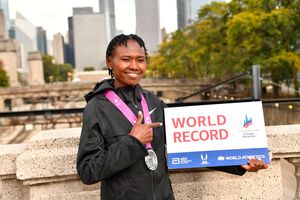
Marathoner Ruth Chepng’etich of Kenya will keep her world record despite being banned for three years by the Athletics Integrity Unit (AIU) for doping.
On Thursday, AIU, which is the independent integrity arm of World Athletics, announced that it had banned Chepng’etich for three years after the three-time Chicago Marathon champion admitted to Anti-Doping Rule Violations (ADRVs) regarding the presence and use of banned diuretic Hydrochlorothiazide (HCTZ).
The 31-year-old 2019 world marathon champion accepted the charges and sanctions following a positive test for the banned diuretic from a sample on March 14, 2025, and a subsequent AIU investigation. Chepng’etich, who is a member of Rosa Associati management, had withdrawn from the London Marathon held on April 27, 2025 alleging that she had not prepared well, only for AIU to pull the rag under her feet on July 17, 2025, by flagging her for anti-doping offence.
Ruth Chepng'etich wins Women's Marathon in Japan in 2023.
Photo credit: Pool
On Thursday, AIU’s Chief Executive Officer Brett Clothier said Chepng’etich will keep her world record and her previous victories because her ban only touches on the results she posted from March 14, 2025 to the present.
Chepngetich's achievements, which pre-date her March 14, 2025 sample that turned positive - including her world record time of two hours, nine minutes and 56 seconds, which she registered in Chicago on October 13, 2024 - will therefore stand.
The AIU issued Chepng’etich with a Notice of Charge seeking a four-year sanction on August 22, 2025. She admitted the Anti-Doping Rule Violations and, since she accepted the proposed sanction within 20 days on September 10, 2025, she was granted an automatic reduction of one year from her impending four-year ban (under ‘Early Admission and Acceptance of Sanction’ provision in ADR clause 10.8.1).
Chepng’etich broke the women’s marathon world record and became the first woman to run the full marathon in under two hours and 10 minutes when she clocked 2:09:56 to win the Chicago Marathon in October 2024.
Chepng’etich, who also won the Chicago Marathon in 2021, retained the title in 2022. She also won the 2023 Chicago Marathon.
Chepngetich had previously maintained that she could not explain the positive test and that she had never doped. She changed that explanation on July 31, 2025 and wrote to AIU that “she had now recalled that she had been taken ill two days before the positive test, and she had taken her housemaid’s medication as treatment, without taking any steps to verify if it contained a prohibited substance.”
She stated that she had forgotten to disclose the incident to AIU’s investigators. She sent a photo of the medication’s blister pack, which was clearly marked ‘Hydrochlorothiazide’.
While the AIU considered her new explanation to be hardly credible, for the purposes of the Anti-Doping Rules (ADR), it did not assist in mitigating the standard two-year sanction for a specified substance such as HCTZ. The ADR treats Chepng’etich’s taking her housemaid’s medication as “indirect intent”, for which a four-year sanction applies.
Ruth Chepng'etich celebrates crossing 10km senior women on December 17, 2022 during the Athletics Kenya Prisons National Cross Country championship at Prisons Staff Training College.
Photo credit: File | Nation
A statement from AIU indicated that whilst diuretics are known to be abused by athletes to mask the presence in urine of other Prohibited Substances, HCTZ has also been identified as a potential contaminant in pharmaceutical products.
WADA has ascribed a minimum reporting limit of 20ng/ml for it, below which a positive test should not be reported. An estimated concentration of 3800ng/mL of HCTZ was found in the positive urine sample collected from Chepng’etich.
When she was initially interviewed by AIU investigators on April 16, 2025, Chepng’etich could not provide an explanation for the positive test.
At the time, to rule out the possibility of contamination, evidence was collected from her, including her detailed recollection of all the supplements and medications she had taken in the lead up to the positive test, and all available supplements and medications in her possession were immediately retained by the AIU for analysis.
At a subsequent interview, on July 11, 2025, Chepng’etich was confronted with evidence acquired from her mobile telephone indicating a reasonable suspicion that her positive test may have been intentional.
Marathon champion Ruth Chepng'etich.
Photo credit: Pool
AIU explained that she was also informed that all the supplements and medications that had been taken for analysis had been reported by a WADA-accredited laboratory as negative for HCTZ.
AIU Chairman David Howman noted that Chepngétich’s conviction showed that nobody is above the rules, and lauded the industry’s commitment to protecting the integrity of the sport.