Spectators of the Chicago Marathon must have noticed a young man with a dark complexion who has been taking part in the wheelchair events since 2022.
His name is Michael Panther, and he insists the “Panther” is a South Sudanese noun that has nothing to do with the cat family.
During this year’s edition of the Standard Chartered Nairobi Marathon, he is aiming to do for the first time in Kenya what he has done numerous times in America – completing a full marathon on a racing wheelchair.
He won’t be participating for the sake of it. Even in the US, he has not been putting his wheelchair to task for no reason as he insists he is not a professional wheelchair marathoner. His main goal is to raise funds.
In his first Chicago Marathon in 2022, he says, he raised $250,000 (Sh32.4 million). Besides the four Chicago Marathon editions he has participated in, he has also taken part in three smaller marathons in the US. By taking part in the Standard Chartered Marathon, he hopes to raise Sh10 million that will fund the construction of wheelchairs for various children across Kenya.
“I want many children to have hope and dignity in their lives and be able to go to school,” he told Nation Sport, adding that he is also out to create awareness about the need for inclusivity for people living with disabilities.
He has been preparing for the marathon by hitting the road and eating well, though he admits that he hasn’t done the preparation to his satisfaction. How did a boy who was normal for the first 10 years of his life end up in a wheelchair? What took him from South Sudan to Kenya and then to the US? Why did he quit his nine-to-five job to focus on wheelchairs? He had a wide-ranging interview where he explained the trajectory of his life so far.
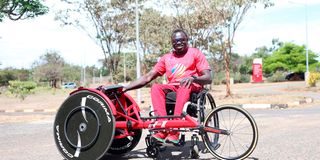
Michael Panther at Moi International Sports Centre, Kasarani, on September 29.
Photo credit: Chris Omollo | Nation
The story begins in South Sudan, which, in the early periods of his life, was the only home he and his parents knew. Then he fell sick. In a country ravaged by wars, this spelt danger for him, but he could hardly realise it. His sickness not improving, his father moved him to Kenya.
“Because of the war, there were no medical facilities. So, my dad had to journey with me to come to Kenya in search of treatment,” he said.
The journey began in 2005. Panther and his father first reached Kakuma Refugee Camp in Turkana, but the treatment he needed was not available there. Missionary doctors later arranged for him to be taken to AIC-CURE International Hospital in Kijabe. By then, two years had passed since he fell ill.
He was diagnosed with tuberculosis of the spine, a disease that had already caused extensive damage. He spent months in intensive care and about two more years in hospital, and his loss of mobility was now confirmed.
“I reached a point where I didn’t have hope in life,” he said.
The American doctor who treated him and his wife took him up as their child, becoming his legal guardians. Panther credits them with changing the course of his life.
“They couldn’t believe that I survived,” he said. “They felt like if they let me go to the refugee camp in a wheelchair, I would be nobody.”
“They’re a very incredible couple; a really wonderful Christian couple. And they listen to God. They told me that my mother, who is my American mum, had a conversation with God one day when she was visiting me; that God told her that they need to take care of Michael. And they have never done that before,” he said.
Panther retained his South Sudanese name as the couple did not adopt it as a family name. They then took him to the Machakos School for the Physically Disabled, where he sat his Kenya Certificate of Primary Education (KCPE) in 2008. He later joined Hillcrest International Schools, completing his studies in 2012, then went to the US for tertiary education. He studied economics at Louisiana State University.
America showed him what infrastructure could do. Roads, buildings and transport systems that were more accessible gave him freedom to study, work and drive without first asking whether he could enter a place. Yet his thoughts returned to Machakos, where he had seen pupils crawl to class or share a large trolley-like wheelchair among three or four children.
Michael Panther warms up while training to break the wheelchair race Three hours/Under in the 42-kilometre marathon on September 29, 2026, in this year's Nairobi Stanchart Marathon.
Photo credit: Chris Omollo | Nation
“I don’t want to just sit at a computer for a nine-to-five job,” he remembers deciding. “I want to tell my story so that it can impact other people.”
In 2018, he brought to Kenya a container of wheelchairs that he had collected from various well-wishers. That was a crucial step in the formulation of his organisation that aims at issuing wheelchairs. During the distribution time, he remembers that more than 1,000 people turned up.
The following year, the shipment grew to two containers and later four. He left his business job in 2020 to concentrate on the work.
His organisation, Hope Mobility, now has close to 40 employees, including therapists, mechanics and technicians, and sends teams into counties to assess recipients and fit devices. Panther says it has provided more than 15,000 wheelchairs since 2018, including 3,500 last year, and expects to distribute more than 4,000 this year.
The distinction between donating a chair and providing an appropriate wheelchair is central to his pitch.
“We don’t just give wheelchairs, because these are medical devices,” he said. “We customise them to meet the needs of the individual.”
The World Health Organisation’s 2023 wheelchair provision guidelines similarly emphasise individual assessment, fitting, user training and follow-up by trained personnel. A poorly matched chair can worsen posture and create new health problems, Panther warned. A child who cannot hold up the upper body may need harnesses, specialised supports and a tray, while foot placement must also be assessed.
“This wheelchair that I’m in right now can be very useless to somebody because it depends on the type of disability,” he said. “Sometimes a wheelchair can cause more problems to you if it’s not the right wheelchair.”
That need pushed his organisation into starting the production of paediatric wheelchairs in Kenya in 2024, working with partners in the US. It produced 1,000 in its first year and is aiming for about 2,000 this year, Panther said. Still, he describes the output as “a drop in the ocean”. He estimates the national need among children at about 200,000 devices and wants production eventually to reach 10,000 paediatric chairs a year.
Kenya’s 2019 census recorded 918,270 persons with disabilities, while the National Council for Persons with Disabilities has cited a shortfall of about 550,000 wheelchairs and assistive mobility devices, including 200,000 needed by children. Panther knows only too well how a wheelchair can transform a child’s life.
Michael Panther before his warm-up training on September 29, 2026 at Moi International Sports Centre, Kasarani. He is aiming to break the wheelchair race Three hours/Under in the 42-kilometre marathon in this year's Nairobi Stanchart Marathon
“You’ve been lying on the ground; you cannot move. With this one, now you can move around. You can go to the washroom. You can sit down, you can eat by myself,” he said. “It gives them freedom and dignity.”
The effect reaches caregivers, too. Parents who have carried children for years often develop back problems as the children grow heavier. A suitable chair, he said, can allow a child to attend school and can free a parent to work.
“A wheelchair really makes somebody alive,” Panther said. “You just see them light up.”
On October 25, during the 23rd Standard Chartered Nairobi Marathon, he will be participating using his red racing wheelchair nicknamed the “Red Ferrari”.
The marathon is scheduled to start and finish around Uhuru Gardens, with runners assembling off the Southern Bypass. The programme includes a 21-kilometre wheelchair race, but Panther plans to tackle the full 42 kilometres.
“This will be historic because no person in a wheelchair has ever done a 42-kilometre marathon here in Kenya,” said Panther.
Organisers of the Standard Chartered marathon say the 2025 event drew 184 wheelchair athletes and more than 80 participants with other disabilities, up from 153 participants with disabilities in 2024.
The full-distance attempt is a different proposition from Chicago. Panther says Nairobi’s hills and altitude make it tough. He realised this only too well when he attempted training on the Southern Bypass recently.
“Going up the hill, you feel like you cannot breathe,” he said. “This is going to be my toughest marathon that I’ll ever do in my life.”
He is targeting three hours, perhaps three and a half, but insists the clock is secondary.
“I’m not here to set a record,” he said. “Maybe the only milestone is that I will be the first person to do the marathon. I know the next person who will come and do it will break that record in a minute.”
Eliud Kipchoge’s visit to Hope Mobility added encouragement. Panther said the two-time Olympic champion reiterated to him his “no human is limited” motto.
“It was very humbling for him to come and pay us a visit and to be able to support me and encourage me,” he said.
The Sh10 million target would fund 200 customised paediatric wheelchairs at about Sh50,000 each. Panther says all donations will go to production. On the campaign website, where M-Pesa contribution details have been published, Sh549,409 had been raised by September 28.
He is a child of three countries: South Sudan is his birthplace, Indiana (where he lives in the US) is where the organisation began, and Kenya is the country that gave him treatment, schooling and what he calls a second chance.
Now he hopes that a gruelling October 25 morning on Nairobi’s roads can offer respite to hundreds of children.