The Nairobi City Marathon 2026 drew thousands of runners onto the streets of the capital on Sunday, but for many first-timers, the race was less about medals and finishing times and more about venturing onto unfamiliar territory.
Wambugu Mangua, a psychologist, mountaineer and founder of Soul to Sole Adventures, said he signed up for his first marathon after finding shorter distances no longer challenging.
Wambugu attempted the 42-kilometre challenge, but didn’t set any targets in terms of time or pace. Although he had completed 5km, 10km and half-marathon races before, the full marathon was uncharted territory.
“My expectation was just to cross that line. The time didn’t matter, and neither did the pace. I was there to have fun and throw myself into a new challenge,” he said.
“My breathing was off, I had a stomach upset, my head was spinning...I was scared,” he recalls. Once the race started, however, the nerves gave way to determination.
What stood out most, Mangua said, was the camaraderie among runners. Participants paced together, shared advice on hydration and encouraged one another throughout the course.
Wambugu Mangua, a registered psychologist and outdoor enthusiast, completed his first-ever marathon at the Nairobi City Marathon on June 7, 2026.
Photo credit: Pool
“Listen to your body. If your body tells you to stop, do it or reduce your pace,” he said, noting that fellow participants played a major role in keeping morale high.
The race was not without challenges. Mangua pointed to gaps in hydration and medical support, particularly between kilometres 26 and 32, where cramping and fatigue began to take their toll.
“There were no supplies along the way. I was really suffering after the 21km mark,” he said, explaining that he had to rely on gels and electrolytes he carried himself. One of the toughest stretches came along the expressway, where several runners dropped out.
“I was tempted to also go because I felt like I was dying, but I remembered the goal was to finish,” he said.
Upon crossing the finish line, Mangua felt a deep sense of gratitude, but also deep respect for the sport and fellow runners.
“I thrive in community. Alone, I negotiate with myself, but with the community there’s no negotiation, you go all the way,” he said.
The experience has already sparked thoughts of future endurance challenges, including ultramarathons and even a triathlon.
Mutinda Kilonzo, a creative entrepreneur and artist, took part in the Nairobi City Marathon for the first time, completing the 21km race.
Photo credit: Pool
While Mangua was chasing a new endurance challenge, creative entrepreneur Mutinda Kilonzo was drawn to the marathon for a different reason: the chance to experience Nairobi from the inside rather than from the sidelines.
“I wanted to be part of the culture of Nairobi,” he said, adding that his fascination with the city’s landscapes, including the expressway, and encouragement from friends, also pushed him to sign up.
While this was not his first race, it was his longest distance so far, having previously taken part in a shorter 11-kilometre event. For this edition, he completed 22 kilometres, describing it as both intentional and accidental due to detours along the way.
On preparation, Kilonzo admitted he did not train extensively but relied on social media content, especially running tips circulating on TikTok, alongside a few short training runs.
Recalling race-day emotions, he described a mix of fear and excitement at the starting line, but said the sense of community quickly reassured him.
“I felt very Kenyan. I felt very Nairobian. I felt like I belong,” he said.
Kilonzo was struck by the diversity of participants, from families and older runners to people living with disabilities, describing the experience as “interesting” and deeply moving.
“So many different people were running next to me. It was very beautiful to see,” he said.
The race was not without challenges. Shoe problems, blisters and occasional cramps forced him to stop, walk, and adjust his pace to manage discomfort, while limited hydration and sanitation facilities added to the discomfort. Yet the atmosphere along the route kept him going.
“The crowd motivated me. It entertained my brain and kept me engaged throughout,” he said, recalling the music, dancing spectators and shared energy that transformed the race into a citywide celebration.
Among his most memorable moments were running through the CBD, particularly Kenyatta Avenue and Uhuru Highway, as well as finishing the race and meeting friends along the way. “Crossing the finish line was the most memorable part. It left me feeling relieved, proud, and empowered.”
For Kilonzo, the biggest takeaway was not pace or distance, but taking the first step.
“I learned that I can do anything if I just start. My mind is the only obstacle standing between me and doing something,” he said, adding that the experience has already pushed him to consider taking on similar challenges.
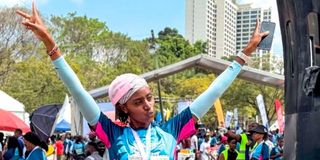
Whitney Nyathira celebrates after finishing the 21km race of the Nairobi City Marathon on June 7, 2026.
Photo credit: Pool
As Kilonzo approached the marathon as an urban adventure, Whitney Nyathira treated it as a promise to herself at the beginning of the year.
“I am determined to do everything I said I would do this year, and in that list was signing up for a marathon,” she said.
Having registered for the 21-kilometre race in April, completing it became part of a broader commitment to follow through on personal goals.
For Nyathira, the race marked a significant milestone in a relatively new running journey. Just six months earlier, she had never run beyond four kilometres.
“I started running consistently in October last year, and I would only manage two or three kilometres. I was like, if I can do four, I can do eight, and if I can do eight, I can do 16.” The half marathon was her first competitive race.
Preparation involved consistency rather than intensity. She maintained weekly long runs, often exceeding 10 kilometres, either alone or with the running community, We Run Nairobi.
“I was consistent with running three times a week,” she said, although balancing gym sessions eventually meant focusing mainly on weekend runs.
During the race, Nyathira found strength in the collective energy of fellow runners. For the first five kilometres, she followed a pacing group aiming for a two-hour-15-minute finish.
Camaraderie among participants
“There was a lot of cohesion and energy,” she said. “People were chanting, and I didn't even have to keep checking my watch.”
“The elevation was really tough,” she said, also pointing to widely spaced hydration stations.
To manage fatigue, she incorporated walking breaks, particularly around the 10-kilometre, 11-kilometre and 18-kilometre marks.
“It was euphoric,” Nyathira said. “I was so proud of myself. I've never done this in my life. It sounded so scary, but I did it.”
“I'm still wearing it right now at work,” she added.
Far from being a one-off achievement, the marathon has inspired her to pursue even bigger challenges. Already planning to sign up for future races, Nyathira has set her sights on eventually completing a full marathon.
Like several first-time runners, she also credited the atmosphere and camaraderie among participants for helping her push through difficult moments.
Tina Nduta (right), a creative finance professional at the Kenya Museum Society, poses for a photo with her cousin, Catherine Wangui, after completing her first-ever 10km race at the Nairobi City Marathon on June 7, 2026.
Photo credit: Pool
Unlike Nyathira, whose race was months in the making, Tina Nduta's marathon journey began almost by accident.
"This was so random," the creative finance professional at the Kenya Museum Society said, explaining that a friend invited her to join as they were discussing plans to meet.
"I actually didn't know Nairobi City Marathon was on. I just said yes because I wanted to go hang out with my friend."
Despite signing up for the 10-kilometre race, Nduta was venturing into unfamiliar territory. Having only started running in March through a local running club, Iron Kino, the furthest she had run before the marathon was six kilometres.
"I was a bit skeptical about doing the 10 kilometres," she said, recalling a failed attempt at an 8km run a few weeks earlier due to dehydration and poor preparation.
Her training consisted mainly of Saturday morning runs with the club whenever her demanding work schedule allowed. In the days leading up to the race, she focused on rest, hydration and nutrition.
"I made sure I had eaten well the previous night, drank lots of water and slept really well," she said, adding that encouragement from fellow runners in the Iron Kino WhatsApp group also boosted her confidence.
Going into the race, Nduta had simple goals.
"I just wanted to have fun, hang out with my friends and make sure to finish so I could get a medal," she said. Unlike seasoned runners chasing personal bests, she approached the marathon with curiosity rather than expectations.
The race quickly tested her resolve. Fatigue set in earlier than expected, and shortly before reaching the expressway section, she became nauseous and threw up.
"I was like, 'Oh my God, people are looking at me. I'm already throwing up and we've not even gotten onto the expressway. What is the rest of the journey going to look like for me?'" she recalled.
The difficult moment revived memories of an earlier unsuccessful 8km attempt, but she refused to let it derail her race. Encouraged by her cousin, who insisted they finish together, Nduta pushed on.
"I didn't want to slow her down, but she was very kind to wait for me," she said.
The atmosphere around the course also played a major role in helping her persevere. Seeing hundreds of fellow participants continue running motivated her to keep moving.
"The moment you walk and other people are jogging, you see this huge crowd of people passing you," she said. "I didn't want that. I didn't want to walk."
She also drew inspiration from the live music, cheer squads and fellow runners she encountered along the route.
"It felt so fulfilling. It felt like I'd achieved something," Nduta said. "Getting the medal was quite nice."
The experience has also inspired her to take running more seriously. Already considering future races, including the Standard Chartered Marathon, she said the experience proved that she enjoys challenging herself.
"I'm glad I set my mind to finish, and I did," she said. "This is something I want to do again."