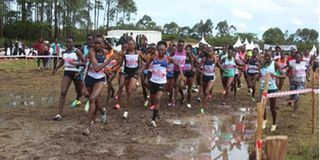
As the Athletics Kenya cross-country season gets underway in Machakos this Saturday, elite athletes will be looking beyond the mud, hills and grueling loops, viewing the opening meeting as the first step towards a successful track and field season.
For many athletes, cross-country is more than a test of endurance and it is an opportunity to build strength, sharpen racing tactics and develop the mental toughness required to compete against the world's best when the track season gathers momentum.
The opening meeting in Machakos marks the beginning of the Athletics Kenya series, which traditionally comprises six events before the competition moves to the county and regional levels, discipline-specific trials and the national championships.
The national championships will be particularly important this season, as they will help determine the Kenyan team for the Africa Cross Country Championships scheduled for March 20 in Mbabane, Eswatini.
However, while the immediate prize for some athletes will be national selection and a chance to represent Kenya internationally, others will be using the series as a crucial component of their preparations for the track and field season.
Kenya's distance-running stars have increasingly demonstrated that a successful campaign on the track can begin on the grass.
World-class athletes are often attracted to cross-country because of its unique physical and tactical demands, and unlike track racing, where athletes compete on a predictable surface, cross-country presents constantly changing conditions, including uneven terrain, sharp bends, hills, soil and mud.
These conditions force athletes to adapt their stride, maintain balance and adjust their pace according to the demands of the course.
The races also provide an opportunity to develop strength and endurance without the repetitive demands of running multiple sessions on a synthetic track. For middle and long-distance runners, that strength can become particularly valuable when the pace accelerates in the closing stages of a championship race.
Cross country also teaches athletes how to compete in a crowded field, negotiate changes of pace and position themselves strategically before launching a decisive move.
Agnes Jebet Ngetich wins the senior women's race in 31:28 during the World Athletics Cross Country Championships Tallahassee 26 at Apalachee Regional Park on January 10, 2026.
Photo credit: Kirby Lee | Reuters
Agnes Jebet Ngetich is among the athletes whose performances have demonstrated the benefits of starting the year on the cross-country circuit.
The road races star began her campaign with a victory at the World Cross Country Championships in Tallahassee, Florida, USA, setting the tone for a remarkable season. She also won the Sirikwa Classic Cross Country in February, underlining her ability to thrive on challenging terrain.
“I just love competing in cross country events because it sharpens your preparations for the season ahead and I’m excited to have won the world title this year after a long search for the medal,” said Ngetich after bagging the title.
Her performances illustrate how cross-country can provide a strong platform for athletes targeting major competitions later in the year, and she has proved that after winning the World Athletics Road Running Championships Half Marathon title in Copenhagen last month.
Kenya's John Korir crosses the finish line to win the men's elite race during Boston Marathon on April 20, 2026.
Photo credit: Reuters
John Korir is another leading Kenyan athlete who has used cross-country as part of his seasonal preparations.
Korir began his campaign at the Sirikwa Classic this year, powering to victory in impressive fashion.
Korir would then go ahead to win the Boston Marathon title on April 20 when he clocked a course record of 2:01:52 ahead of Tanzania’s Alphonce Simbu (2:02:47) and Kenya’s Benson Kipruto (2:02:50).
For marathoners and road-racing specialists, cross-country can provide an opportunity to develop strength, improve running efficiency and build resilience before the demands of the longer road-racing season.
The rough terrain and changes in pace can also help athletes develop the strength needed to maintain their rhythm when fatigue sets in during road races.
While cross-country is particularly valuable to distance runners, its benefits are not confined to long-distance events.
Lilian Odira provided an exciting example of how a different approach to seasonal preparation can pay off on the track.
Kenya's Lilian Odira celebrates after winning gold in the women's 800m final during the World Athletics Championships in Tokyo on September 21, 2025.
Photo credit: Reuters
Odira began her 2025 campaign by competing in the 2km loop during the cross-country season before going on to win the women's 800m world title at the World Athletics Championships in Tokyo last year.
The middle-distance star attributed part of her preparation to the cross-country build-up, demonstrating that the discipline can benefit athletes competing at distances where speed, strength and tactical awareness must work together.
For an 800m runner, cross-country provides an opportunity to build endurance and physical strength, qualities that become important when maintaining speed through the final stages of a demanding race.
As the 2026/2027 series opens in Machakos today, athletes will therefore have different objectives, depending on their events and competition schedules.
Some will be targeting the Africa Cross Country Championships, while others will be seeking to establish a strong endurance base before turning their attention to track meetings and international competitions.
One of the big attractions in Machakos could be Abel Kipsang, the 2022 World Indoor 1,500m bronze medallist.
The six-event circuit will provide opportunities to assess fitness, experiment with race strategies and build confidence against competitive opposition. The subsequent county and regional competitions will also give emerging athletes a chance to measure themselves against their peers as they pursue places at the national championships.
For coaches, the early races offer useful feedback on how athletes are responding to training and whether adjustments are needed before the major competitions begin.
Athletics Kenya head coach Julius Kirwa urged athletes to compete in the cross-country events because it’s a good build-up for what will be a busy season.
“Cross country running helps an athlete to prepare and at the same time gauge himself or herself ahead of the track season. Remember we have World Athletics Championships next year among other events. There are also the World Athletics Continental Cross Country events, which have already started,” said Kirwa.