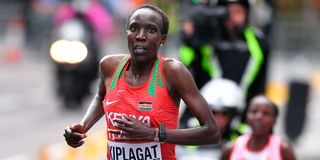
When Edna Kiplagat crossed the finish line in fourth place at the New York Marathon on November 1, she had more than just another impressive result to celebrate.
Then 46 years and 351 days old, the Kenyan marathon great once again demonstrated that experience, discipline and an enduring passion for running could keep an athlete competitive long after many of her contemporaries had retired.
Kiplagat, who turns 47 today, is already thinking of her next Majors marathon race.
Defying her age, Kiplagat was in contention for a win in the New York Marathon, tussling with the lead runners Sheila Chepkirui and Hellen Obiri before they dropped her with some nasty accelerations.
Thirty-two-year-old Chepkirui, won in 2:24:36 as American Jessica McClain (34 years) finished second in 2:24:42, with Obiri (35 years) coming in third in 2:24:43. Kiplagat clocked 2:25:42 for her fourth place finish.
For Kiplagat, a mother of five children, including two adopted from her sister who died of breast cancer in 2003, and one adopted from a neighbor who died in childbirth in 2013, the performance was another reminder that she still has what it takes to compete against athletes decades younger.
“The results mean even at 46, I can still be competitive and inspire many to believe in themselves and do great things,” she told Nation Sport in a telephone interview from Boulder in Colorado, USA where she resides with her family.
Born and raised in Kapkoi village, Mutei location, in Elgeyo Marakwet County, Kiplagat’s athletics career has spanned nearly three decades, spiced by many honours in distance running.
She won the World Athletics Championships women’s marathon in 2011 Daegu and 2013 Moscow. In doing so, she became the first woman to win back-to-back world marathon titles.
For good measure, she added a silver medal at the 2017 World Championships in London.
Edna Kiplagat celebrates after winning the women's marathon at the 2013 IAAF World Championships at the Luzhniki stadium in Moscow on August 10, 2013.
Photo credit: File | AFP
Her achievements on the World Marathon Majors circuit are equally impressive. Kiplagat won the 2010 New York Marathon, 2014 London Marathon and 2017 Boston Marathon.
She finished second in the 2021 Boston Marathon but was later declared the champion after the original winner Diana Kipyogei was stripped of the title because of a doping violation.
Kiplagat started racing in elite local meets at 16 years. When she emerged at the county level, she earned an invitation to the Iten Youth Camp by Bro. Colm O’Connell, a breakthrough moment in her career.
A prodigious talent, she continued to improve, qualifying for the nationals and trials for the World Junior Cross Country Championships in Cape Town, South Africa, in 1996, where she finished fourth. Thirty years later, she is still going strong.
Kiplagat points to a strong support system, particularly her family, with her husband Gilbert Koech playing a central role as both coach and confidant.
“I also have a good support system from my team, including Puma, race organisers who believe in me and my training mates,” she said.
“It’s the love of this sport, and my passion for running that keeps me going and it has become like a fashion where the body just keeps on running,” she said.
Kiplagat has had to adapt to her training environment in the USA after years of living and training in Kenya’s celebrated high-altitude running hub of Iten in Elgeyo Marakwet.
She misses the large running community in Iten, where athletes train together and motivate each other. In Boulder, she says she works with a smaller circle of training partners under the guidance of Koech.
Her approach to training has also evolved, where rather than relying solely on mileage and intensity, she now places emphasis on recovery, strength and mobility.
Kenya's Edna Kiplagat celebrates after winning a silver medal in the women's marathon at the 2017 IAAF World Championships in London on August 6, 2017.
Photo credit: File | AFP
She can still run up to 160 kilometres a week, but understands that managing her workload is increasingly important as she advances in age.
Kiplagat does not view the younger generation as opponents to be feared, but instead, she draws confidence from lining up against them. She believes her experience gives her an advantage.
“Some fear me because I have experience and I might be intimidating but I hope they have respect for me. No matter the age or experience, everyone who lines up at the start is a competitor and is there to win,” she said.
Beyond competing, Kiplagat has increasingly embraced her role as a mentor, particularly to young Kenyan women pursuing athletics opportunities in the United States.
“When I retire, I will continue running and being a mentor to the younger generation,” she said.
Kiplagat keeps her options open on life after elite competition, saying she has yet to decide whether coaching or sports administration will form part of her next chapter.
One thing, however, is certain. She wants to remain connected to athletics and help nurture future champions.
Away from the track, Kiplagat is an amazing mother and a devoted Christian. Her hobbies include watching movies, working on the farm, and cooking.
She enjoys bike rides on easy days as part of cross-training, alongside skipping rope and walking.
Her favourite foods are ugali, chapati, spaghetti, lamb, chicken, vegetables, and fruits. Though she follows a diet when training, she does cheat occasionally with a meal of fries, burgers, and pizza, which she loves.
“Marathon training needs a lot of time, patience, and it is challenging. Without good preparations, one can’t make it,” she said.
Her message to athletics mothers in Kenya, particularly those in Iten is who find it challenging mixing motherhood with elite athletics is: “They need a plan and time management, to continue with their talents and raising their family. It’s not an easy task balancing both but you have to sacrifice for your family,” she said.
For a woman who has conquered the biggest marathon stages in the world, the next challenge may not be another medal or major title. It could be helping another generation discover just how far their dreams can take them.