Four years ago when former cricketer Manoj Patel was elected chairman of Cricket Kenya (CK), optimism swept through the local cricket circles.
Years of leadership wrangles had impeded the growth of Kenyan cricket, weakening the national teams, and Manoj’s promise of revival struck the right tone among local cricket stakeholders.
Yet when his term quietly ended on Thursday, most of those pledges remained unfulfilled, leaving the local game deeper in problems, and stakeholders more divided than before.
“We are worse than where he (Manoj) found us,” lamented former Kenyan international Francis Otieno.
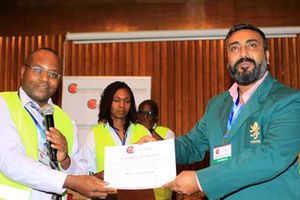
Manoj Patel (right) receives his election certificate from chairman of Cricket Kenya's electoral panel Ken Mutuma on February 26, 2022 after he was elected chairman of the local cricket federation at the Moi International Sports Centre, Kasarani.
Photo credit: Chris Omollo | Nation Media Group
Another former international, Alfred Njuguna, was more blunt, summing up Manoj’s tenure as “four wasted years”.
Although many local cricket stakeholders regard his time as head of the local federation as wasted years, Manoj did not respond to queries put to him by Nation Sport regarding his performance in the last four years.
The 44-year-old businessman also failed to respond to text messages and phone calls to his known phone numbers.
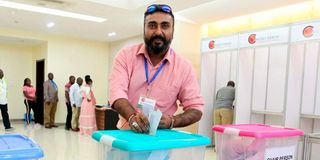
Manoj was overwhelmingly elected CK chairman on February 26, 2022. He secured a resounding victory with 51 votes, while his competitors, Chidambaran Subramanian and veteran cricketer Tariq Iqbal, got no votes.
Other officials elected alongside him on the day included Maina Kiruma Kamau (vice chairman), Kalpesh Solanki (treasurer) and former Kenya internationals Pearlyne Omamo and Kennedy Otieno Obuya, who went unopposed as Director for Women’s Cricket and County Associations Representative respectively.
The elections followed year-long stakeholder engagement facilitated by the CK Normalisation Committee led by Justice (retired) Joyce Aluoch, a process that birthed the 2021 CK Constitution. The CK Normalisation Committee was constituted by the government.
The officials were elected for a four-year term. In the days leading to Cricket Kenya elections, Manoj outlined his vision to Nation Sport, promising to leverage his networks to ensure adequate funding for the game locally.
He also pledged to improve player welfare, establish national men and women’s cricket leagues, and increase international exposure for the national team players by ensuring Kenyan players regularly against some of the world’s top teams.
Additionally, he committed to strengthening cricket at the grassroots by establishing age-group teams, starting from the Under-12 level.
“I know some people have been asking that what if ICC (International Cricket Council) does not release the funds? I am not relying on them because I have sponsors all over the world and that is how we have been organising cricket tournaments across the country,” Manoj told Nation Sport then.
“We will have a national league but it will take time…I want to focus more on women’s cricket because their chances of qualifying for the World Cup is high. But everything will be done equally to the two teams,” he added.
But when Manoj’s term concluded on Wednesday, there were no notable achievements for the teams, and CK remains embroiled in leadership wrangles, much like in the period before him.
Manoj has also faced corruption allegations. Kenyan cricket still struggles financially due to lack of reliable sponsorships, and Kenya remains under ICC’s controlled funding programme. The national team performances have also deteriorated, and players are enduring months without pay.
Additionally, the national teams’ preparation for international assignments throughout the four years have been inadequate while there are still no national men’s or women’s leagues as well as the age group teams.
“There has been zero achievement under him (Manoj),” Njuguna noted. “We don’t even have to look at what he promised but what he has delivered which is zero”.
For his part Otieno said: “We expected a lot from him (Manoj) but instead he has let us down. His performance is below par.”
The two former internationals expressed disappointment that Manoj failed to steer the country out of ICC’s controlled funding programme during his tenure.
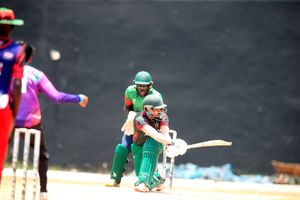
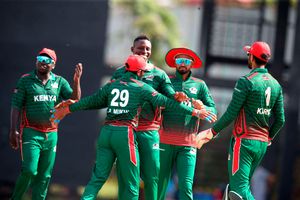
Kenya batsman Lucas Ndandason celebrates a wicket against Papua New Guinea during their ICC Cricket World Cup Challenge League 'A' match at Nairobi Gymkhana on October 5, 2024.
Photo credit: Chris Omollo | Nation Media Group
After a three-year pause due to persistent leadership wrangles at CK, ICC resumed funding Kenya in June 2023, but under controlled funding programme. Under the arrangement, ICC only releases funds to its members on a quarterly basis, with members required to strictly adhere to budgets approved by the world cricket governing body when utilizing the funds.
Kenya received $409,000 (Sh52,761,000 as per the current exchange rate) for the first quarter of 2023. This arrangement was to last until CK streamlined its governance structures after which full funding would resume.
However, close to three years later Kenya is still operating under controlled funding. “Kenya getting out of controlled funding was very important for the growth of the sport but even that he failed to achieve,” noted Otieno.
In September last year, the Directorate of Criminal Investigation summoned Manoj and Obuya over the alleged theft of Sh26 million belonging to CK.
The matter is still under investigation. Earlier in July, the CK board passed a vote of no confidence on Manoj for, among other things, “soiling the CK chairmanship’s position for personal benefits at the expense of the credibility of the larger organization.”
Other allegations included cutting deals, and failing to attend interviews set by auditors concerning “serious issues raised about CK’s accounts.’
CK board had been split as a result of the Sh255 million, five-year deal that the federation signed with a Dubai-based sports promotion company AOS Sports Tournament in April last year. Under the agreement, Nairobi was to host a high-profile T20 League involving Test-playing nations. It was cancelled controversially.
Trouble started in August 2025 when Manoj, and Obuya insisted on the tournament proceeding as planned, while seven members opposed on grounds that it had not been approved by the ICC.
The seven board members who opposed the tournament from happening as scheduled are CK Chief Executive Ronald Bukusi, Omamo, Development Director Thomas Odoyo and members Tariq Iqbal, Mary Maina, Beryl Oyugi, and Pauline Njeru. Due to lack of reliable sponsorship, the players are currently owed eight months’ salary.
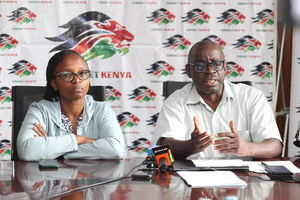
Cricket Kenya (CK) board member Pauline Njeru and CEO Ronald Bukusi speak to the media at Ruaraka Sports Club in Nairobi on September 11, 2025.
Photo credit: Victor Otieno
On the field, Kenya’s performance has consistently deteriorated with Uganda overtaking them as the giants of East Africa. With the national cricket elections planned for April 19, the cricket stakeholders agree that the elections present a crucial opportunity for the country to reset, and rebuild.
“We want a visionary leader. We want to see what somebody has done before,” said Njuguna.
“It will not just be an election for us but a big milestone. It will determine whether we remain in the system of the International Cricket Council (ICC) or be kicked-out,” said Nakuru-based cricket stakeholder Charity Wambui in a previous interview with nation sport.
In September 2024, Kenya parted ways with national men’s senior team coach Dodda Ganesh from India after just a month since his appointment. CK board accused Manoj of irregularly appointing him.