There is a specific kind of electricity that vibrates through a stadium when the hosts are winning, but in Tangier and Rabat this week, that energy feels different. It is deeper. It is the sound of a continent finally trusting its own mind.
For the first time in six decades, the semi-finals of the Africa Cup of Nations (Afcon) feature a line-up in which every coach on the touchline is a son of the soil.
As Morocco, Nigeria, Senegal, and Egypt prepare for the penultimate stage of the 2025 tournament, the narrative has shifted. For years, the ‘White Witch Doctor’, the European journeyman with a clipboard and a hefty salary, was the standard for success in African football. But today, the blueprint is being written in local dialects.
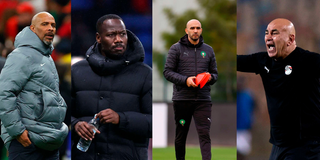
African coaches (from left): Eric Chelle of Nigeria, Pape Thiaw(Senegal), Walid Regragui(Morocco) and Hossam Hassan (Egypt)
Photo credit: Reuters
The emergence of Walid Regragui, Eric Chelle, Pape Thiaw, and Hossam Hassan marks more than just a statistical anomaly; it is a historic reclamation. It proves that African coaches are no longer simply temporary ‘caretakers’ or emotional motivators; they are the primary architects of the game’s highest tactical level.
The death of the 'foreign expert'
The shift didn't happen overnight. It was built on the shoulders of Djamel Belmadi’s game plan precision with Algeria in 2019, Aliou Cissé’s tireless determination with Senegal in 2021, and Émerse Faé’s miraculous ‘rescue mission’ with Côte d’Ivoire in 2023. These men proved that local knowledge isn't merely about understanding the culture; it’s about knowing how to navigate the specific, high-pressure psychological terrain of an African tournament.
At 2025 Afcon in Morocco, the numbers tell a story of dominance: 15 of the 24 participating teams were managed by African coaches. Eleven of them reached the knockout stages. Perhaps most telling is that African-led teams have claimed 75% of all victories in this tournament. This isn't just a ‘growing trend"—it is a takeover.
“This shows the progress that has happened in African football; players have also done well. What made it more interesting is the beauty of the football we have witnessed.”
“The Afcon has been the toughest because our football is progressing. We’ve seen so many exceptional Africans. It’s an added value for this tournament …”
South African journalist Tokelo Mokhesi believes the tide has shifted and that African coaches are beginning to occupy “their space”.
“Federations are beginning to show faith in local coaches. All they ever needed was time to prove themselves, and they are certainly doing so. Maybe the success of coaches like Walid Regragui, Aliou Cisse, Pitso Mosimane and Emerse Fae,” Mokhesi said.
Walid Regragui: The pragmatic visionary
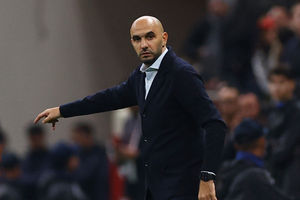
In Morocco, Walid Regragui is less a coach than a national hero. After orchestrating the Atlas Lions' historic run to the World Cup semi-finals in Qatar, the 50-year-old is at this moment responsible for ending a 50-year drought on home soil.
Morocco coach Walid Regragui.
Photo credit: Siphiwe Sibeko | Reuters
Regragui’s genius lies in his pragmatism. He has taken a squad brimming with European-born superstars like Brahim Díaz and convinced them to buy into a rigid, high-energy defensive structure.
Watching Morocco ease past Cameroon 2–0 in the quarter-finals felt like watching an exhibition of game management. Regragui doesn't just play football; he solves the opposition like a puzzle, blending European strategic rigour with a fierce, localised pride.
Éric Chelle: The super eagles’ quiet revolution
If Regragui is the gold standard, Éric Chelle is the revelation. Born in Côte d'Ivoire and having represented Mali as a player, Chelle took the reins of Nigeria’s Super Eagles in early 2025 to a chorus of scepticism. Nigeria has a notoriously difficult relationship with its coaches, often fluctuating between expensive foreigners and local legends.
Nigeria's coach Eric Chelle.
Photo credit: Reuters
Chelle, 48, has brought a quiet, structured calm to a squad that has often been described as "talented but disjointed."
His Nigeria is balanced. They don't just rely on solo talent; they build from the back, with a collective responsibility that has been missing for years. His 2-0 clinical dismissal of Algeria in the quarter-finals was a self-redemption for Chelle, who had exited the previous edition painfully at the hands of Mali. Now, he stands two games away from becoming an immortal figure in Lagos and Abuja.
Pape Thiaw: The young lion
Filling the shoes of Aliou Cissé, the man who came to define Senegalese football for a decade, was never going to be easy. Yet, 44-year-old Pape Thiaw has done so with notable composure. Having already won the African Nations Championship (CHAN) with Senegal’s home-based stars, Thiaw has smoothly moved into the big stage.
Senegal's coach Pape Thiaw.
Photo credit: Reuters
His philosophy is refreshingly honest. Captain Kalidou Koulibaly recently noted that under Thiaw, the goal isn't necessarily to ‘play beautiful football,’ but to win. Their 1-0 quarter-final victory over Mali was a gritty, ugly affair—the kind of win that wins championships. Thiaw represents the new generation: young, technologically savvy, and tactically resilient.
“I think the results are worthy of recognising African coaches because the last four teams are under Africans. They deserve credit because they’ve done so well.
“The Egyptian coach is doing a good job; he’s been an AFCON champion as a player. Unfortunately, it’s not the same for me, although I didn’t win when I made the final.”
Hossam Hassan: The Pharaoh’s spirit
Then there is Hossam Hassan. To understand Egyptian football is to understand the fiery, unshakable drive of Hassan. A three-time Afcon winner as a player, he has returned to the Pharaohs alongside his twin brother, Ibrahim, to restore a "knockout mentality."
Egypt coach Hossam Hassan.
Photo credit: Siphiwe Sibeko | Reuters
Hassan has implemented a flexible five-man defensive system that allows for lightning-fast transitions, perfectly suited for the ageing but still lethal Mohamed Salah. Their 3-2 thriller against defending champions Côte d’Ivoire showed the world that Egypt has found its bite again. Hassan is chasing a rare feat: winning the trophy as both a player and a coach, a feat achieved only by the legendary Mahmoud El-Gohary and Stephen Keshi.
As the tournament moves to Rabat and Tangier for the final four, the air of uncertainty usually reserved for the tactical confrontation between a local coach and a "European expert" is gone.
Whoever lifts the trophy on Sunday, the victory will belong to the continent. It will be a celebration of a tradition where homegrown tacticians no longer look abroad for answers.
They are looking at each other, and in doing so, they are motivating a new wave of African managers to realise that the most successful version of African football is the one coached by Africans.