The next four months will be make-or-break for Kenya and its neighbours Uganda, and Tanzania in as far as co-hosting the 2027 Africa Cup of Nations (Afcon) finals is concerned.
In a worrying development, the Confederation of African Football (CAF) has found that none of the proposed venues for the upcoming Afcon across the three countries meets the required standards for hosting the prestigious continental showpiece.
The 36th edition of Africa’s premier football tournament for men's national football teams will be held in June and July 2027.
The current LOC, which oversaw the twice postponed 2024 African Nations Championship (Chan) is chaired by former Cecafa Secretary-General Nicholas Musonye, with FKF president Hussein Mohammed serving as the vice president and businessman Myke Rabar as CEO.
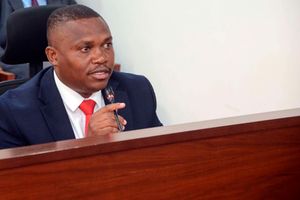
The 2027 Africa Cup of Nations Local Organising Committee chairman Nicholas Musonye speaks during his visit to Nation Centre in Nairobi on August 19, 2025.
Photo credit: Bonface Bogita | Nation Media Group
Kenya co-hosted the Chan with Uganda and Tanzania in August last year. The latest report by CAF on the three countries’ preparedness for the continental showpiece follows an inspection conducted last month.
The assessment focused on infrastructure, safety and security.
According to the CAF’s report seen by Nation Sport , the three nations are expected to have made significant progress in their preparations by August this year.
With full operational readiness targeted for January 2027, the continental football governing body emphasises that the period between now and August “represents the decisive implementation phase” in co-hosting the tournament.
A view of a section of Moi International Sports Centre, Kasarani.
Photo credit: Sila Kiplagat | Nation Media Group
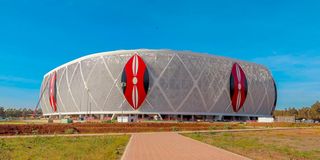
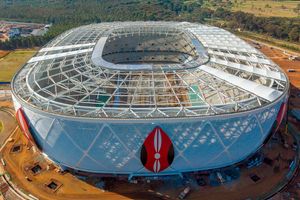
In Kenya, the 48,000-seater Moi International Sports Centre (MISC), Kasarani and 60,000-seater Talanta Sports City are the designated match venues for the tournament. Kipchoge Keino Stadium in Eldoret is the other venue which Kenya is constructing as an alternative match venue for the tournament.
The training facilities are MISC Kasarani Annex “A” and “B”, Nyayo National Stadium, Ulinzi Sports Complex, Police Sacco Stadium, Kenya Utalii Sports Ground, Kenya Academy of Sports “A” and “B” and Kirigiti Stadium in Kiambu.
“As of February 2026, none of the proposed competition stadiums in Kenya fully meet CAF Category 4 requirements,” CAF noted in the report. “Kenya’s AFCON 2027 infrastructure programme is currently in a mixed phase of construction, upgrading and operational adjustments,” it added.
For MISC, CAF states that “while several upgrade works have already started, the overall scope of intervention remains extensive, requiring sustained progress to maintain alignment with the Afcon delivery timeline”.
Planned upgrades at the venue include the reconfiguration of spectator circulation and segregation, development of hospitality areas (VVIP, VIP and skyboxes), relocation and restructuring of the Venue Operations Centre (VOC), reconstruction of the competition pitch, including drainage and irrigation systems and installation of a new lighting system compliant with 3000 lux broadcast standards.
Talanta Sports City Stadium under construction in Nairobi on November 14, 2025.
Photo credit: Pool
Regarding Talanta Sports City, CAF observes that the project is exposed to risks commonly associated with large-scale developments. Consequently, it requires early validation of the operational design to avoid costly or disruptive structural modifications at later stages.
This includes final validation of spectator circulation and segregation plans, confirmation of the VOC location, integration of operational zoning for teams, officials and media, coordination of critical systems installation, including lighting, power redundancy and safety systems.
For Nyayo, CAF noted that despite being an ageing facility, no detailed renovation master plan has been formally submitted.
An aerial view of Nyayo National Stadium.
Photo credit: File | Nation
Owing to the limited remaining delivery time frame, the continental football governing body notes that it is not possible to upgrade Nyayo to host matches.
“At this stage, the stadium may more realistically be considered as a training facility, subject to confirmation of rehabilitation works,” said CAF.
Regarding the training venues, they are required to meet several key standards, including certified lighting of at least 500 lux, rehabilitated pitches with proper drainage and irrigation system and the availability of functioning pitch maintenance equipment and storage facilities.
In the report, CAF has listed several key requirements that the three host countries must meet by the next inspection in August.
Substantial completion of stadium construction and refurbishment works must be achieved, with a minimum of 80 per cent where applicable.
This is to allow for installation, testing, and operational readiness activities. Each host nation is also expected to confirm government funding for infrastructure and operations, demonstrate installation, integration and commissioning of critical stadium systems, including floodlighting, safety and security infrastructure, communication systems, and emergency management systems.
They should also make demonstrable progress on supporting infrastructure, including access roads, traffic circulation plans, utilities, power redundancy systems, and perimeter security installations around competition venues.
The host nations should also confirm airport operational readiness, including arrival and departure handling capacity, VIP and team processing procedures and coordination with immigration and customs authorities.
Other requirements are confirmation of sufficient hotel accommodation capacity meeting CAF requirements for teams, officials, media, commercial partners and other tournament stakeholders and the establishment and confirmation of a common visa facilitation framework across the three host countries to ensure smooth and timely entry for all accredited tournament stakeholders.
Principal Secretary in the State Department for Sports, Elijah Mwangi, when he appeared before the National Assembly Departmental Committee on Sports and Culture to consider Supplementary Budget Estimates I for the financial year ending June 30, 2026.
Photo credit: Dennis Onsongo | Nation Media Group
Signs that Kenya could miss CAF’s deadline for readiness of its venues became clearer on March 20 when Sports Principal Secretary Elijah Mwangi appeared before the National Assembly’s Committee on Sports and Culture to present the 2025/26 Supplementary Budget Estimates No. 1.
The PS revealed that Afcon projects account for Sh11.7 billion, which is the largest share of the Sh14. 47 billion shortfall in the Department for Sports. According to a breakdown of the contractual costs of the venue's upgrade, while the refurbishment of Nyayo phase one and two is Sh1.18 billion and Sh1.50 billion respectively, only Sh200 million has been paid for phase one, with no payment for phase two.
Expenditure on pitch equipment and stadium signage at both MISC and Nyayo stands at Sh 251.96 million and Sh 234.24 million, respectively, but only Sh100 million has been disbursed for each.
Meanwhile, the contract cost for Kipchoge Keino is Sh3.51 billion, of which only Sh300 million has been paid.
For Police Sacco, only Sh50 million has been disbursed against a contract cost of Sh713 million, while Sh50 million has been paid for Ulinzi against a contract cost of Sh1 billion.
Kenya also faces a Monday deadline to pay the $30 million (Sh3.9 billion) hosting rights fees for the Afcon. Kenya was awarded and later stripped of the right to host the 1996 Afcon and 2018 Africa Nations Championship due to inadequate preparations.