The Confederation of African Football (Caf), the body that runs football on the continent, expects Kenya to have stadiums and training venues for the 2027 Africa Cup of Nations (Afcon) finals ready by December.
However, all indications show the country is falling behind in preparations to co-host the tournament with its East African neighbours.
Kenya is scheduled to co-host the 36th edition of Afcon with Uganda and Tanzania under the “East Africa Pamoja Bid” in June and July 2027.
Apart from match venues and training grounds, the three countries are also required to provide adequate hotels, quality hospitals near venues, functional airports in host cities, and sufficient road infrastructure and security.
Caf expects match venues and training pitches to be ready by December 2026, but concerns are mounting that Kenya may miss the deadline due to funding constraints.
In addition to delays in paying the hosting rights fee of $30 million (Sh3.9 billion), Kenya is grappling with slow progress in upgrading its match venues and training facilities to world-class standards.
During a benchmarking visit to the 2025 Afcon in Morocco in January, Caf Head of Safety and Security Christian Emeruwa told Kenya’s Local Organising Committee (LOC) that infrastructure must be ready at least six months before kick-off, effectively setting a December deadline.
Signs that Kenya may miss the deadline became clearer when Sports Principal Secretary Elijah Mwangi appeared before the National Assembly’s Committee on Sports and Culture on Thursday to present the 2025/26 Supplementary Budget Estimates No. I.
“For Kasarani Stadium (Moi International Sports Centre), we owe the contractor more than Sh3.7 billion. The contractor has significantly reduced the workforce, and we may not meet the six-month deadline set by Caf to have competition and training venues ready,” said Mr Mwangi.
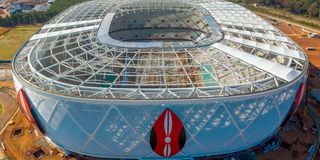
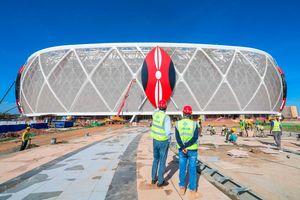
An exterior view of the under-construction 60,000-seater Raila Odinga Talanta Stadium in Nairobi, which will be one of the venues of the 2027 Africa Cup of Nations tournament.
Photo credit: Sila Kiplagat | Nation Media Group
Mwangi said Caf has given Kenya until March 30 to pay, noting that Uganda and Tanzania have already settled their contributions.
“We are aware that Uganda and Tanzania have paid, but Kenya is yet to remit the $30 million (Sh3.9 billion). Therefore, the gains made so far could be in jeopardy if we fail to raise the funds by March 30,” he added.
Kenya previously lost hosting rights for the 1996 Afcon and the 2018 African Nations Championship (Chan) due to inadequate preparations.
Paying hosting rights fees is a primary obligation for countries hosting Afcon or Chan. Caf uses the funds to cater for officials’ allowances, teams’ air travel, accommodation and meals.
The current delays mirror those experienced during preparations for the 2024 Chan, which Kenya co-hosted with Uganda and Tanzania. Caf postponed the tournament from February to August 2025 due to lack of preparedness.
Sources within the LOC earlier told Nation Sport that Kenya was largely responsible for the postponement. The country paid its $13 million (Sh1.6 billion) Chan hosting fee close to the deadline after pressure from Caf.
Closure of Kasarani Stadium
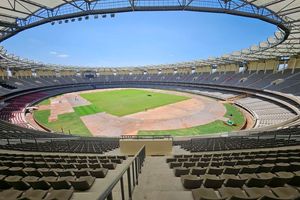
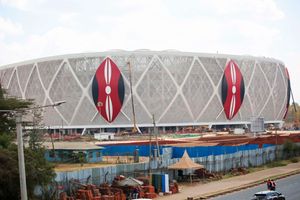
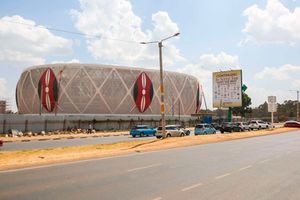
The 48,000-seater Kasarani Stadium and the 60,000-seater Talanta Sports City, currently under construction, are Kenya’s main match venues for Afcon 2027. Kipchoge Keino Stadium in Eldoret is being developed as an alternative venue.
Training facilities include Kasarani Annex “A” and “B”, Nyayo National Stadium, Ulinzi Sports Complex, Police Sacco Stadium, Kenya Utalii Sports Ground, Kenya Academy of Sports “A” and “B”, and Kirigiti Stadium in Kiambu.
To meet Caf timelines, the LOC announced in January that renovations would begin in February. On February 11, the government announced the closure of Kasarani Stadium for refurbishment. Nyayo Stadium was also set to close after a World Rugby Sevens Division II tournament.
However, both facilities remain open and continue to host competitions, including FKF Premier League matches.
Mr Mwangi told MPs that the contractor at Nyayo Stadium has abandoned the site over unpaid dues of more than Sh2.6 billion.
“We contracted Nyayo Stadium during Chan, and we have not paid more than Sh2.6 billion, excluding additional works such as installing a canopy. The contractor has vacated the site, and we currently have little to show in terms of preparation,” he said.
The Talanta Stadium in Nairobi that is under construction in this picture taken on February 8, 2026.
Photo credit: Billy Ogada | Nation Media Group
According to the supplementary budget report, the total cost of renovating Afcon stadiums and training venues stands at Sh15.11 billion. Of this, only Sh3.74 billion has been paid, leaving an outstanding balance of Sh11.37 billion.
The Sports, Arts and Social Development Fund (SASDF) cannot meet the financing gap due to competing obligations, the PS said.
“Given competing demands, SASDF is unable to finance critical Afcon 2027 projects,” the report states.
Sports advocate Charles Njenga, a member of Caf's Legal Committee, warned that delays could increase contract costs by 10 to 15 per cent.
He noted that remobilising contractors, rising material costs and breach of completion timelines could significantly inflate project costs. “Any delay leads to additional interest and cost escalation,” he said.
During an inspection tour in February, Caf officials gave Kenya a three-month deadline to address key infrastructure and safety concerns. The only reprieve is CAF’s decision to postpone a follow-up inspection from May to August.
Among issues to be addressed are completion of installations at stadiums’ Venue Operation Centres (VOC) and emergency and life safety systems.
These include emergency lighting, clear evacuation routes, fire detection systems, backup safety systems and defined emergency access routes to the pitch. Designs for mixed zones and host broadcaster compounds must also be completed.
Planned upgrades at Kasarani include improved lighting, expansion of the media tribune and adjustment of technical benches. Nyayo Stadium is set for canopy installation, media tribune expansion and bench adjustments.
At Police Sacco Stadium, works include pitch replacement, drainage installation and floodlights.
Emeruwa emphasised the need to complete venues at least six months before the tournament to allow for test matches and minimise safety risks.