The Sports ministry is grappling with a budget deficit of Sh14.47 billion for its department for sports, hindering the implementation of several key projects, including the country’s preparation to co-host the 2027 Africa Cup of Nations (Afcon) finals with Uganda and Tanzania.
The details are contained in Report on the Financial Year 2025/26 Supplementary Estimates No.I, presented before the National Assembly’s Committee on Sports and Culture last week by Sports Principal Secretary Elijah Mwangi.
The report also indicates that the Ministry of Youth Affairs, Creative Economy, and Sports is seeking an additional allocation of Sh4.82 billion for the State Department of Sports in the 2025/26 Supplementary Estimates No.I. However, the request for additional funding of Sh4.82 billion for the State Department of Sports is not part of Sh14.47 billion budget deficit for the Department of Sports.
According to the Report on the Financial Year 2025/26 Supplementary Estimates No.I, which was presented before the National Assembly’s Committee on Sports and Culture on Thursday, March 17, by Mr Mwangi, 2027 Afcon project accounts for Sh11.37 billion, which is the largest share of the Sh14.47 billion shortfall.
As part of the preparations to co-host the 2027 Afcon with Uganda and Tanzania in June and July next year under “East Africa Pamoja Bid”, Kenya should upgrade several of its match venues and training pitches to international standards.
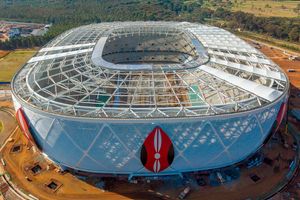
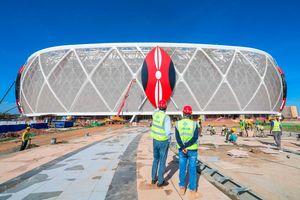
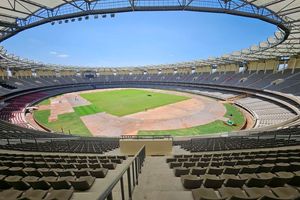
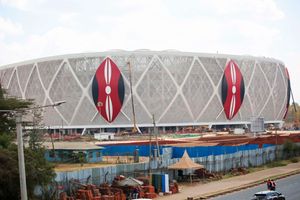
The 48,000-seater Moi International Sports Centre (MISC), Kasarani, and the 60,000-seater Talanta Sports City, which is currently under construction, are the match venues Kenya has earmarked for the 2027 Afcon. Kenya is also constructing Kipchoge Keino Stadium in Eldoret as an alternative match venue for the tournament.
A view of a section of Moi International Sports Centre, Kasarani.
Photo credit: Sila Kiplagat | Nation Media Group
The training facilities are MISC Kasarani Annex “A” and “B”, Nyayo National Stadium, Ulinzi Sports Complex, Police Sacco Stadium, Kenya Utalii Sports Ground, Kenya Academy of Sports “A” and “B”, and Kirigiti Stadium in Kiambu.
Mr Mwangi stated in the report before the National Assembly’s Committee on Sports and Culture that, while the total contract cost of upgrading MISC Kasarani Stadium, Nyayo National Stadium, Kipchoge Keino Stadium, Police Sacco Stadium, and Ulinzi Sports Complex is Sh15.11 billion, only Sh3.7 billion has been paid, leaving a huge outstanding balance.
As a result, the refurbishment works at the venues have stalled.
While requesting the additional funds to be factored into the 2025/26 Supplementary Estimates No.1, Mr Mwangi explained that the Sports, Arts and Social Development Fund (SASDF) is unable to meet the cost of the projects due to other major financial commitments.
These include Sh6.29 billion annual loan repayment for the construction of Talanta Sports City, Sh6 billion for participation and hosting of sports events, Sh2.1 billion for the establishment of Constituency Sports Academies, and Sh2.1 billion for upgrading community sports grounds.
“Given the above competing obligations, SASDF is unable to meet the financing requirements for critical Afcon 2027 projects. The total contractual cost of the earmarked stadium projects is Sh15.11 billion, out of which Sh3.74 billion has been paid, leaving an outstanding balance of Sh11.37 billion,” Mwangi stated in the report.
According to a breakdown of the contractual cost of the stadiums, the refurbishment of MISC Kasarani Stadium, phase one, is estimated at Sh3.18 billion, and Sh3.48 billion for phase two.
However, only Sh2.93 billion has been paid by SASDF for phase one. No payment has been made for phase two.
While the first and second phases of upgrading Nyayo Stadium will cost Sh1.18 billion and Sh1.50 billion, respectively, only Sh200 million has been paid for phase one, with no payment for phase two.
Expenditure on pitch equipment and stadium signage at both MISC Kasarani Stadium and at Nyayo National Stadium stands at Sh251.96 million and Sh234.24 million, respectively, but only Sh100 million has been disbursed for each.
Meanwhile, the contract cost for Kipchoge Keino Stadium is Sh3.51 billion, out of which only Sh300 million has been paid.
For Police Sacco Stadium, only Sh50 million has been disbursed against a contract cost of Sh713 million, while Sh50 million has been paid for Ulinzi Sports Complex against a contract cost of Sh1 billion.
Other key entities listed for additional funding are the Anti-Doping Agency of Kenya (Adak), Sports Kenya and the department for sports’ headquarters. Adak, Mwangi stated, needs Sh96 million more to fully implement the 2021 World Anti-Doping Code, while Sports Kenya requires an additional Sh580 million. Out of an additional funding of Sh580 million that Sports Kenya has requested, Sh300 million will be spent on the construction of a perimeter wall around its 1,000-acre piece of land at Kasarani, while Sh140 million will be channelled towards the renovation of its swimming pool at Nyayo National Stadium.
Sh10 million will be spent on repairing the circulation system of the swimming pool at MISC Kasarani, while Sh130 million will be spent on the installation of solar panels at both Nyayo National Stadium and at MISC Kasarani “to reduce the energy cost, and to go green.”
Additionally, Sports Kenya requires Sh336 million more to cover staff pension claims, utilities, gratuity, operations, insurance for securing sports facilities and maintenance of stadiums.
With regard to the headquarters of the Department for Sports, an additional Sh395 million is required for recurrent expenditure. Out of this, Sh100 million will be used for coordination and preparations for the 2027 Afcon, while another Sh100 million will go towards monitoring and evaluating sports programmes and infrastructure projects.
Further, the review and implementation of the National Sports Policy and Sports Act, as well as preparations for the 2026 Commonwealth Games and 2026 Youth Olympics, will each consume Sh50 million.
The Talanta Stadium in Nairobi that is under construction in this picture taken on February 8, 2026.
Photo credit: Billy Ogada | Nation Media Group
Regarding the proposed additional allocation of Sh4.82 billion for the Department for Sport in the 2025/26 budget, Mwangi said it had been driven by several factors, including expanded workforce and the need to pay Sh3.8 billion in court award arising from the ownership dispute of the 79-acre piece of prime land off Ngong Road in Nairobi in which the government is constructing Talanta Sports City.
In the 2025/26 budget, the Treasury allocated the Department for Sports Sh17.46 billion, out of which Sh1.62 billion was spent on recurrent expenditure (operational costs such as salaries, rent, office supplies, fuel and transport). The remaining Sh15.83 billion was channelled towards development expenditure, such as stadium construction.
However, in the 2025/26 Supplementary Estimates No.1, the allocation for the department for sports has jumped to Sh22.29 billion.
The allocation for recurrent expenditure has increased by Sh28.89 million to Sh1.65 billion, while the development expenditure has jumped to 20.63 billion, which is an increase of Sh4.82 billion. The PS explained that initially, a local court had awarded Sh15 billion to Telkom Kenya, which is a State corporation in the form of compensation for the piece of land where Talanta Sport City is being constructed. However, the amount was revised downwards to Sh9.18 billion following an out-of-court settlement.
The Sh3.8 billion provided in the Supplementary Estimates No.1 forms part of the government’s obligation towards settlement of the agreed amount, Mwangi explained.
“The additional allocation of Sh4.8 billion will enable the State Department to address personnel capacity gaps, strengthen sports governance through enhanced election oversight, improve funding for sports development programmes, and facilitate settlement of legally binding financial obligations,” he said.