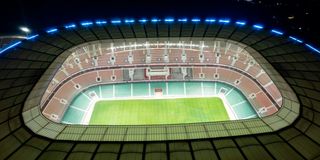
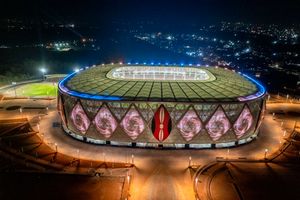
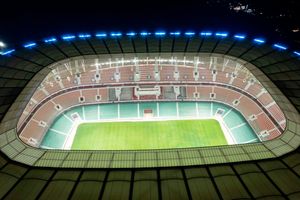
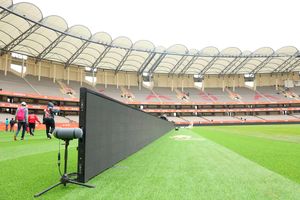
When the 60,000-seater Raila Odinga International Stadium at Talanta Sports City in Nairobi is officially inaugurated on January 5, it will arguably be East Africa’s best sports facility.
The project’s architect, Major Victor King’e, on Thursday estimated that the construction is about 95 per cent complete.
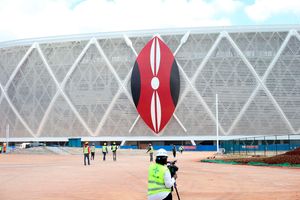
Beyond the stadium’s imposing exterior, which makes it a sight to behold, are the three annexes, different categories of seats which include spacious ones, a vintage viewing experience made possible by the absence of a running track, world-class media facilities and hospitality areas. The stadium boasts several other interesting features that could set it apart from others in the region.
President William Ruto at the Raila Odinga International Stadium at Talanta Sports City Stadium on October 28, 2026.
Photo credit: PCS
Hydraulically tensioned steel cable roofing system
Faced with a challenge of providing cover to 60,000 spectators at the stadium without obstructing their view with gigantic pillars, King’e said engineers adopted a hydraulically tensioned steel cable roofing system.
The Kenya Defence Forces (KDF) Major said the stadium is the first in East and Central Africa to use this roofing technology.
He explained that through the technology, steel cables form the primary support structure of the roof.
They are arranged radially across the stadium, with the cables’ tension supporting the canopy and other equipment.
“In East and Central Africa, there is no other stadium with this kind of roofing technology,” he asserted. Further, the material used for the roofing is polytetrafluoroethylene (PTFE), which King’e said is lightweight and allows light to filter into the stadium.
Engineers have used special materials and designs to minimise noise escaping from the stadium. King’e explained that they have installed perforated screens on the stadium’s upper levels to prevent echoes or reverberation of sounds. The PTFE used in roofing, the project architect said, also prevents sounds from escaping from the stadium.
It is an enclosed stadium, so it allows us to contain the sound within the stadium. We have minimised echoes by the choice of materials we have used,” he said.
Raila Odinga International Stadium at Talanta Sports City in Nairobi on October 28, 2026.
Photo credit: PCS
Specialised flooring, indoor warm-up areas
This is found in the four spacious players’ dressing rooms, which are all designed to the same specification, complemented by an illuminated jersey display area and indoor warm-up area.
Each dressing room has 26 players’ stations fitted with a safe, a charging area and a place to hang jerseys. Other features include ice baths, timers, air conditioning, television sets and table areas. However, what makes the dressing standout is the material used for the flooring. King’e explained that they opted for a specialised sports flooring since it is better suited to handle players walking on boots with studs.
“Instead of going for rubber tiles or mats, this one was a specialised sports floor,” said King’e.
He said the jersey hanging areas have been illuminated to ensure that the kits are captured clearly and attractively by the cameras.
In between two dressing rooms on either side is an indoor warm-up area for teams. King’e stated that they are all fitted with artificial turf to “simulate what the players will experience on the pitch.”
Notably, the stadium has four coaches’ changing rooms, which are large enough to accommodate several people at a time, plus a dressing room for match officials.
A view of a section inside the under construction Talanta Sports City Stadium in Nairobi on May 15, 2026.
Photo credit: Chris Omollo | Nation Media Group
Many cannot imagine that a stadium in Kenya could have a playing surface comparable to the best in the world.
King’e explained that the pitch is a mixture of natural grass and artificial turf. He said the grass planted is the Bermuda Monaco variant, which is the one recommended by Fifa and CAF.
King’e explained that artificial turf has been stitched into the fabric of the natural grass to offer a resilient playing surface. The KDF major explained that the hybrid surface is able to recover quickly from use.
“The benefit of stitching artificial turf into the grass is that it offers a more resilient playing surface. For example, if you have a series of matches taking place at the stadium across several days, the recovery time for the grass is shortened because the artificial turf basically acts as a support system for the grass.”
Perforated French drains have been installed across the pitch. They collect rain and irrigation water before channelling it into the drainage system along the perimeter of the pitch
From there, the water is directed into the external drainage system.
“At no point will the pitch or the centre area be flooded,” he said.
An exterior view of the under-construction 60,000-seater Raila Odinga Talanta Stadium in Nairobi.
Photo credit: File | Nation Media Group
VAR and Goal line technology
King’e said the stadium is fully compliant with both VAR and goal line technology. Goal line technology uses dedicated cameras positioned around the goalposts to detect the exact moment the entire ball crosses the line, instantly relaying the signal to the referee’s watch.
Live broadcast facilities
In addition to workstations, charging points and internet, the media tribune will also provide journalists with access to the live broadcast feed. Major King’e said the stadium has also met international broadcast standards with regard to production. Broadcast cables have already been laid and camera crews shooting live productions only have to come and connect their cameras to the designated broadcast ports.