On December 5, 1987, a crowd of about 60,000 packed Nairobi's Kasarani Stadium to witness Gor Mahia take on Tunisia's Espérance Sportive de Tunis in the final of the African Cup Winners' Cup.
Gor Mahia were seeking to become the first club from East and Central Africa to win a continental title, having secured a 2-2 draw in the first leg played in Tunis in November.
The first leg presented a major test for the Kenyan side. Goalkeeper David Ochieng travelled as an observer after collecting two yellow cards but was cleared to play after the Confederation of African Football (CAF) cancelled his suspension. Midfielder George Onyango ‘Fundi’ missed the match through injury and was replaced by George Nyangi Odembo. Peter Dawo was the only recognised forward as Gor relied on counter-attacks.
The approach paid off when Abbas Khamis Magongo volleyed Gor ahead on the break. Espérance scored twice from penalties before Peter Dawo equalised late in the second half, leaving the tie level ahead of the return leg.
The decisive match at Kasarani attracted enormous public interest. The Daily Nation urged the team on with the headline, "Go! Go! Mighty Gor!", while the stadium was full by mid-morning. Captain Austin Oduor led the Gor Mahia side, with Ochieng in goal, Tobias Ocholla, George Otieno 'Solo' and Peter Otieno 'Basanga' in defence, Charles Otieno, Isaiah Omondi and Nyangi in midfield, and Magongo, Sammy Onyango 'Jogoo' and Dawo in attack.
Dawo scored in the first half to give Gor Mahia the lead. Espérance equalised later in the match, but the Kenyan side held on to secure a 3-3 aggregate draw and win the trophy on the away goals rule. President Daniel arap Moi attended the match, while thousands of supporters who could not enter the stadium gathered outside, singing and dancing ahead of kick-off.
Players had been promised parcels of land in Nairobi’s Githurai area and cash rewards if they won the competition. Reports later indicated that each player received an envelope containing Sh1,000 in Sh50 notes. Defender George Otieno 'Solo' recalls spending his share the same night.
The historic afternoon and the turbulent years that preceded it are documented in the book “The Mighty FC Gor Mahia: A Celebration of the 1970–1990 Golden Legacy” written by Philip Oyoo. It was launched in Nairobi on September 16, 2026.
The cover of Philip Oyoo's The Mighty FC Gor Mahia: A Celebration of the 1970–1990 Golden Legacy , book.
The 230-page publication traces Gor Mahia's journey from its formation in 1968, through a near-fatal split in the 1970s, to the unprecedented treble of 1987, when the club won the league, the Moi Golden Cup and the African Cup Winners' Cup in one season.
Oyoo, who first watched the team as a schoolboy at Kisumu Municipal Stadium in 1976, says he set out to preserve a history that existed largely in fading memories, newspaper cuttings and recollections of ageing players, officials and supporters.
In the preface, he notes that official records from the football federation were incomplete or non-existent. He therefore relied on newspaper reports, radio commentaries by Leonard Mambo Mbotela and Salim Mohammed, family scrapbooks and interviews to reconstruct the club's history.
One of his most significant interviews was with the club's late patron, Raila Odinga, who died on October 15, 2025. Oyoo says Mr Odinga, who played for Luo Union before the merger that created Gor Mahia, spoke to him about eight months before his death. The book is dedicated to his memory.
The opening chapters examine the political circumstances surrounding the club's formation. According to Oyoo, Tom Mboya, then a government minister, changed the registration of Luo Union to Luo Stars in late 1967, triggering protests.
A meeting at Kaloleni Social Hall in February 1968 resolved the dispute through a merger of the two sides under the name Gor Mahia.
The new club won the league in its first season and reached the second round of the 1969 African Champions Cup, where it lost to Egypt's Ismailia.
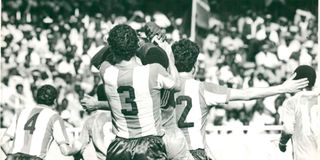
Khamir Samir (jersey number 3) of Esperence holds Gor Mahia’s Peter Dawo (partly hidden) as another Esperance player keeps a close eye in the first leg of the 1987 Mandela Cup final at Moi International Sports Centre Kasarani, in November 1987. The match ended on a 1-1.
Photo credit: File | Nation
Its first derby against Abaluhya, (AFC Leopards) on May 5, 1968, ended in a 2-1 victory, with William 'Chege' Ouma scoring both goals.
Oyoo argues that the political rivalry between Mboya and Jaramogi Oginga Odinga continued to influence the club's affairs, culminating in a split in 1973 that revived Luo Union and left Gor Mahia close to extinction
The book also explores the folklore behind Gor Mahia's identity. Drawing on Mr Odinga's account, Oyoo explains that the club's name originates from a Luo magician born on the shores of Lake Victoria in the late 18th century. His spirit is believed by supporters to inspire the team's late recoveries, popularly known as the 'Mahia half'.
Ahead of the 1987 final, the squad visited the magician's burial site at Kanyamwa in Homa Bay County.
Not all the club's history is triumphant. Oyoo documents Gor Mahia's 1979 African Club final defeat against Cameroon's Canon Yaoundé, when the Kenyan side lost 6-0 in the second leg, a margin he says remains the largest in a final of the competition.
Players interviewed in the book offer different explanations for the result. Some point to overconfidence within the team, while substitute goalkeeper George Ayuka attributes the defeat to stage fright before a huge crowd in an unfamiliar stadium. Gor Mahia's revival gathered momentum in the mid-1980s under technical director Len Julians.
In 1985, the club won its first league and CECAFA Club Cup double, with William Obwaka scoring twice against AFC Leopards in the regional final in Sudan.
Julians resigned the following year amid internal disagreements and was replaced by Danish coach Jack Johnson, whom Oyoo credits with introducing a fast, incisive counter-attacking style.
The chapter covering 1987 is the longest in the book. Oyoo describes the year as one in which "everything converged", documenting the club's progress through the Cup Winners' Cup campaign.
The journey included a 5-0 aggregate victory over Somalia's Marine FC, two draws against Sudan's El-Merreikh, a 4-1 second-leg victory over Togo's Entente Deux and Benin's Dragons Oueme in the semi-final. Oyoo also notes that eight of the team's key players had spent months together on national duty ahead of the All-Africa Games.