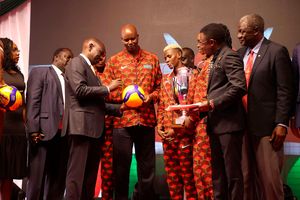
Harambee Stars fans probably had to brush up on their geography when Fifa announced the draw for the 2026 Fifa World Series. Harambee Stars was pooled in a group that has East Africans Rwanda, Europeans Estonia, and Grenada, a Caribbean Island nation.
Rwanda are familiar rivals for Stars but Estonia and Grenada are countries that Kenya has never played against before.
Still, Grenada will strike a chord among Kenyan sports fans through recall of the exploits of former Olympic and World 400 metres champion Kirani James. The visit by former Estonian President Kersti Kaljulaid to Kenya in September 2021 is perhaps the most recent memory that Kenyans have of the European nation.
However, beyond their interactions in athletics and politics, there is a certain obscurity about football in Estonia and Grenada that makes their upcoming encounters against Harambee Stars in March this year in Kigali, Rwanda, more of a fact-finding mission for both parties.
Harambee Stars players during a training session at Nyayo National Stadium in Nairobi.
Photo credit: Chris Omollo | Nation Media Group
The Fifa World Series, first played in 2024 but initiated in 2022, exists to satisfy such curiosities and give nondescript football nations a taste of what it feels like to play at a Fifa World Cup.
“In order to increase the possibilities for teams from different confederations to play each other, Fifa would launch friendly tournaments – Fifa World Series – which would take place in the March window in even years,” Fifa said in statement in December 2022.
Football Kenya Federation President Hussein Mohammed described Harambee Stars’ involvement in the 2026 Fifa World Series as “a very welcome and forward-looking initiative by Fifa”.
“The Fifa Series gives countries like Kenya a rare and valuable opportunity to measure ourselves against opponents from different continents, in environments that mirror the demands of major international tournaments. It is exactly the kind of exposure and competition that our national team needs as we continue to grow and raise our standards,” Mohammed said on X.
“Facing teams with different styles, strengths and football cultures helps us learn, adapt and improve, both on and off the pitch. We look forward to using this platform to test ourselves, gain experience and keep building Harambee Stars in the right direction,” he added.
When the Fifa series was first played, in March 2024, it featured 24 teams split into six groups. Algeria, Azerbaijan, Egypt, and Sri Lanka hosted one group each while Saudi Arabia accommodated two groups.
Harambee Stars' Alpha Onyango (left) shields the ball from Senegal's Nicolas Jackson during Kenya's 8-0 loss to the West Africans in Antalya, Turkey, on November 18, 2025.
Photo credit: Pool
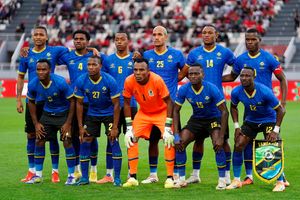
Tanzania featured in that edition, playing against Bulgaria and Mongolia in Azerbaijan. Tanzania will also feature in this year’s edition. They are in a group that has Gabon, Trinidad and Tobago, and Uzbekistan. Uzbekistan will host the group’s matches.
High-ranked African countries such as Algeria, Egypt, South Africa, and Tunisia also participated in 2024. Croatia, then ranked 10th in the world, was in the group that had Egypt, New Zealand, and Tunisia.
Eleven Fifa member associations will host the series of events, with Rwanda hosting two groups, bringing the total number of groups to 12.
The confirmed hosts for the men’s groups are Australia, Azerbaijan, Indonesia, Kazakhstan, New Zealand, Puerto Rico, Rwanda and Uzbekistan. The women’s contests will take place in Brazil, Côte d’Ivoire and Thailand.
Harambee Starlets will miss the action as they will be competing at the 2026 Women’s African Cup of Nations from March 17 to April 3.
Fifa World Series 2026 matches will take place between March 23 and March 31. The fixtures are yet to be released but Kenya is expected to play two matches, possibly against Estonia and Grenada, since the Stars have played Rwanda in the past.
Rwanda hosting Harambee Stars’ Fifa World Series group is also an eye opener on opportunities that Kenyan football stands to gain if the country improves its infrastructure and sports facilities. If playing the Fifa World Series gives a feel of playing in a World Cup, then hosting it magnifies the experience.
Therefore, Harambee Stars competing in the Fifa World Series 2026 should pave the way for Kenya hosting some of the matches in the near future.
Harambee Stars players during a training session at Police Sacco Stadium in Nairobi on October 6, 2025.
Photo credit: Chris Omollo | Nation Media Group
However, critics have perceived the World Series as Fifa’s sneaky attempt to have more control of the football calendar after Uefa launched the Uefa Nations League (UNL) in 2018. The UNL, conceived in 2014 when Gianni Infantino was the Uefa general secretary, ended up reducing the number of international friendly matches European nations played and gave Uefa more control of European national football teams.
Before the UNL came along, Fifa had a stake in the activity of European national football teams during international breaks that were set aside for friendly matches. Such occasions would see European nations playing friendly matches against teams from other confederations but the UNL has since limited such opportunities to once every two years. With Infantino now at Fifa, the Fifa World Series is seen as Fifa’s response to the UNL in their subtle quest to reclaim some degree of control of international football.
Speaking at the 73rd Fifa Congress in Kigali, Rwanda, in March 2023, Infantino had highlighted the significance of the Fifa World Series in the future of the sport.
Infantino said the series provided a possibility for Fifa to promise more opportunities for growth by means of the organisation and financial support for more events across – and between – teams from all six confederations.
“We will organise this Fifa World Series for those teams who want it – four teams from four different confederations who can join and play together and encounter each other, to create communities from all over the world,” said Infantino. “And as Fifa, we have a duty, as well, to assist and help all those who ask us for it.”
Hence, the Fifa World Series appeals as a noble attempt to create more opportunities for countries that have a remote chance of playing against each other as they may never qualify for the Fifa World Cup and even if they do, their low seeding means they could be in different groups.
Harambee Stars fans cheer on their team during their 2024 CHAN match against Angola at the Moi International Sports Centre, Kasarani, on August 7, 2025.
Photo credit: Sila Kiplagat | Nation Media Group
Kenya, Rwanda, Estonia, and Grenada are examples of such countries. Without an initiative such as the Fifa World Series, Kenya and Rwanda, who have never qualified for the World Cup, would have limited opportunities of playing opponents from other confederations. The same applies to Estonia and Grenada.
The cost of organising friendlies for low-ranked football nations such as Kenya prohibits such encounters with teams that are not from the same geographical region. On their own, it would be expensive for Kenya and Estonia (or Grenada) to organise a friendly match between themselves.
However, with Fifa’s help, the cost reduces significantly, and with every kick of the ball in the Fifa World Series 2026, Fifa’s grip on international football will tighten even more.