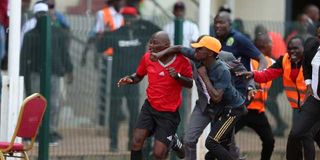
In Kenyan football, referees no longer just control the game. They run for their lives.
The latest incident happened on Tuesday at the Ulinzi Sports Complex, situated inside a military barracks.
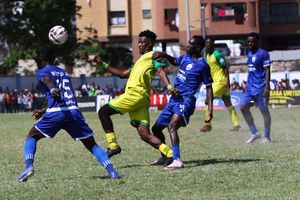
Centre referee John Sulwe awarded a penalty to Mombasa United in the 62nd minute of their Kenya Premier League (KPL) promotion play-off second-leg match against Kariobangi Sharks.
Sharks were then leading 2-1 through Patila Omoto’s 28th-minute goal and Denis Omanga’s 35th-minute strike, after Jamal Messi had given Mombasa an eight-minute lead.
Incensed Sharks players surrounded Sulwe, protesting the penalty call.
Moments later, irate fans broke through the low perimeter wall and went after the referee.
That a referee could be attacked inside a Kenya Defence Forces facility should force Kenyan football to confront a difficult question: if a referee is not safe inside a military barracks, where exactly is he safe?
Kariobangi Sharks players confront centre referee John Sulwe during their FKF promotion play-offs second-leg match against Mombasa United after the official awarded a penalty to the visitors at Ulinzi Sports Complex, Nairobi.
Photo credit: Chris Omollo| Nation Media Group
On April 17, 2013, fans invaded the pitch and attacked the referee during an ill-tempered KPL Top Eight match between AFC Leopards and Chemelil Sugar at Nyayo Stadium.
A Leopards fan, simply known as “Dennis”, who led the attack, was banned from football for life by the federation.
One famous incident happened at Bukhungu Stadium on April 12, 2023, when a referee was literally caned in front of a governor.
Kakamega Homeboyz were leading AFC Leopards 1-0 through Hillary Otieno’s 24th minute goal in a league match.
Six minutes later, Leopards fans believed Homeboyz goalkeeper Farouk Shikalo had handled the ball outside his area and a foul ought to have been called. Centre referee Michael Obuya instead waved play on.
A section of AFC Leopards supporters stormed the pitch and went straight for Obuya. He was assaulted and beaten with sticks. Video footage of the incident circulated widely online.
Police fired tear gas as Kakamega Governor Fernandes Barasa and other officials in the VIP area were hurriedly evacuated to safety.
Outside the stadium, rival supporters threw stones at one another, while Leopards’ driver drove the club bus onto the pitch to protect it from angry Homeboyz supporters who were attacking it.
For once, Football Kenya Federation (FKF) responded decisively.
The Leagues and Competitions Committee (LCC) awarded the match 2-0 to Homeboyz while docking Leopards three points and fining them Sh500,000. The club was ordered to pay for Obuya’s medical expenses and play four home matches behind closed doors.
Disciplinary proceedings were also opened against the then Leopards coach Patrick Aussems (now coach at Nairobi United) and goalkeeper trainer Lawrence Webo.
In March this year, another referee became the target of an angry crowd.
At Jomo Kenyatta Stadium, Mamboleo, during the Mozzart Bet Cup Round of 32 match between AFC Leopards and Mara Sugar, centre referee Simeon Ongaga initially awarded AFC Leopards a late penalty with the game still goalless.
After consulting his assistant referee, Ongaga reversed the decision, angering Leopards players and supporters. A pitch invasion followed, and Ongaga was attacked before eventually being evacuated to safety.
On May 16, at Gems Cambridge Grounds in Nairobi, centre referee Joshua Muthiga was attacked at full time of a National Super League match between Kibera Black Stars and 3K FC.
Video footage of the incident showed dozens of fans surrounding the referee as he tried to run for his life.
In 1985, the federation, then known as Kenya Football Federation, took the unprecedented action of expunging Baruti FC - a Kenya Army side - from all its football competitions and issuing a life ban to several of its players.
This followed an attack by Baruti players on centre referee William Ngaah during their Kenyan National Football League match against Breweries (now Tusker) at City Stadium.
The football authority has routinely punished clubs for crowd trouble, but many times fans who perpetrate violence in stadiums have escaped individual punishment.
FKF, through its internal mechanisms, was yesterday gathering evidence to help in deciding on the fate of the abandoned match.