Organisers of the TotalEnergies CAF Africa Cup of Nations have laid grand plans to decongest the precincts of the 69,500-seater Prince Moulay Abdellah Stadium and control crowds during tonight’s final between hosts Morocco and 2021 champions Senegal.
Official “Fan Zones” were set up in the tournament host cities of Rabat, Tangier, Fez, Casablanca, Agadir and Marrakech throughout the tournament, punctuated by concerts, chill-out corners, fun games and sampling of local cuisine.
On Friday night, Nigerian music superstar Burna Boy (Damini Ebunoluwa Ogulu) performed the highlight act at an “Afcon Last Dance” concert at the 47,707 square metre OLM Soussi “Fan Zone” in Rabat alongside Ghanaian Afropop star Stonebwoy (Livingstone Etse Satekla), Moroccan songbird Jaylann (Khaoula El Moujahid) and Moroccan rapper Stormy (Yasser El Malih).
Entry to the “Fan Zones” was absolutely free for “Fan ID” holders. And with tickets for tonight’s final at the Prince Moulay Abdallah Stadium going for between 400 and 900 Moroccan Dirhams (Sh5,608 to Sh12,620), the price shooting up to as much as 1,500 Moroccan Dirhams (Sh21,031) in resale and on third-party platforms, many ticketless fans will settle to watch the final on big screens and the “Fan Zones” helping to decongest traffic at the stadium.
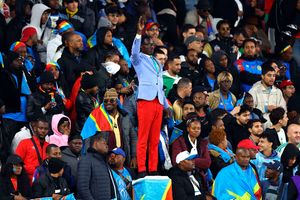
Morocco fans display pictures of the Democratic Republic of Congo fan Michel Nkuka Mboladinga posing as a statue of the country's independence hero Patrice Lumumba during the quarter final match between Morocco and Cameroon in the 2025 Africa Cup of Nations at Prince Moulay Abdellah Stadium in Rabat on January 9, 2026.
Photo credit: Reuters
Moroccan cities and hamlets were sleepless on Wednesday night as the nation burst into celebrations after the “Atlas Lions” squeezed their way into the final with a post-match penalties victory over Nigeria’s “Super Eagles”.
Goalkeeper Yassine Bounou stopped spot kicks by Samuel Chukwueze and Bruno Onyemaechi to deny Nigeria and lead the hosts to a 4-2 victory at the Prince Moulay Abdallah Stadium.
It will be an “all-Lions” battle in tonight’s final with Morocco’s “Atlas Lions” facing in-form Senegal’s “Lions of Teranga” who needed a second half Sadio Mane super strike to dispatch Egypt 1-0 in the other semi-final at the Tangier Stadium.
The final will bring the curtain down on what has been an impeccably organized, incident-free competition, thanks to joint efforts by security teams from the Confederation of African Football (CAF), world football governing body Fifa and Moroccan authorities.
Media interest in the Morocco finals has also been overwhelming with over 6,000 journalists having applied for accreditation on the CAF platform, with the organisers putting up a huge Main Media Centre with a capacity to hold at least 1,000 journalists at any given time at the flagship Prince Moulay Abdallah Stadium in Rabat.
A delegation from next year’s Pamoja Afcon organising committees in Kenya, Uganda and Tanzania have been in Morocco on a knowledge exchange Observer Programme targeting various aspects of the tournament.
“This Observer Programme reflects CAF’s commitment to long-term excellence in tournament delivery. By strategically exposing future host nations to operations of our flagship event, we are ensuring consistency in hosting world-class African football events.
“The delegation’s presence in Morocco is a vital step in transferring knowledge, strengthening capacity and preparing Kenya, Tanzania and Uganda to successfully host a world-class TotalEnergies CAF Africa Cup of Nations in 2027,” CAF General Secretary, Veron Mosengo-Omba said.
Kenya’s Sports Principal Secretary, Elijah Mwangi, Secretary of Administration in the Ministry of Sports, Evans Achoki, Sports Fund CEO Nur Ibrahim and the Director of Sports, Jaxon Indakwa, are also among the Kenyan delegation in Morocco that also met with CAF President Patrice Motsepe and were hosted on Friday by Kenya’s Ambassador to Morocco, Jessica Muthoni Gakinya, at the Rabat mission.
Also in the delegation are Kenya’s Pamoja Afcon 2027 Local Organising Committee officials Nicholas Musonye (Chairman), Myke Rabar (CEO), Hussein Mohammed (Vice-Chairman and President of Football Kenya Federation) and Football Kenya Federation Vice-President and football legend McDonald Mariga.
Both PS Mwangi and LOC Chairman Musonye agree that preparations for Kenya’s hosting of next year’s Afcon tournament must get moving at full speed, and immediately,given the high bar raised by the Moroccan organisers.
“We have been in Morocco for benchmarking and what we have observed is that we must start serious preparations as soon as possible to maintain the standards set by Morocco. The lessons learnt from here together with our experience at last year’s Chan (African Nations Championship) should put us in a good place to organise a great Afcon 2027,” Musonye said yesterday.
“Kenyans are very good organisers. We have the capacity to organise a great tournament and we just need to give everyone the direction to take. I sincerely thank the Kenyan government, led by Cabinet Secretary Salim Mvurya and Principal Secretary Elijah Mwangi, for approving our LOC team to come to Morocco and learn. We shall also ask the government for further learning opportunities ahead as we get closer to Afcon 2027.”
Sports Principal Secretary Elijah Mwangi (left) greets Manchester United legend Patrice Evra as Football Kenya Federation President Hussein Mohammed looks on during a workshop at the Africa Cup of Nations Finals in Rabat.
Photo credit: Pool
Morocco 2025 organisers employed a flawless ticketing programme in which tickets were sold in phases through CAF’s official ticketing programme. Fans also had to register for a mandatory “Fan ID” to purchase digital, non-transferable tickets through a tournament application known as “Yalla” that also assisted in processing free visas for fans travelling to Morocco.
The “Yalla” app prevented black market notorious with the physical, printed tickets like those that attracted controversy at last year’s Chan tournament in Nairobi.
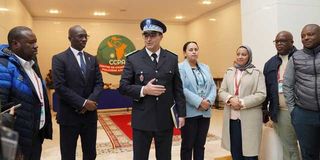
The highlight of the Morocco tournament’s security operations has been the setting up of the African Police Co-ordination Centre (APCC) in Sale, Rabat, to monitor fans trooping into the various cities to watch the matches. But, with a membership of 15 African nations so far, the centre’s vision goes beyond just football.
“The APCC was set up thanks to the enlightened leadership and vision of His Majesty King Mohammed VI – May God assist him – illustrating Morocco’s willingness and commitment to build strong relations and enhance South-South co-operation which is a key pillar for Africa’s future and development,” Abderrafie Mnaouri, Director of the APCC explains.
The APCC, the first of its kind in Africa, was inaugurated last December and has deployed members of Morocco’s national security services and “spotters” or liaison officers from the security services of the 23 countries that are featuring in this year’s Afcon finals.
The centre will also be used to police the 2030 Fifa World Cup finals which Morocco will co-host with Spain and Portugal.
“The aim of the APCC is also to reinforce co-operation between security agencies in Africa through intelligence-sharing,” Mnaouri adds.
The centre’s operations feature software developed by Morocco’s General Director of National Security (DGSN), a backroom reserved for DGSN analysts, a cyber monitoring office and a video conference room that connects local police and the “spotters” in cities hosting the games.
“The aim of the centre is to share police information and conduct security assessment related to matches, analysing supporters and crown management. There is daily web monitoring to prevent, detect and investigate online illegal content which contributes to the prevention of attacks on Afcon platforms and information systems.
The APCC also includes two representatives from 2030 Fifa World Cup co-hosts Spain and Portugal as observers alongside two representatives from the 2022 Qatar World Cup and four experts from the International Criminal Police Organisation (Interpol).
CAF’s Head of Security, Dr Christian Emeruwa, is proud of the legacy the Afcon security operations will bequeath on the future on police operations in Morocco.
Prior to the Afcon finals, Morocco witnessed fierce anti-government disquiet in which citizens demanded immediate reforms to, inter alia, healthcare and education with a wave of GenZ-led protests mobilized across multiple cities, demanding a radical recalibration of governmental priorities.
Confederation of African Football Head of Security, Dr Christian Emeruwa (left) with Edward Achola, a member of the Kenyan Africa Cup of Nations 2027 Local Organising Committee in Rabat
Photo credit: Pool
The protestors wanted to see investment in healthcare and education rather than the allocation of billions to global spectacles such as the World Cup, Afcon and the construction of opulent stadiums.
But Omeruwa argues that, on the contrary, Morocco will benefit a great deal from the investment in the sports ecosystem, with enhanced security one of the quick wins from this year’s Afcon Finals.
“Before the Afcon, for instance, the different arms of the Moroccan security set-up never sat on one table and operated in silos. But the Afcon security operations have brought together the national police force, the gendarmerie (paramilitary force) and other units to sit on the same table and plan operations which was unthinkable before,” Emeruwa explains.
Morocco 2025 introduced water-tight stadium access systems that include personalized passes complete with the holder’s photo and personal details and zone mapping to ease access with the security department taking over management of accreditation.
Integrated, CCTV-inclined security systems have also been deployed with local police taken through intensive training programmes.
On match days, access control programmes launch at least nine hours before kickoff when managers of the respective teams also register match documentation such as squad lists.
“For the Morocco 2025 Afcon, the General Co-ordinators at the various venues and their core teams arrived seven months ahead of the tournament to counter any challenges on ground. Managing remotely and managing while on ground are two different things,” says Serge Assume, CAF’s Competitions Officer (Tournaments and Events Division).
Bizarrely, perhaps the only security blot in the tournament centred around the Senegal team’s security scare that saw the team’s delegation mixed up with members of the public on their one-and-half-hour trip from Tangier to Rabat on Friday.
January 15, 2026, Morocco fans celebrate on the streets after winning their semi final against Senegal.
Photo credit: Reuters
Senegal’s coach Pape Thiaw was livid at yesterday’s pre-match press conference: “This shouldn’t have happened! It’s not about Senegal but about African football. It was unacceptable! The players could have been harmed by ill-intentioned members of the public,” Thiaw fumed.
The Senegalese federation lodged an official protest to CAF and also complained about their training ground being assigned at the Moroccan federation’s official academy, arguing that the arrangement could favour Moroccan team spies.
Meanwhile, the organisational success of this year’s Afcon has also run in tandem with commercial success, with CAF announcing a 90 per cent increase in revenues from the tournament.
“This is driven by a significant increase in the commercial partners of CAF, increase in media rights distribution and also CAF venturing into new markets most notably the Far East, China, Japan while also consolidating traditional markets,” CAF explained in a statement issued in Rabat yesterday.
The number of CAF’s commercial partners has increased from nine in 2021 to 23 this year thanks to a data-led strategy and innovation, such as the introduction of esports that has repositioned the competition globally.
“Long-term partners such as TotalEnergies, Orange, Lonaci, 1xBet, Visa, Tecno, and Puma have continued their association with the competition, while brands including AGL, Danone and Unilever have also renewed,” CAF added, noting that from the Afcon in Kenya, Uganda and Tanzania onwards, these digital assets will also form part of CAF’s commercial assets inventory.